


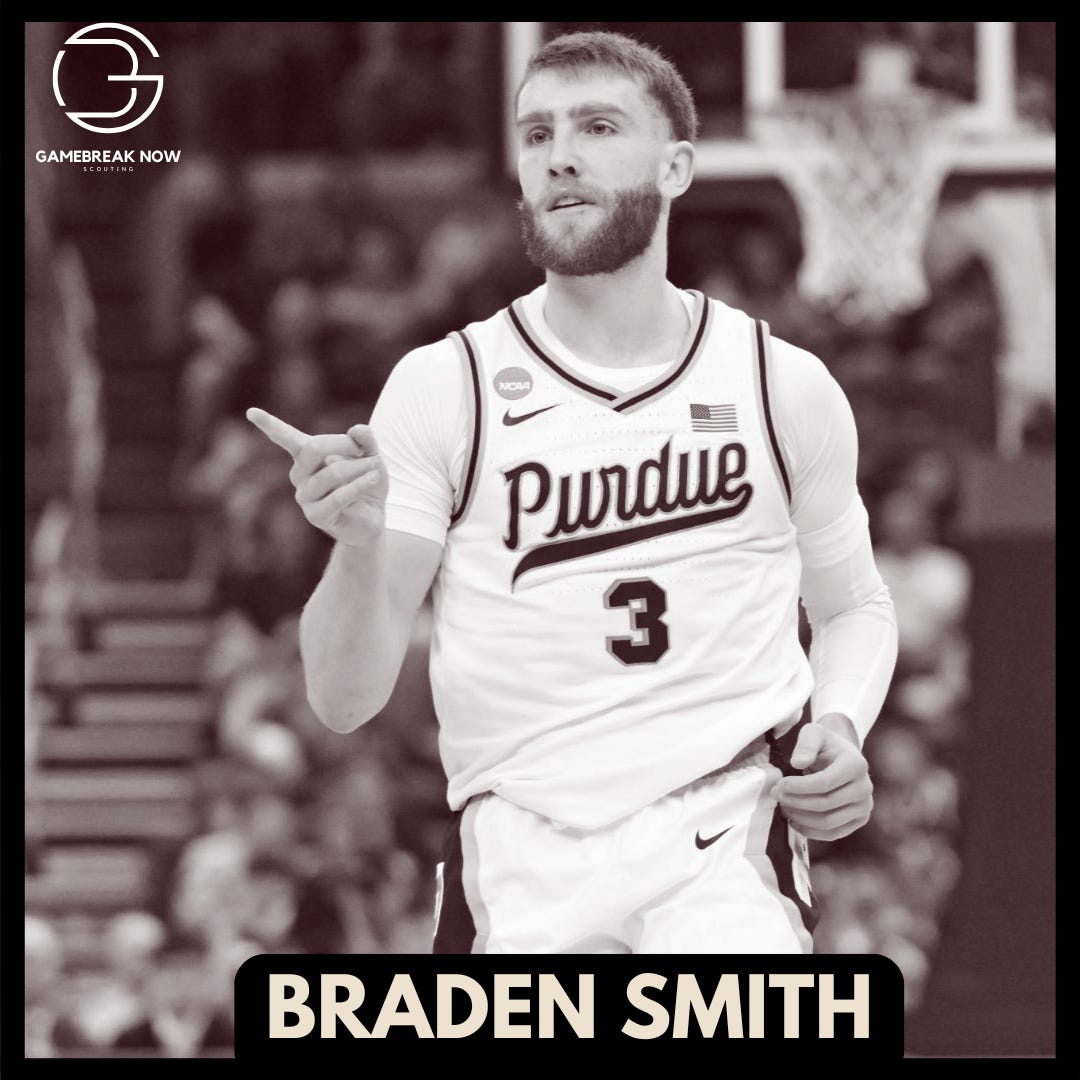
Height: 6’0” Weight: 170Lbs Team: Purdue Class: Senior
Age at Draft: 22.92 Height (Barefoot): 5’10.25 Weight: 166.6Lbs Wingspan: 75.25" (+5) Standing Reach: 93.5”
Scouting Snapshot
For four years, Braden Smith has been the engine behind Purdue’s sustained rise into one of college basketball’s premier programs. While much of the national spotlight often centered around Purdue’s dominant frontcourt presence and offensive structure, Smith quietly evolved into one of the most productive and impactful lead guards in the country. Entering the 2026 NBA Draft cycle, he arrives as a battle-tested floor general whose combination of pace control, playmaking vision, decision-making, and competitive toughness consistently elevated Purdue into championship contention.
Unlike many modern lead guards who rely heavily on explosive athleticism or isolation-heavy scoring, Smith’s game is rooted in orchestration and efficiency. At roughly 6-foot, he does not overwhelm physically, nor does he possess elite burst or vertical pop. Instead, he consistently wins with timing, processing speed, advanced feel, and an exceptional understanding of how to manipulate defensive structure. Across four seasons at Purdue, Smith transformed from a steady freshman contributor into one of the most statistically impactful point guards in college basketball.
That progression becomes evident immediately when examining the year-by-year development of his advanced impact profile.
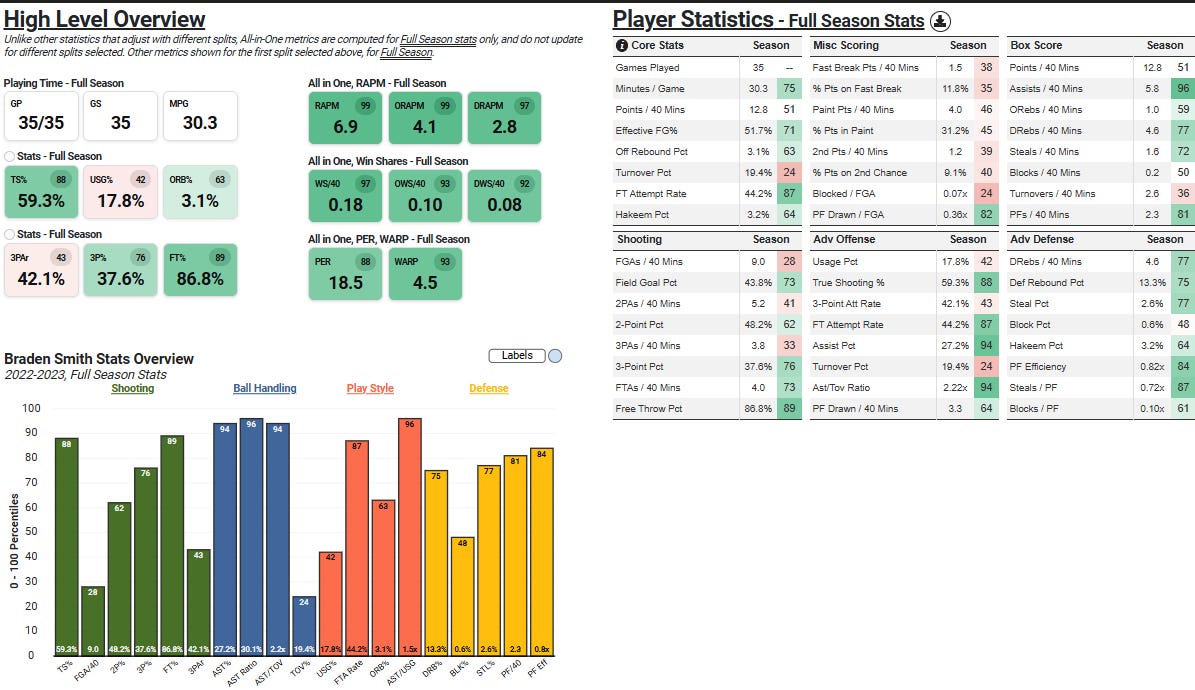
As a freshman during the 2022-23 season, Smith immediately provided value as a stabilizing presence within Purdue’s offense. Even in a secondary role, he posted a remarkable 6.9 RAPM, ranking in the 99th percentile nationally, while producing 4.7 total win shares and a 18.5 PER. His offensive impact was already elite, reflected by a 4.1 ORAPM and strong offensive win share production. More importantly, Purdue consistently functioned better with Smith on the floor, a trend that would continue throughout his career.
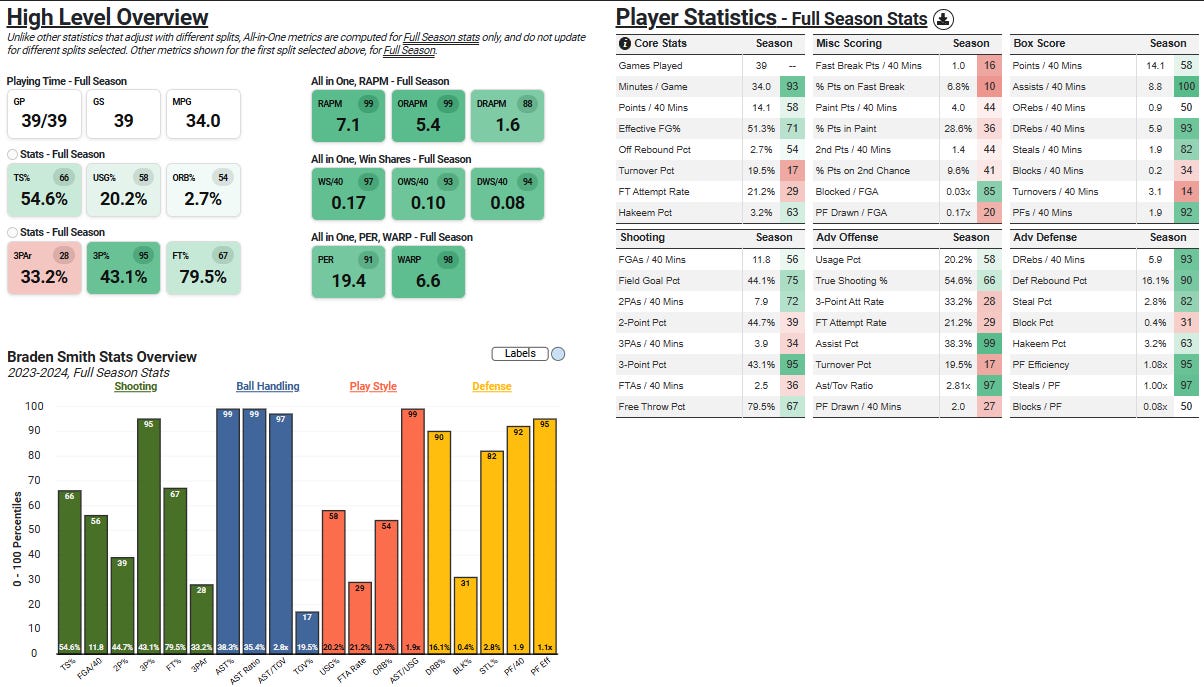
By his sophomore season, Smith’s offensive responsibilities expanded significantly. His RAPM remained elite at 7.1 while his offensive win shares climbed to 3.2. The overall scoring efficiency and playmaking burden increased as he settled fully into Purdue’s primary initiator role. Smith’s ability to dictate pace, create advantages within ball screens, and consistently deliver high-level entry passes became foundational elements of Purdue’s offense.
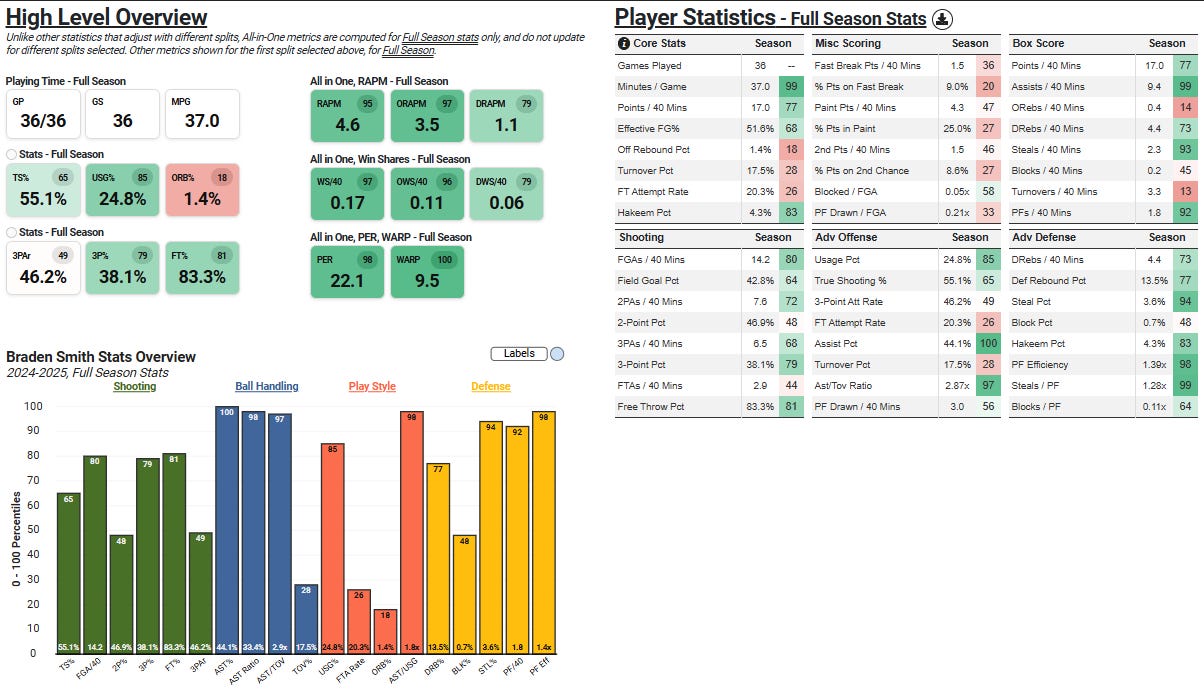
The 2024-25 season showcased another leap in overall offensive control. Smith posted a career-best 9.5 WARP while continuing to maintain elite efficiency metrics across the board. His RAPM remained among the best in the nation, and his offensive orchestration became even more refined. Purdue’s offense consistently generated efficient looks when Smith was on the floor, particularly through transition pace control, interior creation, and ball movement. Despite increasing defensive attention, he maintained strong turnover control and continued producing efficient offense without excessive shot hunting.
As a senior during the 2025-26 season, Smith appeared to fully mature into one of college basketball’s premier lead guards. He posted a 9.0 RAPM, again ranking near the top nationally, while generating 5.8 total win shares and a career-best offensive win share rate per 40 minutes. His overall production profile reflected complete command of Purdue’s offensive ecosystem. Even as opponents increasingly schemed specifically to contain him, Smith continued driving winning at an elite level through pacing, shot creation, passing manipulation, and leadership.
The broader impact metrics reinforce just how valuable Smith became to Purdue’s success.
Across his senior season, Purdue dramatically outperformed opponents with Smith on the floor. The Boilermakers improved by over 12 points per 100 possessions in net rating during his minutes, an enormous on/off differential for a lead guard. Purdue’s offense became substantially more efficient, posting major improvements in effective field goal percentage, free throw rate, and overall offensive rating with Smith orchestrating possessions.
Statistically, Smith’s offensive impact extended far beyond scoring. Purdue’s assist rate jumped significantly with him on the floor, while turnover percentage declined meaningfully. The offense simply operated cleaner, faster, and more efficiently when Smith controlled the game. His ability to consistently create high-value opportunities without dominating possessions is one of the defining traits of his profile.
As a scorer, Smith developed into a far more complete offensive threat than many initially projected. While not an overwhelming isolation scorer, he consistently pressured defenses through pull-up shooting, floaters, and advanced pacing in pick-and-roll situations. His three-point volume and efficiency improved steadily throughout his career, forcing defenders to play him more aggressively beyond the arc and opening passing windows inside.
Still, the defining feature of Smith’s game remains his playmaking.
Few guards in college basketball manipulated defensive rotations more consistently. Smith excels changing speeds, using hesitation dribbles, controlling pocket passing angles, and delivering highly accurate interior feeds in traffic. He understands how to force weak-side rotations and consistently punishes defensive mistakes with quick reads. Purdue’s offensive infrastructure often revolved entirely around his ability to organize possessions and generate efficient looks for teammates.
Defensively, Smith’s profile is more nuanced.
He competes extremely hard, communicates well, and generally understands positioning. However, physical limitations remain a legitimate concern when projecting to the NBA level. At his size, there will be questions surrounding switchability, point-of-attack containment against elite athletes, and overall defensive scalability in professional playoff environments. While his effort and instincts consistently produced positive collegiate impact, the physical translation defensively remains one of the more important long-term evaluation points.
Ultimately, Braden Smith projects as one of the safer offensive bets among upperclass guards in this class because of how translatable his mental processing and offensive orchestration appear. The ceiling may be somewhat capped by physical tools and defensive limitations, but players who can consistently organize offense, make advanced reads, control pace, and elevate team functionality tend to carve out long professional careers.
Smith may never become a star-level NBA initiator, but the broader body of work strongly suggests he can become the type of intelligent, reliable lead guard who enhances winning basketball environments. After four years at Purdue, there is overwhelming evidence that very few players impacted college basketball more consistently than Braden Smith.
Statistical Overview By Year:
2025-2026 (Senior Season)
2024-2025 (Junior Season)
2023-2024 (Sophomore Season)
2022-2023 (Freshman Season)
Scoring Context By Year:
2025-2026 (Senior Season)
2024-2025 (Junior Season)
2023-2024 (Sophomore Season)
2022-2023 (Freshman Season)
Key Note about Scoring Context:
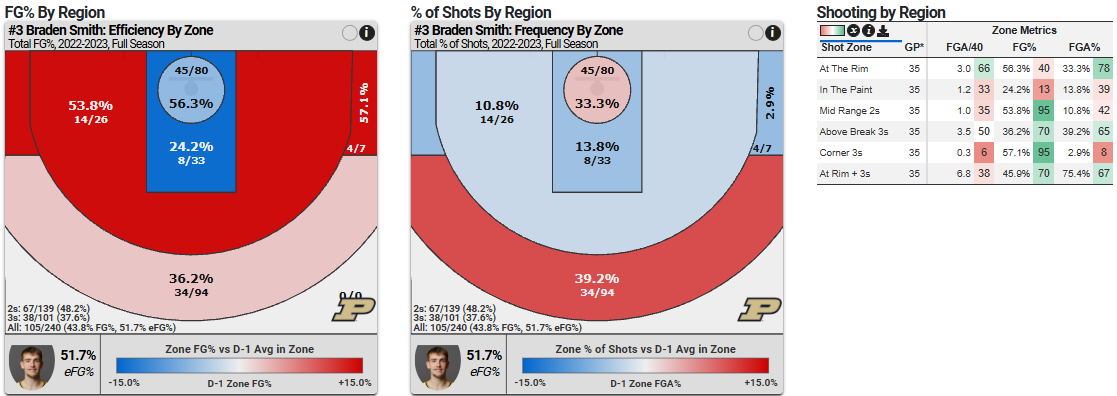
One of the most important contextual elements when evaluating Braden Smith’s offensive profile is understanding both the evolution of his shot distribution and the burden of offensive creation he carried within Purdue’s system. Unlike many high-efficiency guards whose production is built around simplified reads or purely spot-up opportunities, Smith consistently operated as Purdue’s offensive organizer while simultaneously maintaining one of the more perimeter-oriented shot profiles among lead guards in college basketball.
That balancing act becomes especially evident when examining the progression of his scoring profile across four seasons.
As a freshman in 2022-23, Smith functioned primarily as a facilitator and connective offensive piece. Over 75 percent of his total shot attempts came either at the rim or from three-point range, reflecting an analytically strong shot diet from the beginning. However, the overall efficiency remained somewhat inconsistent. He converted just 36.2 percent of his above-the-break threes while relying heavily on difficult perimeter attempts created late in possessions or within Purdue’s structured half-court offense. Even then, the willingness to take high-volume pull-up and above-the-break threes hinted at future offensive scalability.
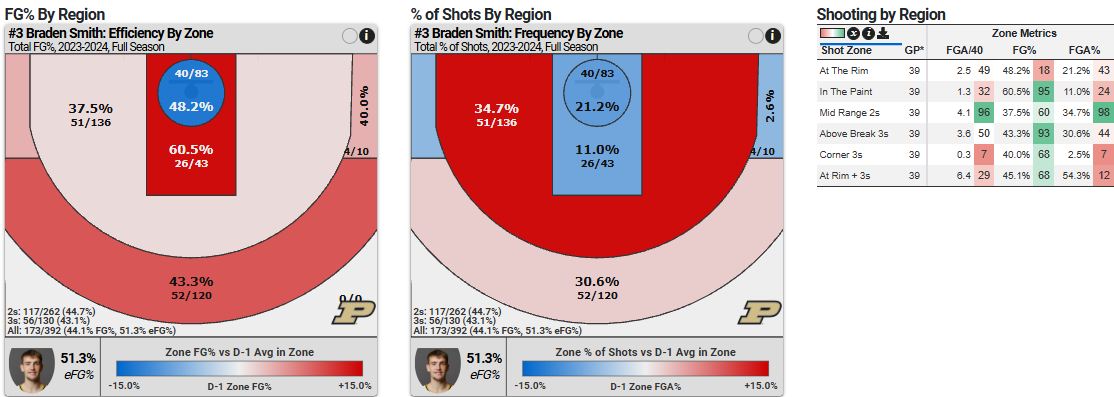
By his sophomore season in 2023-24, Smith’s offensive responsibility increased dramatically. His perimeter volume remained extremely high, but the degree of difficulty also climbed significantly. Over 30 percent of his total shot attempts came from above-the-break threes, and nearly 35 percent of his overall offensive possessions ended at the rim, reflecting a more aggressive downhill scoring approach. Despite that expanded workload, he elevated his above-the-break three-point percentage to an elite 43.3 percent while maintaining strong efficiency as a primary initiator. That season marked the beginning of Smith evolving from a pure table-setter into a legitimate scoring threat defenses had to actively gameplan against.
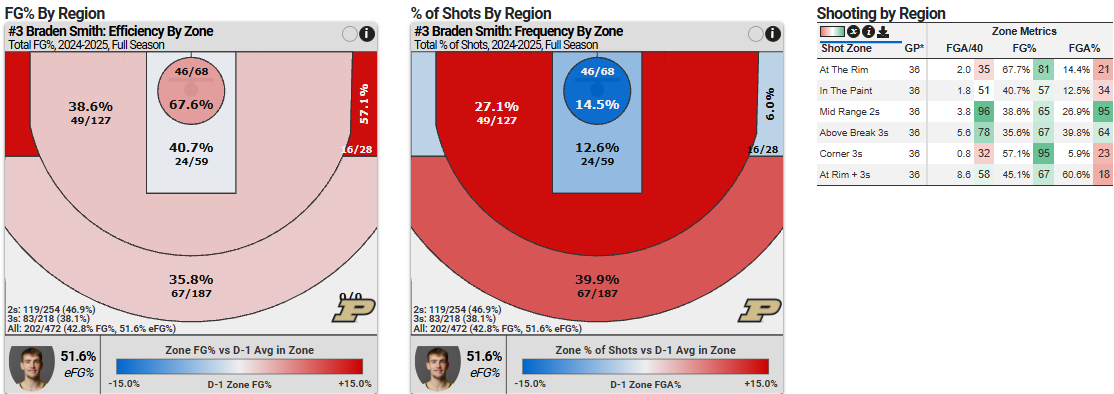
The 2024-25 season introduced another shift in offensive context. Smith leaned even more heavily into perimeter creation responsibilities, attempting nearly 40 percent of his total shots from above the break while reducing some of his rim frequency. Defenses increasingly prioritized containing Purdue’s interior offense and crowding Smith’s decision-making windows, forcing him into more difficult self-created perimeter attempts. Although the overall efficiency normalized slightly, the shot profile itself became more NBA translatable. He was no longer simply capitalizing on offensive flow. He was actively generating difficult perimeter offense against loaded defensive attention.
That context becomes especially important when evaluating Smith’s 2025-26 senior season.
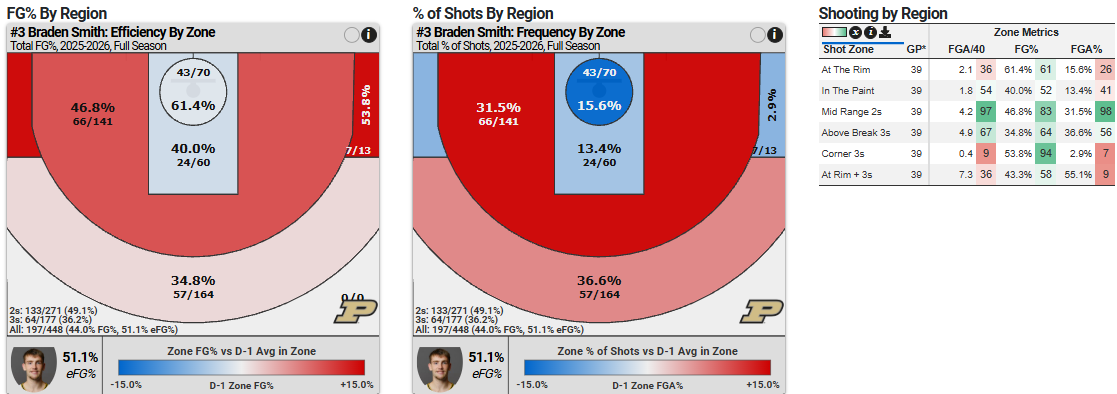
On the surface, the raw efficiency numbers may not immediately overwhelm evaluators. Smith converted 34.8 percent from above-the-break three while posting a 43.3 effective field goal percentage on rim-and-three attempts overall. However, the broader offensive environment and shot burden tell a far more impressive story.
During the 2025-26 season, over 51 percent of Smith’s total shot attempts came from either the rim or beyond the arc, with an enormous percentage of those perimeter looks coming above the break rather than from easier corner spacing opportunities. He attempted nearly five above-the-break threes per 40 minutes while functioning as Purdue’s primary initiator, primary decision-maker, and late-clock offensive creator. That distinction matters significantly.
Smith was not operating as a low-usage complementary guard benefiting from defensive attention elsewhere. He was Purdue’s offensive engine. Many of his perimeter attempts came off ball screens, pull-up situations, relocation sequences, or late-clock possessions where he was forced to create difficult offense against set defenses. The efficiency profile must therefore be viewed through the lens of offensive responsibility rather than raw percentages alone.
What becomes particularly encouraging is how his interior efficiency improved despite his size limitations. Smith converted over 61 percent of his at-rim opportunities during the 2025-26 season, a strong mark for a smaller guard lacking elite vertical explosiveness. His ability to finish through timing, touch, pacing, and angles rather than pure athleticism consistently stood out on film. He became increasingly comfortable manipulating defenders in ball-screen situations before attacking interior gaps with floaters, extension finishes, and quick-release touch shots.
The shot distribution also reflects a player increasingly comfortable embracing high-level perimeter difficulty. Nearly 37 percent of his total attempts came from above-the-break threes during his senior season, an extremely high figure considering the defensive attention he commanded nightly. Even while the percentages fluctuated somewhat year to year, the willingness to consistently take difficult perimeter shots off movement and off the dribble remains one of the more translatable aspects of his scoring profile.
Another important contextual factor is how little Smith relied on inefficient midrange volume throughout his career. Across four seasons, he consistently maintained an analytically favorable shot diet built primarily around rim pressure and perimeter creation. His offensive profile avoided many of the low-efficiency tendencies often associated with smaller collegiate guards who struggle translating upward in competition.
Ultimately, Smith’s scoring context suggests a player whose raw efficiency numbers may undersell the overall offensive difficulty he was tasked with handling. Purdue’s offense consistently relied on him to organize possessions, create advantages, manipulate defensive coverages, and generate perimeter offense under pressure. That level of creation responsibility naturally introduces tougher shot quality and greater efficiency volatility.

(Provided by Cbbanalytics)
Video Reference
(Video Credit: Big Ten Men’s Basketball)
(Video Credit: March Madness)
NBA Projection & Player Comparisons
Projected Role: Second Unit Offensive Organizer
For Braden Smith, the projection begins with understanding the type of offensive burden he carried at Purdue and how his skillset translated to winning offense across multiple seasons.
Throughout his collegiate career, Smith consistently operated as Purdue’s primary offensive organizer while maintaining one of the more difficult perimeter shot profiles among lead guards in college basketball. A significant portion of his offensive workload came from above-the-break three-point attempts, many of which were self-created through ball screens, pull-up situations, late-clock possessions, or secondary actions against loaded defenses. Unlike lower-usage guards benefiting primarily from spot-up opportunities, Smith was tasked with initiating offense, controlling tempo, and generating efficient shots for both himself and teammates simultaneously.
That context is critical when evaluating his efficiency profile and NBA projection.
The translation model also places significant value on his assist creation profile. Smith consistently generated efficient rim-and-three opportunities for teammates while maintaining strong turnover control despite extremely high offensive responsibility. Purdue’s offense frequently revolved around his ability to manipulate help defenders, organize spacing, and create structure within half-court possessions. Guards capable of stabilizing offensive flow without excessive turnover volatility often transition more cleanly into secondary NBA guard roles.
Smith does not possess elite positional size, vertical explosiveness, or overwhelming physical tools. Defensively, there will be concerns surrounding switchability, point-of-attack containment, and matchup scalability against larger NBA guards. Offensively, while he proved capable of difficult collegiate shot creation, there may be questions regarding how efficiently that scoring translates against NBA length and athleticism without high-end burst or separation ability.
Ultimately, Smith projects most naturally as a second-unit offensive organizer and change-of-pace lead guard capable of stabilizing bench units through tempo control, playmaking, and offensive structure. His ability to process quickly, limit mistakes, create efficient opportunities for teammates, and maintain offensive flow gives him a pathway toward rotational value even without elite physical tools.
In many ways, Smith fits the mold of the modern backup point guard NBA teams consistently value during regular season and playoff environments: intelligent, competitive, low-maintenance, and capable of organizing offense without requiring high-volume scoring. His combination of advanced feel, perimeter shot versatility, leadership experience, and proven impact within winning environments creates a relatively stable projection as a rotational lead guard capable of elevating second-unit offensive ecosystems.
Projected Player Comparison:
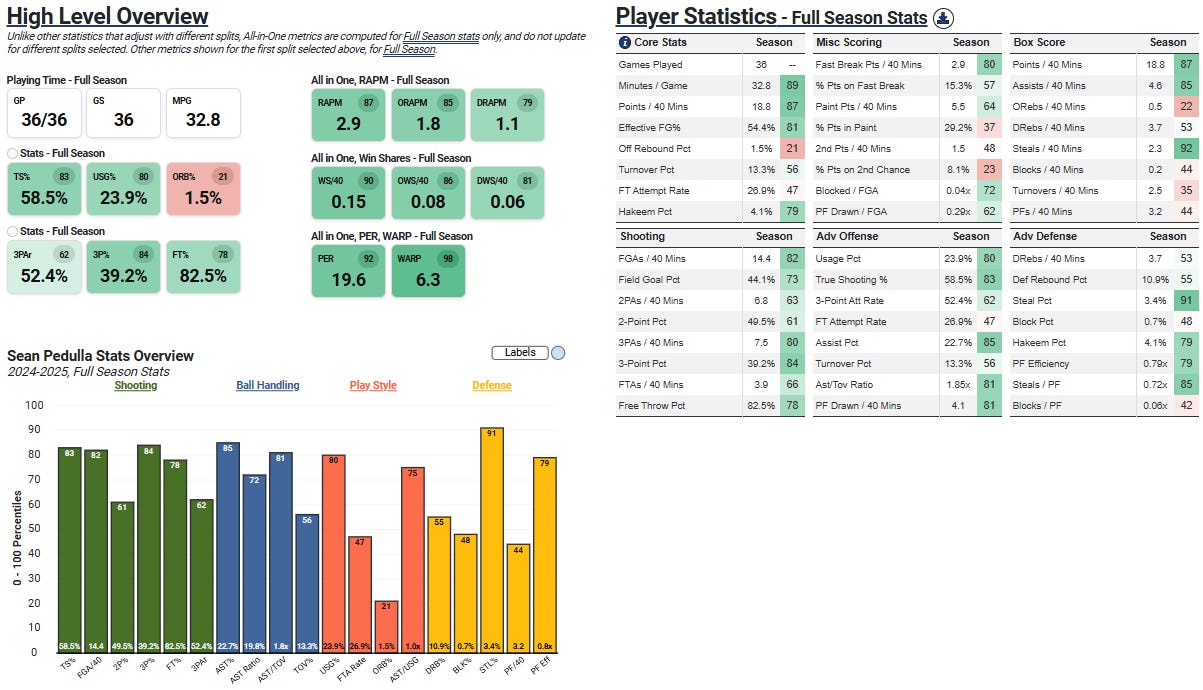
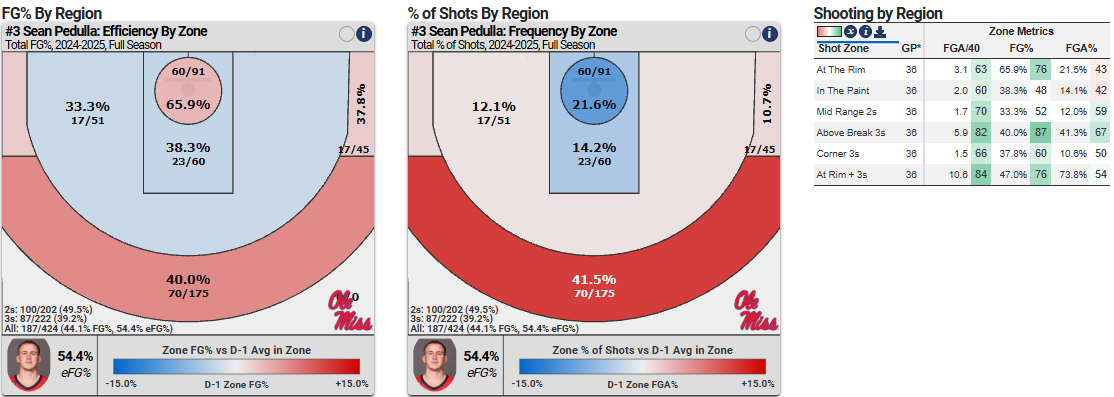
Sean Pedulla + Playmaking, Less Shooting from Distance
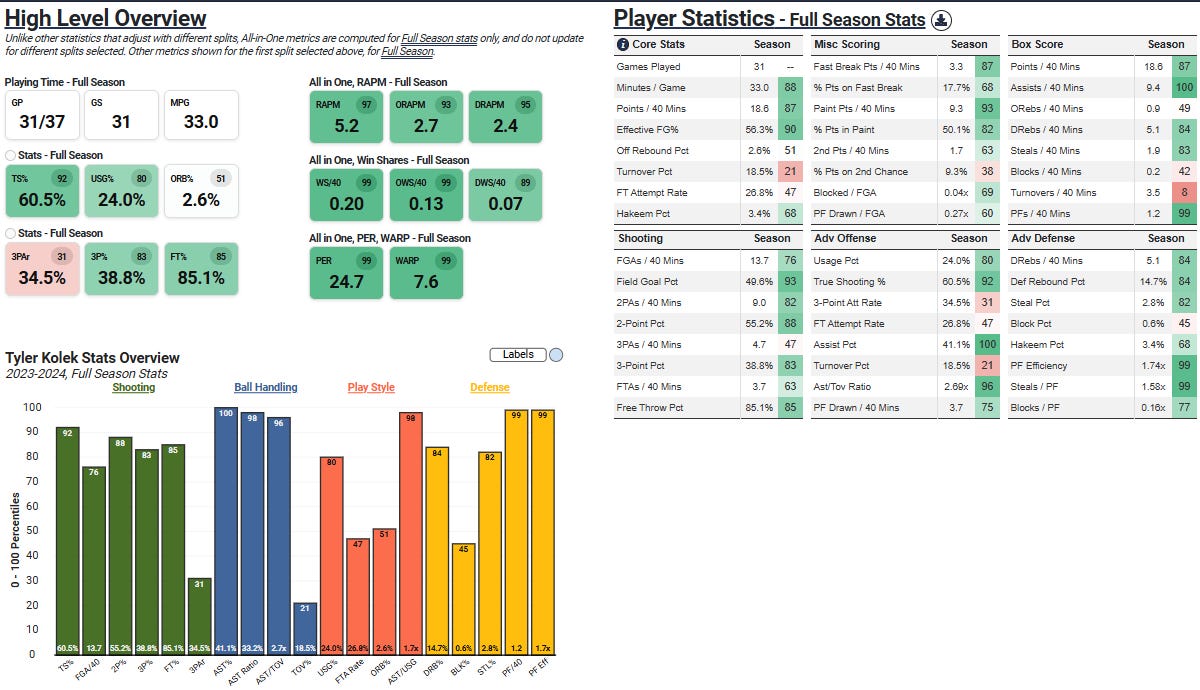
Tyler Kolek -Rim Pressure
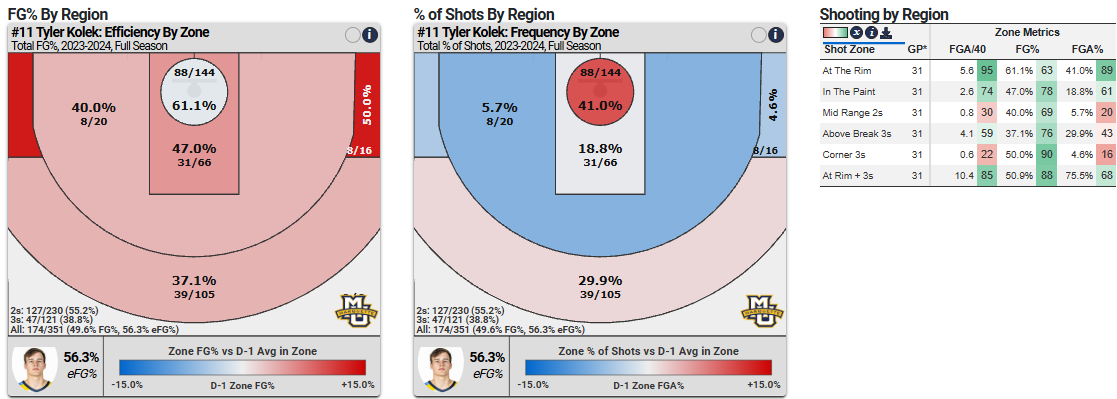
(Provided by Cbbanalytics)
Analysis:
Overall Impact: 17/25
Braden Smith’s overall impact profile is one of the strongest among upperclass guards in the 2026 draft cycle because the combination of advanced offensive responsibility, lineup impact, and sustained winning production consistently translated to elite team-level results at Purdue. While there are understandable concerns surrounding physical upside and defensive scalability, the broader body of work strongly supports the idea that Smith materially improved offensive environments at one of the highest levels in college basketball.
The advanced impact metrics are overwhelmingly positive.
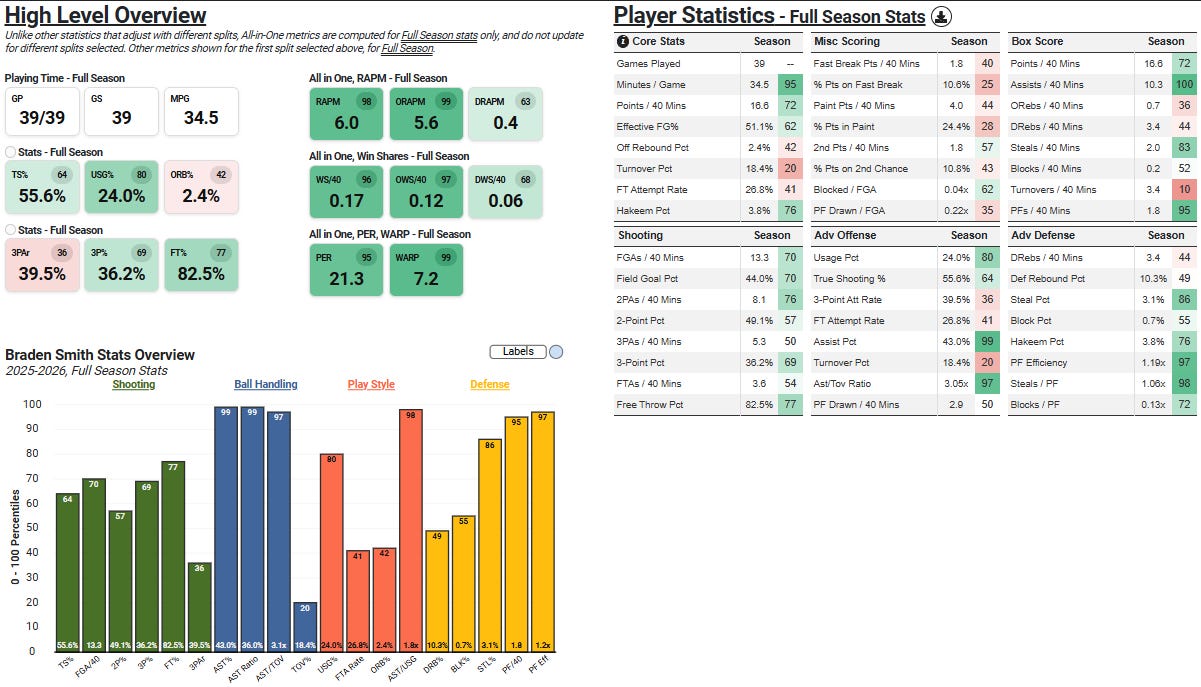
Smith posted a 5.98 overall RAPM during the 2025-26 season, ranking in the 98th percentile nationally, while generating an elite 5.57 ORAPM that ranked in the 99th percentile. That distinction is important because it reinforces what consistently appeared on film throughout his career: Smith’s value overwhelmingly stemmed from his ability to organize and elevate offense at a high level.
Purdue’s offensive ecosystem consistently improved dramatically with Smith on the floor.
The Boilermakers posted substantial improvements in offensive rating, effective field goal percentage, assist rate, free throw rate, and overall offensive efficiency when Smith was operating as the lead initiator. Purdue’s offensive rating jumped significantly with him on the floor, while the team’s assist percentage increased by nearly 14 percent. Those shifts are massive indicators of offensive control and organizational impact rather than simply individual statistical production.
Perhaps most impressively, Purdue’s turnover percentage dropped substantially when Smith was on the floor despite the enormous offensive burden he carried. That is one of the clearest indicators of his ability to stabilize possessions and maintain offensive structure even while functioning as a high-usage lead guard.
The overall lineup impact numbers further reinforce his value.
Purdue’s net rating improved by over 11 points per 100 possessions with Smith on the floor, an enormous differential for a lead guard operating within a high-major environment. The offense consistently functioned cleaner, faster, and more efficiently under his orchestration, particularly within half-court settings where his pick-and-roll manipulation and processing speed became foundational components of Purdue’s identity.
The traditional advanced metrics also paint an extremely favorable picture.
Smith generated 5.8 total win shares, ranking in the 99th percentile nationally, while posting elite offensive win share production as well. His 21.3 PER ranked in the 95th percentile, and his WARP numbers were among the strongest in the country. Most importantly, those metrics remained consistently elite despite Smith carrying one of the larger offensive organizational burdens in college basketball.
Unlike some guards whose efficiency is heavily inflated through simplified roles or low-usage spacing opportunities, Smith’s production came while orchestrating nearly every aspect of Purdue’s offense.
That context matters significantly.
Smith accounted for an enormous percentage of Purdue’s total assists, scoring creation, and possession control. He consistently balanced shot creation, perimeter scoring, and offensive organization simultaneously without the offense collapsing under his usage load. The fact that Purdue remained one of the nation’s most efficient offensive teams despite defenses aggressively loading toward Smith nightly speaks heavily to his offensive scalability and mental processing.
The on/off shooting numbers are also revealing.
Purdue’s effective field goal percentage improved notably with Smith on the floor, particularly from three-point range and within structured half-court offense. His ability to generate high-quality rim and perimeter opportunities for teammates repeatedly elevated overall lineup efficiency beyond what traditional assist totals alone fully capture.
At the same time, the impact profile is not completely flawless.
Defensively, while Smith competed hard and generated strong steal production, the overall defensive impact remained more moderate than elite. His DRAPM finished solidly positive but nowhere near the level of his offensive metrics. That aligns closely with the broader projection concerns surrounding his size, positional versatility, and long-term point-of-attack defensive scalability at the NBA level.
Additionally, because so much of his overall value is tied directly to offensive orchestration, there is naturally increased pressure on his offensive translation professionally. Smaller guards without elite athletic tools generally need their offensive processing and playmaking to translate cleanly in order to maintain rotational value.
Still, the overall impact profile is extremely difficult to dismiss.
Very few players in college basketball consistently elevated team offense the way Smith did across multiple seasons. The advanced metrics, lineup data, and eye test all point toward a guard who fundamentally improved offensive structure, decision-making, and possession efficiency whenever he was on the floor.
Smith’s overall impact reflects the profile of a highly intelligent lead guard whose value stems less from raw physical upside and more from offensive control, organization, and the ability to consistently drive winning basketball environments. While the physical limitations likely cap the overall ceiling, the statistical evidence strongly suggests he possesses legitimate NBA-caliber offensive orchestration ability capable of translating into a long-term rotational role.
Scoring: 5/9
Braden Smith’s scoring profile is deeply tied to the broader offensive burden he carried throughout his career at Purdue. Unlike many smaller collegiate guards who generate efficient offense primarily through transition opportunities or simplified spot-up roles, Smith consistently operated as Purdue’s primary initiator while simultaneously carrying substantial perimeter creation responsibility. His scoring value came less from overwhelming athletic tools and more from pace manipulation, difficult shot-making, pick-and-roll orchestration, and offensive control.
The overall statistical profile reflects a guard who balanced strong offensive involvement with respectable efficiency despite difficult shot quality.
Smith averaged 13.3 field goal attempts per 40 minutes during the 2025-26 season, ranking around the 70th percentile among guards. That volume is notable because it came while functioning as Purdue’s offensive engine and primary playmaker. More importantly, he maintained respectable efficiency across multiple scoring areas, posting a 43.9 percent overall field goal percentage, 51.1 effective field goal percentage, and 55.6 true shooting percentage. While those numbers may not immediately jump off the page compared to lower-usage guards, the offensive context surrounding them significantly raises their value.
Much of Smith’s scoring profile revolved around perimeter creation and high-difficulty shot generation.
He attempted over 5.2 three-pointers per 40 minutes while converting 36.2 percent from beyond the arc, both strong indicators given his shot profile. Unlike stationary catch-and-shoot guards, a substantial portion of Smith’s perimeter attempts came above the break, off ball screens, late-clock situations, and self-created pull-up opportunities against loaded defenses. Purdue relied heavily on him to create offense late in possessions, which naturally increased the difficulty level of many of his attempts.
Equally important is the balance within his shot distribution.
Smith maintained a relatively healthy scoring blend between perimeter creation and interior offense, attempting over eight two-point field goals per 40 minutes, ranking in the 76th percentile. Despite lacking elite size or vertical explosiveness, he converted nearly 49 percent of his two-point attempts, a respectable mark considering the amount of defensive attention he faced nightly. His ability to finish through pacing, touch, angles, and timing became increasingly important to Purdue’s offense throughout his career.
The paint scoring profile itself provides important context.
Smith generated just over 4.0 paint points per 40 minutes, while only roughly 24 percent of his total scoring came inside the paint. Those numbers are relatively modest compared to more downhill-oriented guards and reinforce the reality that Smith’s offense is built more around perimeter orchestration, pull-up creation, and half-court manipulation than constant rim pressure. He is not consistently collapsing defenses through overwhelming athleticism or living at the free throw line.
At the same time, his interior efficiency remained quietly encouraging for a smaller lead guard. Smith consistently demonstrated strong touch finishing around length, particularly in ball-screen situations where he manipulated defenders with hesitation dribbles, change of pace, and extension finishes rather than pure burst.
His free throw profile also reflects the balance within his offensive approach. Smith averaged 3.6 free throw attempts per 40 minutes, a fairly average figure relative to high-usage collegiate guards. He was capable of drawing contact when attacking gaps, but he was not an elite foul-pressure generator who consistently forced defenses into rotation breakdowns through rim aggression alone.
Another important contextual element is how little of Smith’s scoring came through transition padding. His fastbreak scoring production remained fairly modest, with only around 10 percent of his total offense generated in transition situations. Similarly, his scoring off turnovers was solid but not overwhelming. That matters because much of his offensive production came in structured half-court environments where defenses were specifically scheming against him as Purdue’s primary initiator.
In many ways, Smith’s scoring profile mirrors the broader evaluation of his offensive game overall.
He is not a pure scoring guard capable of consistently overwhelming defenses through athletic dominance or isolation shot creation. There are legitimate concerns regarding how his scoring efficiency scales against NBA length and physicality, particularly given his size limitations and modest rim pressure profile. However, the difficulty of his offensive workload, combined with his shot versatility, perimeter confidence, and ability to generate offense within structure, makes the scoring profile more impressive than the raw percentages alone may initially suggest.
Ultimately, Smith projects less as a primary NBA scorer and more as a secondary offensive organizer capable of supplementing offense through pull-up shooting, perimeter creation, and intelligent half-court pacing. His scoring value is closely tied to his playmaking gravity and offensive orchestration rather than raw scoring volume itself, but the overall offensive package still provides enough versatility to function within second-unit NBA offensive ecosystems.
Self Creation: 7/9
One of the more impressive aspects of Braden Smith’s offensive profile is the amount of self-created offense he generated despite lacking elite physical tools or overwhelming athletic advantages. Unlike many collegiate guards whose efficiency is heavily dependent on assisted opportunities or transition creation, Smith consistently produced offense independently while functioning as Purdue’s primary initiator and offensive organizer.
The statistical profile strongly reinforces that reality.
Smith generated 12.1 unassisted points per 40 minutes during the 2025-26 season, ranking in the 85th percentile among comparable guards. That is an extremely strong number considering the level of defensive attention he faced nightly and the offensive burden Purdue placed on him. More importantly, he averaged 4.2 unassisted field goals made per 40 minutes, ranking in the 89th percentile, illustrating how much of his offense came directly from his own creation rather than system-generated opportunities.
Perhaps the clearest indicator of Smith’s self-creation ability is the overall assisted percentage on his made field goals. Only 28.4 percent of his made baskets were assisted, ranking in just the 12th percentile. In other words, nearly three-quarters of his offense was self-generated. That is a massive contrast compared to more complementary guards or movement shooters whose production is heavily dependent on offensive structure and teammate creation.
The interior scoring profile becomes even more impressive when viewed through that lens.
Smith generated 3.39 unassisted two-point field goals per 40 minutes, ranking in the 85th percentile, despite standing around 6-foot and lacking elite vertical athleticism. His ability to consistently create interior offense through pacing, hesitation dribbles, timing changes, and manipulation of pick-and-roll coverages became one of the defining traits of Purdue’s offense. Rather than relying on explosive burst, Smith repeatedly created driving angles through craft, deceleration, and advanced footwork.
That level of independent rim pressure is particularly notable given the defensive attention he commanded.
Opposing defenses consistently loaded toward Smith in ball-screen situations, often prioritizing limiting his downhill creation while simultaneously protecting Purdue’s interior actions. Even within those constraints, Smith remained capable of generating efficient offense in tight spaces. Only 14 percent of his made two-point baskets were assisted, reinforcing how often he was creating those opportunities himself.
The perimeter creation profile also deserves significant attention.
Smith produced over 0.8 unassisted three-pointers per 40 minutes, ranking in the 92nd percentile among guards. While his overall three-point percentages may not always fully capture the efficiency, the degree of difficulty attached to many of those attempts matters substantially. A large portion of Smith’s perimeter offense came off pull-ups, late-clock possessions, relocation dribbles, and above-the-break creation against defenders specifically scheming to contain him.
Unlike many smaller guards who struggle creating perimeter separation without elite athleticism, Smith consistently leveraged advanced pacing and manipulation to manufacture enough space for pull-up opportunities. He understands how to use ball screens, change speeds, snake dribbles, and hesitation movements to force defenders into compromised positioning before rising into jumpers or floaters.
The broader usage profile further reinforces the level of offensive responsibility he carried.
Smith posted a 24 percent usage rate while accounting for over 19 percent of Purdue’s total field goal attempts and an astonishing 45 percent of the team’s assists. That last figure is especially important. Purdue’s offense was not simply asking Smith to score. He was simultaneously responsible for organizing the offense, creating for teammates, and carrying major self-creation duties within the half court. Very few guards nationally handled that combination of scoring and playmaking responsibility.
At the same time, the limitations within the profile remain important when projecting upward.
While Smith consistently created offense at the collegiate level, there are legitimate questions surrounding how efficiently that self-creation translates against NBA length, athleticism, and physicality. He does not possess elite first-step explosiveness or vertical pop, and some of the difficult pull-up scoring he relied upon at Purdue may become more volatile against longer defenders and more aggressive point-of-attack pressure.
Additionally, the turnover burden remains part of the equation. Because so much of Purdue’s offense flowed directly through Smith, he also accounted for over 32 percent of the team’s turnovers. That is partially a reflection of offensive responsibility rather than poor decision-making, but it still highlights the challenges that come with high-difficulty creation volume.
Playmaking: 8/9
Playmaking is unquestionably the defining trait of Braden Smith’s NBA projection and the skill that gives him the clearest pathway toward long-term professional value. Across four seasons at Purdue, Smith consistently functioned as one of the most advanced offensive organizers in college basketball, blending elite processing speed, pick-and-roll manipulation, pacing, and passing creativity into an offensive engine capable of elevating entire lineups.
The statistical profile overwhelmingly supports that evaluation.
Smith generated 40.8 points created per 40 minutes during the 2025-26 season, ranking in the 99th percentile nationally. That number alone reflects the enormous offensive burden Purdue placed on him nightly. Between his own scoring and direct assist creation, Smith was responsible for an overwhelming percentage of Purdue’s half-court offense. More impressively, he maintained elite creation volume while consistently generating efficient shot quality for teammates rather than simply inflating assist totals through high possession usage.
The sheer scale of his passing production immediately stands out.
Smith recorded 345 assists across the season while directly assisting on 816 points. Purdue’s offense revolved almost entirely around his ability to organize possessions, manipulate defensive rotations, and consistently create efficient looks within structure. He accounted for over 45 percent of Purdue’s total assists, an absurdly high number for a major-conference offense operating at a championship-contending level.
What separates Smith from many collegiate playmakers is the diversity and scalability of the reads he consistently generated.
He was elite creating rim opportunities for teammates, producing 3.69 at-rim assists per 40 minutes, ranking in the 99th percentile among guards. Those reads came through advanced pick-and-roll manipulation, pocket passing, interior timing, and his ability to force weak-side rotations before delivering accurate passes into tight windows. Smith consistently leveraged hesitation dribbles, deceleration, and angle changes to compromise defenders before punishing coverage mistakes.
His paint creation numbers were even more impressive.
Smith generated 2.17 paint assists per 40 minutes, ranking in the 100th percentile nationally. That statistic is particularly important because it highlights his ability to consistently collapse defenses and create efficient interior offense despite lacking elite physical tools. Rather than relying on overwhelming burst, Smith created advantages through timing, processing, and manipulation of defensive structure.
The broader shot-quality creation profile further reinforces how translatable his passing may become.
Smith generated 7.44 rim-and-three assists per 40 minutes, ranking in the 99th percentile. In other words, the overwhelming majority of his playmaking directly created the two most valuable shot types in modern basketball: attempts at the rim and three-point opportunities. That distinction matters enormously from an NBA projection standpoint because scalable playmakers are often defined less by raw assist totals and more by their ability to generate analytically efficient offense.
The perimeter passing profile also deserves significant attention.
Smith generated 2.53 above-the-break three assists per 40 minutes, ranking in the 97th percentile, while consistently manipulating help defenders into rotation conflicts. Purdue frequently relied on Smith to create weak-side passing windows through ball-screen pressure, and he repeatedly demonstrated the vision and timing necessary to capitalize once defenses shifted.
Perhaps most impressive is how advanced the overall orchestration looked on film.
Smith consistently played with exceptional pace control, rarely appearing rushed despite constant defensive attention. He manipulated defenders with timing changes, snake dribbles, re-screens, hesitation moves, and advanced pick-and-roll pacing that typically translates more cleanly than athleticism-dependent creation. He routinely anticipated rotations before they occurred and displayed high-level touch on interior dump-offs, skip passes, and short-window deliveries.
Unlike many collegiate guards who rely heavily on predetermined reads, Smith consistently demonstrated reactive playmaking ability. He adjusted in real time to coverages, identified secondary rotations quickly, and showed a strong understanding of spatial manipulation within half-court offense.
The overall offensive context also makes the production more impressive.
Purdue’s offense was heavily dependent on Smith’s ability to generate structure and organization. Defenses consistently loaded coverage toward him, particularly in ball-screen situations, yet he continued producing elite creation numbers despite facing aggressive defensive game-planning nightly. His combination of scoring gravity and passing vision repeatedly forced defenses into impossible decisions.
There are still some projection questions at the NBA level.
Because of his size limitations and average vertical athleticism, there may be concerns regarding how consistently Smith can create the same level of paint collapse against larger, longer, and more explosive NBA defenders. Some passing windows available collegiately will naturally shrink at the professional level. Additionally, the extremely high offensive responsibility Purdue placed on him occasionally led to elevated turnover totals, though much of that was simply a byproduct of creation burden.
Still, the overall playmaking profile is one of the strongest in the class.
Smith projects as the type of guard capable of stabilizing second units, organizing offense, and elevating lineup functionality through intelligence and pacing alone. The combination of elite rim creation, advanced pick-and-roll orchestration, high-level passing vision, and sustained offensive impact suggests a player whose playmaking should translate meaningfully even if the scoring efficiency fluctuates against NBA athleticism.
Shooting: 5/9
Braden Smith’s shooting profile is one of the more nuanced evaluations in this class because the raw percentages only partially capture the level of difficulty and offensive burden attached to his perimeter scoring. While Smith may not profile as an elite pure shooter in the traditional sense, the context surrounding his shot creation, volume, and offensive role significantly raises the value of his overall perimeter game.
At the surface level, the numbers are solid across the board.
Smith converted 36.2 percent from three-point range while attempting over five threes per 40 minutes, both respectable marks for a high-usage collegiate lead guard. He also posted a strong 82.5 percent free throw percentage, an encouraging indicator for long-term touch projection. Overall, he maintained a 51.1 effective field goal percentage and 55.6 true shooting percentage despite functioning as Purdue’s primary initiator and offensive organizer.
The broader shot profile, however, is where the evaluation becomes far more interesting.
Unlike many guards who derive efficiency from catch-and-shoot opportunities or simplified spacing roles, Smith consistently generated offense through difficult self-created jump shooting. Over 31 percent of his total shot attempts came from midrange areas, ranking in the 98th percentile among guards. That number immediately stands out because most modern collegiate offenses actively discourage high-volume midrange creation unless the player possesses genuine pull-up shot-making ability.
Smith not only embraced those difficult attempts, he converted them at a highly efficient rate.
He shot 46.8 percent on midrange attempts, ranking in the 83rd percentile. That level of efficiency on self-created intermediate offense is extremely impressive for a smaller guard carrying heavy offensive responsibility. Much of Purdue’s half-court offense relied on Smith manipulating pick-and-roll coverages before flowing into floaters, pull-up jumpers, or short-area creation shots against dropping bigs and recovering defenders.
The pull-up shooting context is especially important when evaluating his NBA translation.
A significant percentage of Smith’s perimeter attempts came above the break and off the dribble rather than from easier corner spacing opportunities. He attempted over 36 percent of his total shots from above-the-break three while consistently facing aggressive defensive coverage. His ability to generate pull-up offense despite lacking elite burst or vertical explosiveness speaks heavily to his pacing, balance, and shot preparation.
The shot versatility itself is one of the stronger indicators within his profile.
Smith consistently demonstrated comfort shooting from multiple levels of the floor. His overall average two-point attempt distance exceeded 10 feet, ranking near the bottom percentile in proximity to the basket. In other words, he was rarely relying on easy rim attempts to inflate efficiency. Instead, much of his scoring came from difficult intermediate pull-ups, floaters, and above-the-break perimeter attempts created through ball screens and late-clock offense.
The situational rim finishing numbers also provide encouraging context.
Despite lacking size and explosiveness, Smith converted over 61 percent of his at-rim attempts overall while posting especially strong efficiency late in possessions. During the 20-30 second portion of the shot clock, he converted over 73 percent of his rim attempts, an excellent mark considering the degree of defensive pressure attached to late-clock offense. That reflects strong composure, touch, and creativity finishing in difficult situations rather than pure athletic finishing ability.
Another subtle but interesting element of Smith’s shooting profile is his directional comfort.
He was dramatically more efficient shooting from the right side of the floor, converting nearly 48 percent of attempts compared to roughly 36 percent from the left side. Over half of his total shot attempts originated from the right side, reinforcing both his comfort attacking that direction and the possibility of strong hand preference within his pull-up game.
At the same time, there are still meaningful projection concerns.
Smith’s overall perimeter efficiency, while solid, may not fully offset the physical limitations he will face at the NBA level. Because he lacks elite size and separation explosiveness, much of his shooting translation will depend on how effectively he can continue generating clean pull-up windows against longer and more athletic defenders. Some of the difficult midrange creation that worked collegiately may become less efficient professionally when defensive gaps tighten considerably.
Additionally, his corner three volume remained extremely low, with just 13 corner attempts all season. Most of his shooting profile was heavily creation-oriented rather than movement-based spot-up spacing, which creates a different translation pathway than traditional off-ball shooters.
Still, the broader shooting profile remains encouraging because of the degree of difficulty attached to the production.
Smith consistently generated offense through advanced pacing, pull-up creation, and difficult perimeter shot-making while simultaneously orchestrating Purdue’s offense. The combination of shot versatility, touch, self-created perimeter scoring, and high-level midrange efficiency gives him a much stronger offensive floor than many smaller collegiate guards entering the draft process.
Defensive Attribution: 4/10
Defensively, Braden Smith’s evaluation becomes one of balancing production, effort, and instincts against very real physical limitations that will become increasingly magnified at the NBA level. The statistical profile reflects a player who consistently competed, generated disruptive events, and avoided mistakes, but whose long-term defensive scalability remains difficult to fully project because of size and athletic constraints.
The most immediately encouraging aspect of Smith’s defensive profile is his activity level.
Smith posted a 3.1 percent steal rate during the 2025-26 season, ranking in the 86th percentile among guards, while generating 66 total steals across the year. That level of event creation reflects strong anticipation, quick hands, and active engagement within defensive possessions. He consistently disrupted passing lanes, dug down effectively on drives, and created turnovers through timing and awareness rather than overwhelming physical tools.
His steal-to-foul efficiency was especially impressive.
Smith generated over one steal per personal foul committed, ranking in the 98th percentile nationally. That is a significant indicator because it demonstrates disciplined aggression rather than reckless gambling. Smaller guards who generate high steal volume often compensate through excessive reach-ins or overhelping, but Smith generally maintained strong control within Purdue’s defensive structure. He consistently understood when to pressure passing lanes and when to remain connected within team concepts.
The foul discipline overall was one of the stronger aspects of his defensive profile.
Smith committed just 1.84 fouls per 40 minutes, ranking in the 95th percentile among guards, while posting an elite personal foul efficiency rating in the 97th percentile. For a smaller lead guard consistently involved at the point of attack, that level of foul avoidance is impressive. He rarely put opponents on the line unnecessarily and generally defended with good body control and positional awareness.
The broader defensive activity metrics also suggest strong competitiveness.
Smith consistently played with high motor energy, particularly within Purdue’s half-court structure. He fought over screens reasonably well, rotated with effort, and frequently competed above his physical profile would suggest. His help instincts and communication were generally solid, and he displayed a clear understanding of Purdue’s defensive principles throughout his career.
At the same time, the limitations within the projection remain substantial.
Physically, Smith lacks ideal NBA positional size, length, and explosiveness. While the steal numbers and defensive activity are encouraging, much of his disruption came through anticipation and intelligence rather than physical deterrence. Against NBA guards with greater size, burst, and strength, some of the passing lane gambles and aggressive digs that produced collegiate steals may become significantly riskier.
The rebounding profile further reinforces some of those concerns.
Smith’s defensive rebounding numbers were fairly average overall, posting a defensive rebounding percentage around the 49th percentile. While that is respectable for a smaller guard, it does not suggest a player capable of significantly impacting possessions physically on the glass. At the NBA level, guards often need either elite physical tools or exceptional versatility to consistently survive defensively across playoff matchups.
The lack of verticality also limits some defensive scalability.
Smith produced only eight total blocks across the season, which is expected given his size, but still reinforces the reality that he provides very little rim deterrence or weak-side vertical resistance. He is unlikely to offer significant switch versatility against larger wings or forwards, which may place structural pressure on surrounding defensive personnel.
Perhaps the biggest projection question centers around point-of-attack containment.
While Smith consistently competes and understands positioning, there are understandable concerns regarding how effectively he can stay attached against elite NBA athletes in isolation and ball-screen environments. He does not possess elite lateral recovery speed, length, or physical strength, meaning quicker or larger guards may consistently target him within screening actions.
Still, there are reasons to believe he can remain functionally competent within the right environment.
Guards with strong processing speed, communication ability, and disciplined team-defense awareness often survive defensively longer than purely physical projections might suggest. Smith clearly understands rotations, competes consistently, and rarely loses focus within possessions. Coaches tend to trust guards who execute schemes properly and avoid mental mistakes, particularly within bench or secondary-unit structures.
Ultimately, Smith’s defensive profile projects more as manageable than impactful.
He is unlikely to become a defensive difference-maker or highly versatile stopper at the NBA level, and there will almost certainly be matchup limitations tied to his physical profile. However, the combination of effort, anticipation, activity, and discipline gives him a pathway toward surviving defensively within structured systems, particularly if paired alongside stronger perimeter defenders.
Off-Ball Offense: 2/9
Off-ball offense is one of the weaker areas of Braden Smith’s overall projection, though much of that stems from role context rather than a complete inability to function without the basketball. Throughout his career at Purdue, Smith operated almost exclusively as the initiator and organizer of the offense. The system consistently relied on him to dictate tempo, manipulate defensive coverages, and generate advantages as the primary ball-handler rather than functioning as a secondary spacer or movement scorer.
That distinction is critical when evaluating this portion of his profile.
Unlike guards who spend large portions of possessions relocating around actions, spacing in weak-side corners, or functioning as movement shooters off screens, Smith’s offensive value was overwhelmingly tied to on-ball orchestration. Purdue’s offense consistently flowed through his decision-making and ball-screen management, which naturally limited the amount of off-ball development within his game.
The statistical profile supports that reality.
Smith generated most of his offensive production through self-created offense and direct playmaking responsibility rather than assisted scoring or secondary movement opportunities. Only a small percentage of his overall offense came through catch-and-shoot situations, cuts, or off-ball relocation actions. Much of his perimeter shooting came above the break and off the dribble, reinforcing how heavily his role centered around primary initiation responsibilities.
There are still some encouraging functional traits within his off-ball profile.
Smith is an intelligent offensive player who understands spacing and generally maintains strong floor balance when possessions move away from him. He is capable of relocating into secondary passing windows and can function as a spot-up threat given his respectable perimeter shooting touch. His willingness to move the ball and re-space possessions quickly also helps maintain offensive flow rather than stalling actions after initial passes.
However, he is not currently a dynamic off-ball offensive player in the traditional sense.
Smith rarely operated as a movement shooter flying off screens or relocating aggressively around half-court actions. He is also not a vertical cutter or athletic off-ball finisher capable of generating easy offense through physical tools. Because much of his offensive rhythm comes through controlling possessions directly, there are still questions surrounding how naturally he adjusts when playing alongside higher-usage initiators at the NBA level.
That adjustment may become especially important professionally.
At the NBA level, backup and secondary guards are often required to play alongside multiple primary creators rather than controlling every possession themselves. Smith will likely need to continue improving his catch-and-shoot consistency, relocation timing, and ability to remain impactful offensively during possessions where he is not directly orchestrating action.
There is also a broader positional concern tied to his size profile. At his physical dimensions, Smith may simply be too small to consistently function as an off-ball guard at the next level. Smaller guards who do not possess elite movement shooting gravity or high-level defensive versatility often struggle fitting alongside other primary ball-handlers because opposing teams can target them physically on the defensive end while minimizing their offensive value when the ball is not in their hands.
That reality places even greater importance on Smith’s role as a lead initiator.
His clearest pathway to NBA success likely comes through functioning as a second-unit organizer and primary bench creator rather than as a complementary off-ball guard sharing possessions with larger initiators. The offensive value is strongest when he is controlling pace, orchestrating pick-and-rolls, and leveraging his processing speed to create structure for teammates.
Post (Scoring/Playmaking): 1/9
Post offense is almost entirely absent from Braden Smith’s overall offensive profile and projects as a non-factor at the NBA level. Given his size, physical dimensions, and role within Purdue’s offense, Smith was rarely utilized in traditional post situations, and there is very little evidence suggesting post scoring or post facilitation will become a meaningful component of his professional projection.
The statistical profile reinforces that immediately.
Smith generated very little offense through interior back-to-the-basket situations or physical mismatch exploitation. Most of his interior scoring came through ball-screen creation, floaters, touch finishes, and downhill pacing rather than post seals or half-court post isolations. At roughly 6-foot without elite size or strength advantages, he simply does not possess the physical profile to consistently create efficient post offense against larger defenders.
Even his interior scoring profile reflects this reality.
While Smith was effective generating self-created two-point offense through craft and pick-and-roll manipulation, those opportunities almost exclusively occurred facing the basket. His offensive value came through space navigation, change of pace, and decision-making rather than physical interior play. He rarely established deep positioning, operated through post footwork, or generated offense through strength-based scoring angles.
As a passer, there are some transferable traits that technically overlap with post facilitation concepts.
Smith processes quickly, reads help defenders effectively, and consistently manipulates interior rotations through timing and vision. However, almost all of those reads came within pick-and-roll orchestration or live-dribble creation rather than true post playmaking environments. He was not functioning as a stationary offensive hub from the elbows or block areas the way larger initiators occasionally do.
Physically, the projection limitations are fairly straightforward.
At the NBA level, Smith’s size alone will likely prevent any meaningful post utilization offensively. Smaller guards without elite physical advantages generally do not generate efficient post offense professionally unless they possess truly elite strength, footwork, or mismatch exploitation ability. Smith’s game is built almost entirely around perimeter orchestration and ball-screen creation, making post offense largely irrelevant within his broader projection.
Ultimately, the low grade here is more reflective of role irrelevance than a major weakness within his actual archetype.
Intangibles/Eye Test: 8/11
Braden Smith’s overall evaluation becomes significantly stronger once the eye test, leadership profile, and overall offensive control are factored into the equation. While there are legitimate physical limitations within his projection, few guards in college basketball consistently impacted winning at the level Smith did across four seasons at Purdue. His combination of toughness, offensive command, competitiveness, and basketball intelligence repeatedly elevated Purdue into one of the nation’s most stable and efficient programs.
The first thing that immediately stands out on film is his command of the game.
Smith consistently operated with the poise and pacing of a veteran floor general. Rarely did he appear sped up or uncomfortable, even against heavy ball pressure or aggressive defensive schemes. He controlled tempo exceptionally well, understanding when to slow possessions down, when to push pace, and when to manipulate defensive positioning to create advantages. Purdue’s offense consistently played with organization and structure because Smith dictated possessions with a high level of composure.
The processing speed is arguably his most translatable trait.
Smith routinely identified defensive rotations early, manipulated help defenders through pacing, and delivered quick reads without overdribbling or stalling offensive flow. He consistently played one step ahead of the defense, particularly in pick-and-roll situations where his timing and anticipation became major offensive weapons. That level of feel is difficult to teach and often translates more cleanly than purely athletic advantages.
Competitively, Smith plays with a level of toughness that coaches typically gravitate toward immediately.
Despite lacking ideal physical tools, he consistently embraced heavy offensive responsibility without shying away from pressure moments. He competed through physicality, absorbed contact, and repeatedly delivered in high-leverage situations throughout Purdue’s deep tournament runs and conference play. The confidence and control he played with became foundational elements of Purdue’s offensive identity.
Leadership also became increasingly evident throughout his career.
As Purdue’s offensive engine, Smith consistently carried major responsibility while maintaining offensive organization and accountability. Teammates clearly trusted him to control possessions, and Purdue’s overall offensive consistency across multiple seasons reflects how stable the program became with him operating as the lead guard. Players who can successfully orchestrate high-level college offenses for multiple years often enter the NBA with stronger situational understanding than younger, purely upside-based guards.
The advanced impact metrics strongly reinforce the eye test as well.
Smith repeatedly posted elite RAPM, WARP, and lineup impact numbers throughout his collegiate career. Purdue consistently performed dramatically better with him on the floor, particularly offensively. Those kinds of sustained impact indicators over a large sample size are often reflective of players who positively influence winning in ways not always fully captured through traditional box scores.
At the same time, the eye test also exposes the primary limitations within the projection.
Physically, Smith will likely face an uphill battle defensively at the NBA level. His lack of size, length, and vertical athleticism limits some positional versatility and may create matchup concerns against larger professional guards. There are also moments where his offensive creation windows become significantly tighter against elite athletic defenders, particularly when forced into difficult isolation scoring situations.
Additionally, because so much of his value is tied to on-ball orchestration, there are questions regarding lineup flexibility if he is unable to consistently control possessions at the NBA level. Smaller guards without elite physical tools generally need very high offensive processing and decision-making to survive professionally, which places substantial pressure on Smith’s offensive translation.
Still, the overall eye test remains highly favorable relative to his projected role.
Smith consistently looked like a player who understood how to run a team, organize offense, and elevate the functionality of everyone around him. His pace manipulation, leadership, competitive toughness, and advanced offensive feel give him a relatively high floor as a professional backup point guard candidate.
Complete Evaluation: 57/100
 | A guest post by
|