


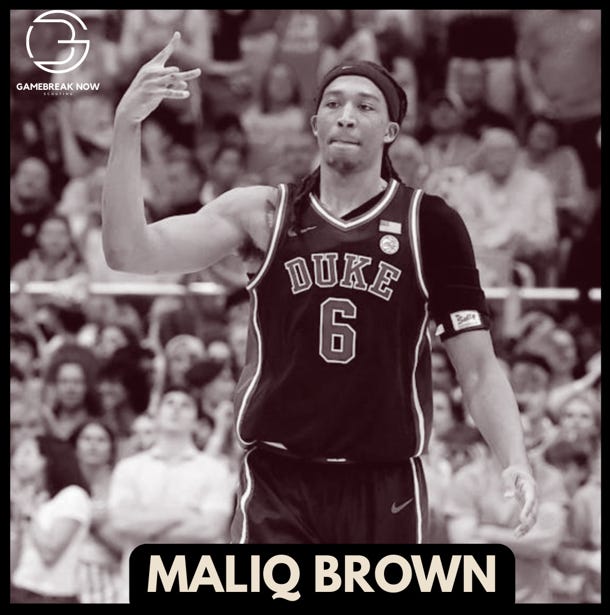
Height: 6’9” Weight: 210Lbs Team: Duke Class: Senior
Age at Draft: 22.61 Height (Barefoot): 6’8 Weight: 216.6 Lbs Wingspan: 84.5” (+4.5) Standing Reach: 107”
Scouting Snapshot
Maliq Brown carved out one of the most unique roles among high-major forwards during his collegiate career. After beginning at Syracuse and later transferring to Duke, Brown evolved into a highly impactful defensive specialist whose value was driven far more by versatility, intelligence, activity, and winning plays than traditional scoring production. While his offensive game remained limited throughout his career, his defensive impact consistently ranked among the best in college basketball and ultimately became the defining trait of his NBA projection.
At 6-foot-9 and approximately 220 pounds, Brown possesses the size, mobility, and instincts that modern defenses covet. Unlike many forwards whose value is tied primarily to scoring or floor spacing, Brown built his game around defensive disruption, switchability, rebounding, connective passing, and positional versatility. His impact frequently exceeded his box-score production because of the number of possessions he influenced without directly recording points.
The offensive profile remained highly role-specific throughout his career.
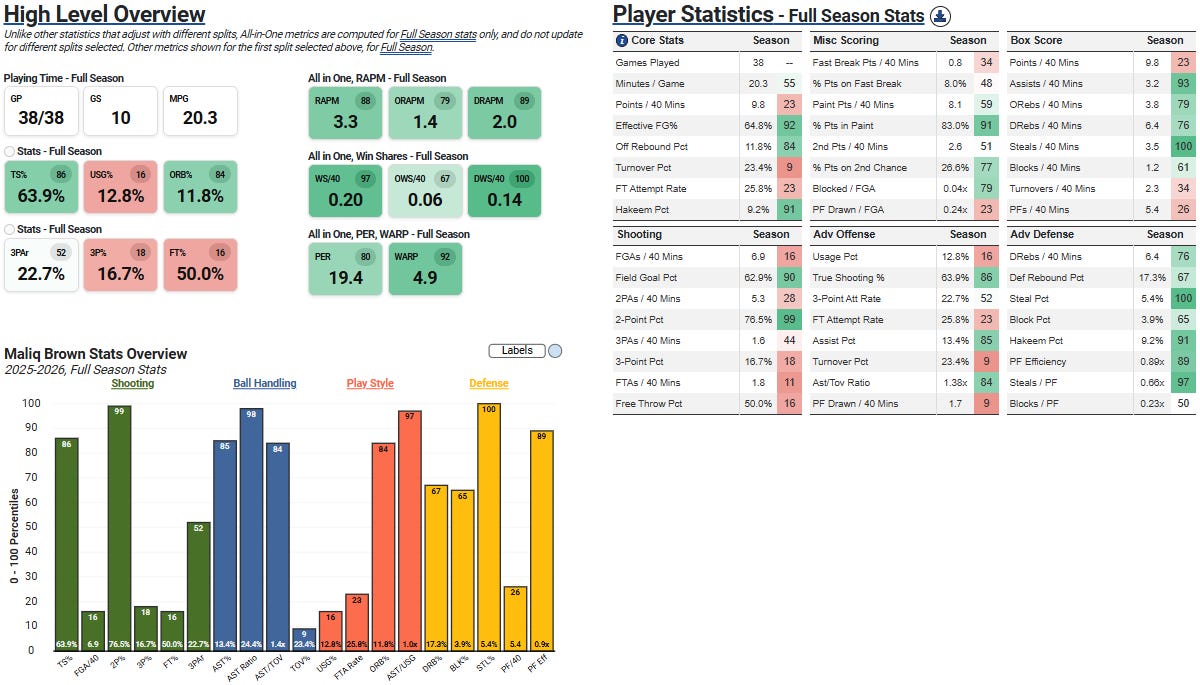
By his senior season at Duke, Brown averaged just 9.8 points per 40 minutes while carrying a modest 12.8 percent usage rate. However, he maintained an outstanding 63.9 percent true shooting percentage and converted an elite 76.5 percent of his two-point attempts, ranking in the 99th percentile nationally. Rather than creating offense for himself, Brown thrived as a finisher, cutter, offensive rebounder, transition runner, and connective piece within Duke’s offensive structure.
His efficiency was largely driven by shot selection.
Over 80 percent of his scoring came in the paint, and nearly all of his offensive production was generated around the basket. Brown rarely settled for difficult jumpers and consistently converted high-value opportunities created through cuts, dump-offs, offensive rebounds, and transition finishes. His offensive role was designed around maximizing efficiency rather than volume.
The passing and decision-making profile also deserves attention.
Despite limited scoring responsibility, Brown averaged over 3 assists per 40 minutes while posting strong assist-to-turnover metrics throughout his career. He frequently functioned as a connective passer who kept possessions flowing without forcing offense. His feel for the game consistently showed up through quick reads, ball movement, and unselfish play rather than traditional shot creation.
Defensively, however, is where Brown becomes a genuinely intriguing prospect.
Few players in college basketball matched his combination of defensive activity and impact. During his senior season, he posted a 5.4 percent steal rate, ranking in the 100th percentile nationally, while also recording strong block rates and elite defensive rebounding numbers. Those metrics are exceptionally rare for a player with forward size and highlight the versatility of his defensive skill set.
The advanced impact metrics strongly support the eye test.
Brown posted a 2.0 Defensive RAPM and a 3.3 overall RAPM while leading one of the nation’s top defensive teams. His defensive win shares ranked in the 100th percentile nationally, reinforcing the extent to which he consistently influenced possessions on that end of the floor. Whether switching onto guards, rotating as a help defender, disrupting passing lanes, or protecting the rim, Brown consistently found ways to generate defensive value.
His versatility is arguably his greatest NBA selling point.
Brown has the mobility to defend multiple positions, the instincts to anticipate actions before they develop, and the activity level to create defensive events without gambling excessively. Modern NBA defenses increasingly prioritize forwards capable of operating within switching schemes while maintaining help-side awareness, and Brown demonstrated many of those traits throughout his collegiate career.
The offensive limitations remain the primary concern.
Brown offers very little perimeter shooting value, converting just 16.7 percent from three and 50 percent from the free-throw line during his senior season. He does not project as a floor spacer, self-creator, or high-volume offensive contributor. His scoring remains almost entirely dependent on team structure and opportunistic finishing around the basket.
That naturally places pressure on the defense to carry the profile.
Fortunately, the defensive impact appears legitimate. Brown’s elite steal production, strong rebounding, positional flexibility, and advanced metrics all suggest his value extends well beyond traditional box-score evaluation. Players with similar offensive limitations typically struggle to reach the NBA unless they provide exceptional defensive value, and Brown’s profile consistently points in that direction.
From an NBA projection standpoint, Brown profiles most cleanly as a defensive-minded rotational forward whose value is driven by versatility, activity, connective offense, and defensive playmaking. The archetype resembles players such as Kyle Anderson, Xavier Tillman, or a smaller version of Larry Nance Jr., forwards who impact winning through intelligence, versatility, and defensive functionality rather than scoring volume.
The swing factor is simple: can the offense become just functional enough to stay on the floor?
If Brown can continue improving as a passer, finisher, and occasional perimeter threat, his elite defensive tools give him a legitimate pathway toward a professional rotation role. Even without major offensive growth, his combination of defensive instincts, positional versatility, rebounding, and winning impact makes him one of the more intriguing defensive specialists in the class.
Statistical Overview By Year:
2025-2026 (Senior Season)
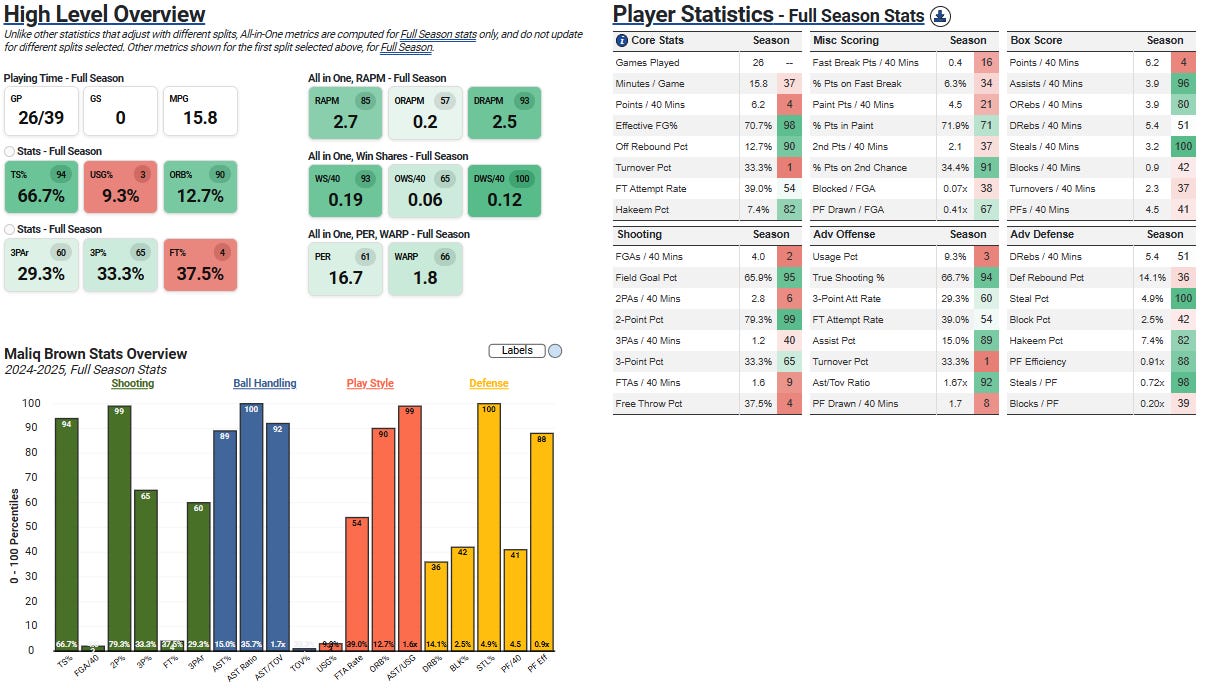
2024-2025 (Junior Season)
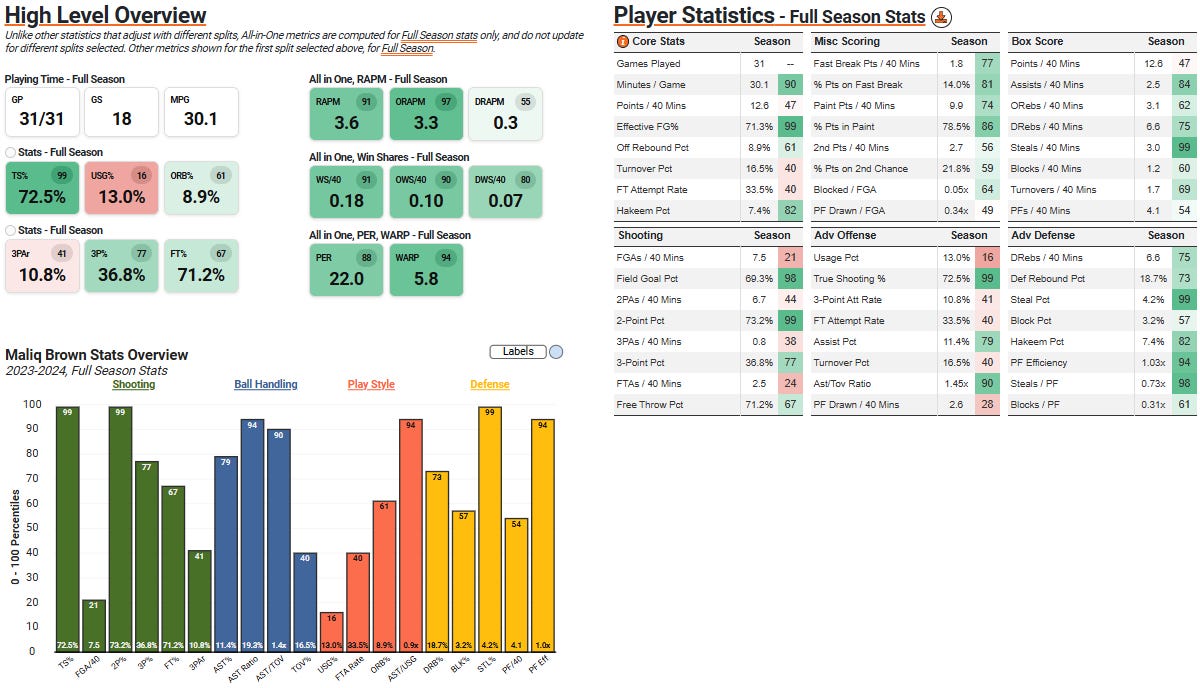
2023-2024 (Sophomore Season)
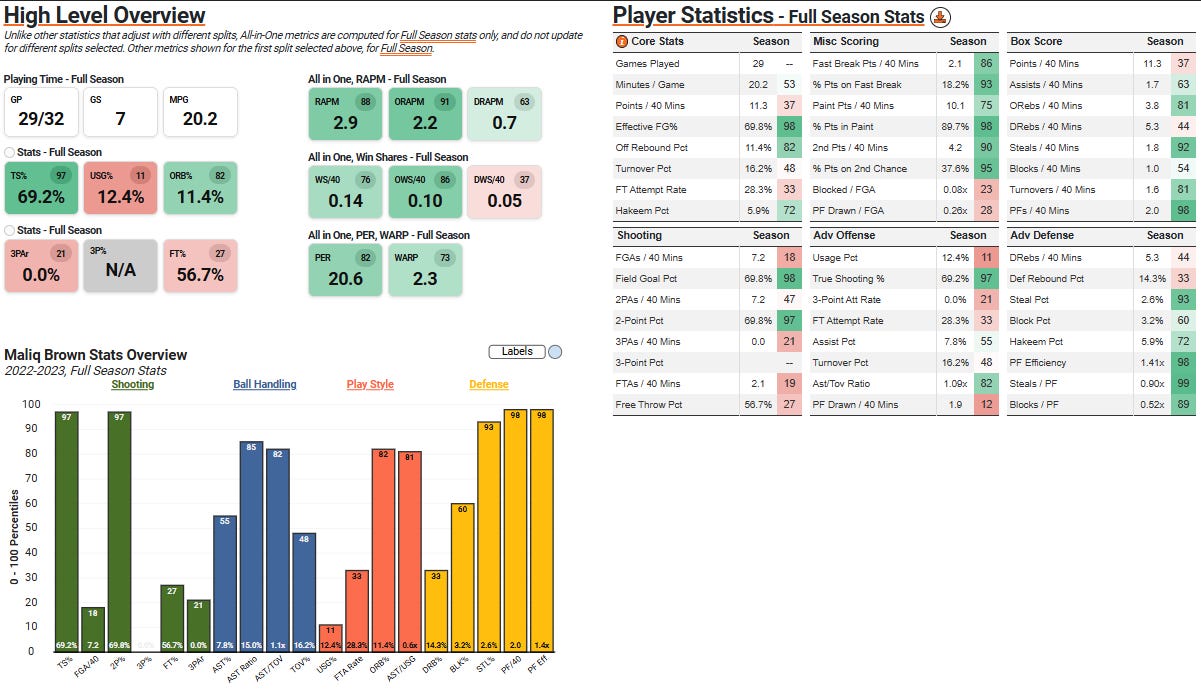
2022-2023 (Freshman Season)
Scoring Context By Year:
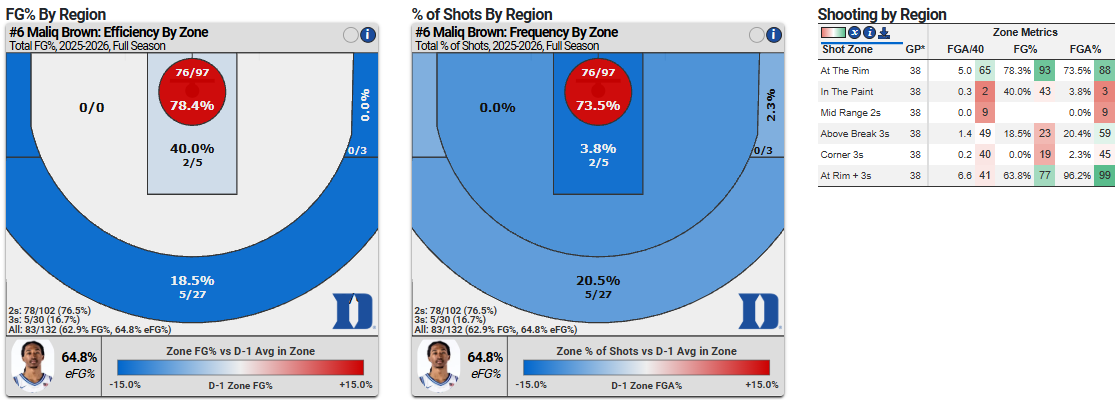
2025-2026 (Senior Season)
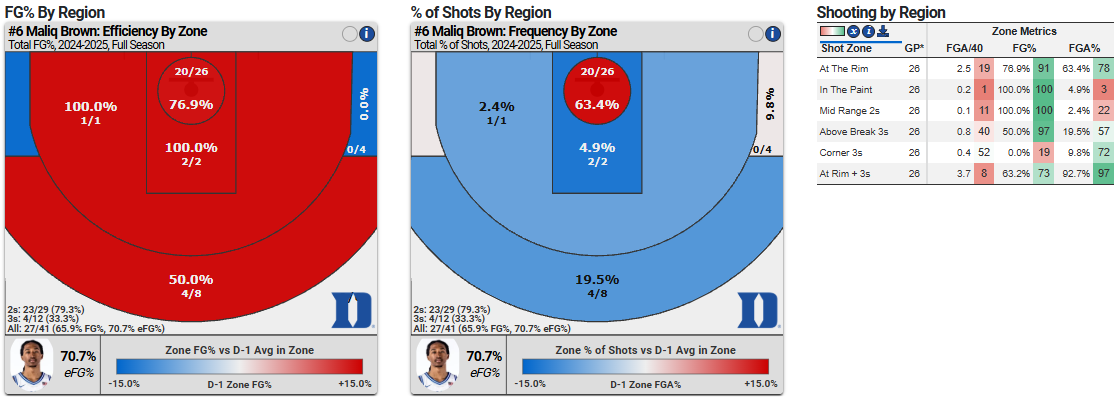
2024-2025 (Junior Season)
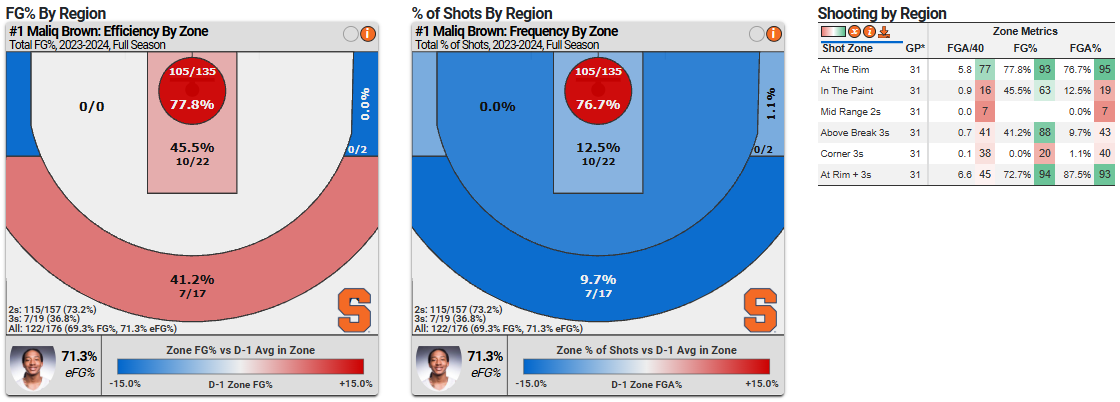
2023-2024 (Sophomore Season)
2022-2023 (Freshman Season)
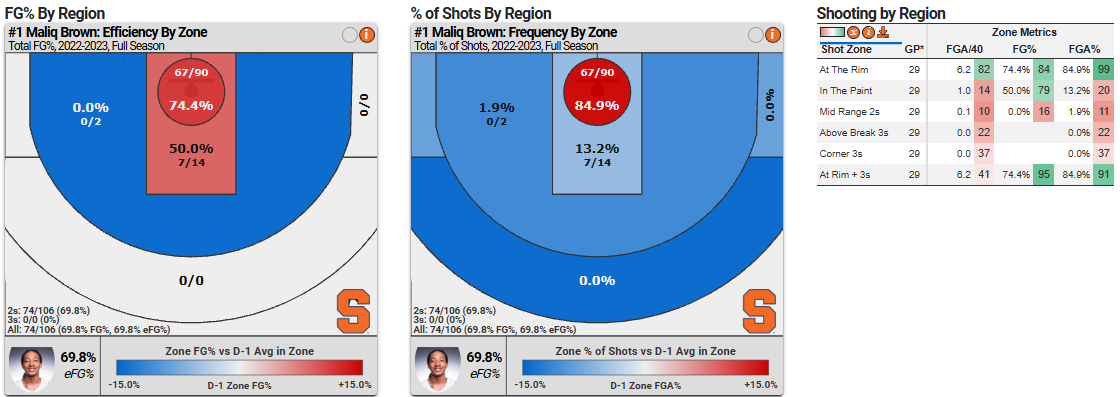
Key Note about Scoring Context: One of the most important contextual factors when evaluating Maliq Brown’s offensive profile is understanding that scoring was never the primary source of his value. Throughout four collegiate seasons at Syracuse and Duke, Brown functioned as a low-usage, highly efficient complementary piece whose offensive role revolved around finishing plays rather than creating them.
That reality remained remarkably consistent throughout his career.
Across all four seasons, Brown generated the overwhelming majority of his offense at the rim and in the paint. By his senior season at Duke, over 77 percent of his two-point attempts came directly at the basket, where he converted an elite 78.4 percent of his attempts. Very few forwards nationally matched that level of interior efficiency.
The shot distribution tells the story clearly.
Brown’s offensive profile was almost entirely concentrated around high-value opportunities. During his final season, roughly 74 percent of his total field-goal attempts came at the rim while another 20 percent came from three-point range. Virtually none of his offense originated from mid-range areas, pull-up jumpers, isolation scoring, or self-created perimeter offense.
His efficiency was driven by role acceptance and shot selection.
Unlike many forwards who attempt to expand into perimeter scoring roles, Brown consistently operated within his strengths. Cuts, transition finishes, offensive rebounds, dump-offs, slips to the rim, and opportunistic finishing opportunities accounted for most of his production. His 63.9 percent true shooting percentage and 76.5 percent two-point conversion rate were products of consistently taking high-percentage shots.
The year-over-year consistency is particularly impressive.
From Syracuse through Duke, Brown never posted a season below 74 percent finishing at the rim. His at-rim efficiency ranged between 74 and 78 percent across four consecutive seasons, demonstrating that his finishing success was not a one-year outlier but rather a sustainable skill tied to timing, positioning, touch, and decision-making.
However, the perimeter profile remained extremely limited.
Despite occasional attempts to expand his range, Brown never developed into a reliable floor-spacing threat. During his senior season he shot just 16.7 percent from three, and his overall three-point volume remained low throughout his collegiate career. Defenses consistently prioritized protecting the paint rather than respecting him as a perimeter shooter.
The lack of offensive diversity naturally creates some projection questions.
Brown generated very little offense from mid-range areas, almost no pull-up shooting, and limited self-created scoring opportunities overall. His offensive efficiency was heavily dependent on teammates creating advantages and placing him in positions to finish possessions rather than initiate them himself.
That context becomes important when projecting his NBA role.
Players who derive most of their offense from rim finishing often face a more difficult transition unless they possess elite vertical athleticism, high-level playmaking, or developing shooting ability. Brown’s offensive value is not built around individual scoring talent but rather around maximizing possessions through efficient finishing and intelligent off-ball movement.
Still, there is meaningful value in that archetype.
Modern NBA teams consistently seek role players who understand spacing, finish efficiently around the basket, avoid mistakes, and contribute without requiring touches. Brown’s offensive profile may never generate significant scoring volume, but his ability to convert elite percentages at the rim while maintaining low turnover rates gives him a functional offensive baseline.

(Provided by Cbbanalytics)
Video Reference
(Video Credit: ACC Digital Network)
(Video Credit: Duke Basketball)
NBA Projection & Player Comparisons
Projected Role: Versatile Defensive Minded Forward
Maliq Brown projects most cleanly as a versatile defensive-minded forward whose long-term professional value will be driven by defensive versatility, connective playmaking, basketball IQ, and low-maintenance offensive efficiency rather than scoring production. While his statistical profile lacks the offensive volume typically associated with NBA frontcourt prospects, Brown consistently impacted winning through defensive disruption, positional flexibility, and intelligent complementary play.
At 6-foot-9 with a strong frame and excellent mobility, Brown possesses many of the physical tools NBA teams covet in modern defensive role players. Throughout his collegiate career at Syracuse and Duke, he demonstrated the ability to defend multiple positions, switch across matchups, protect the rim as a help defender, and consistently create defensive events without sacrificing discipline.
The defensive metrics strongly support the projection.
Brown finished his senior season with a 5.4 percent steal rate, ranking in the 100th percentile nationally, while also posting a 3.9 percent block rate. Few forwards in college basketball generated steals and blocks at comparable levels. His combination of anticipation, active hands, rotational awareness, and timing consistently allowed him to impact possessions beyond traditional box-score production.
His overall defensive impact extended well beyond event creation.
Brown posted a 2.0 Defensive RAPM during his final season at Duke while contributing to one of the nation’s best defenses. Across multiple seasons and multiple programs, his defensive impact metrics remained consistently strong, suggesting his value translated regardless of scheme or supporting cast. He routinely disrupted passing lanes, rotated effectively as a help defender, and provided switchability that allowed defenses greater schematic flexibility.
The rebounding profile further reinforces his defensive utility.
Brown generated strong defensive rebounding numbers throughout his career, particularly during his final two seasons. While not an elite volume rebounder, he consistently secured possessions and finished defensive sequences without needing the ball to create value.
Offensively, Brown projects as a connective player rather than a scoring option.
His offensive contributions primarily came through rim finishing, screening, cutting, offensive rebounding, and keeping the ball moving within the flow of the offense. He posted elite finishing efficiency around the basket throughout his collegiate career while maintaining strong turnover rates and generally making sound decisions with the ball.
The offensive limitations are straightforward.
Brown offers very little perimeter shooting gravity, limited self-creation, and minimal scoring versatility outside the paint. He is unlikely to function as a floor spacer or offensive initiator at higher levels. His offensive value will largely depend on his ability to continue finishing efficiently, making quick reads, and complementing higher-usage offensive players.
Fortunately, his NBA pathway does not require significant scoring production.
Modern NBA teams consistently seek forwards who can defend multiple positions, switch actions, generate turnovers, protect the rim in help situations, and make winning plays without needing offensive touches. Brown already demonstrates many of those traits at a high level.
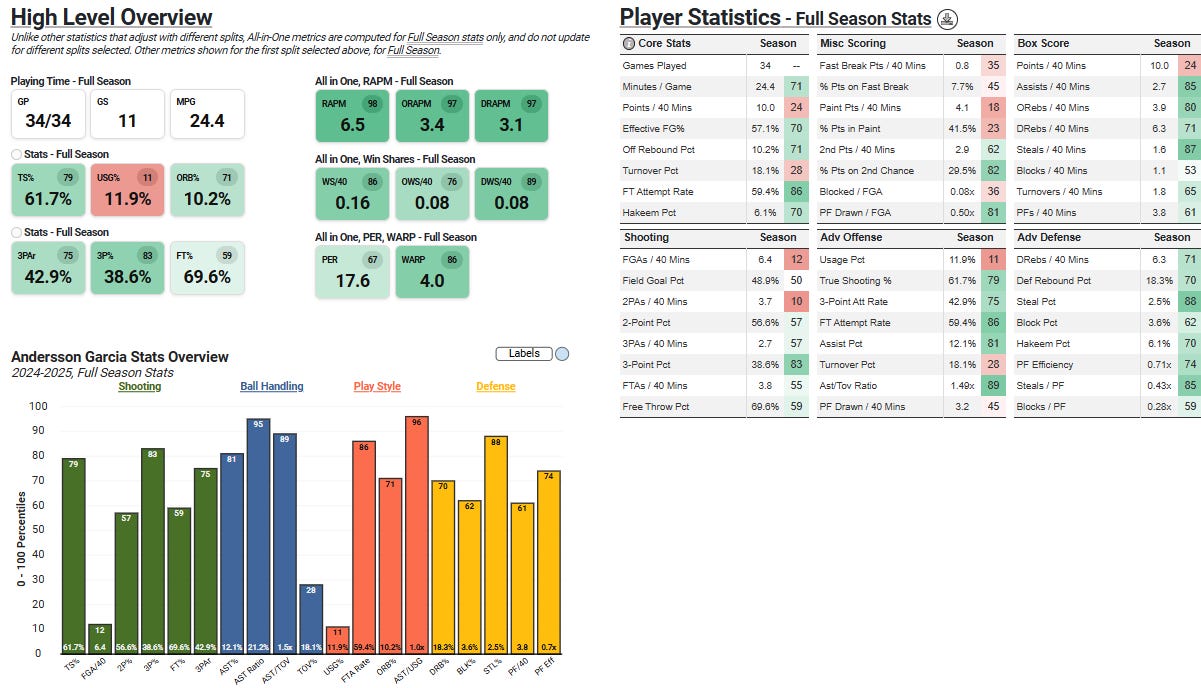
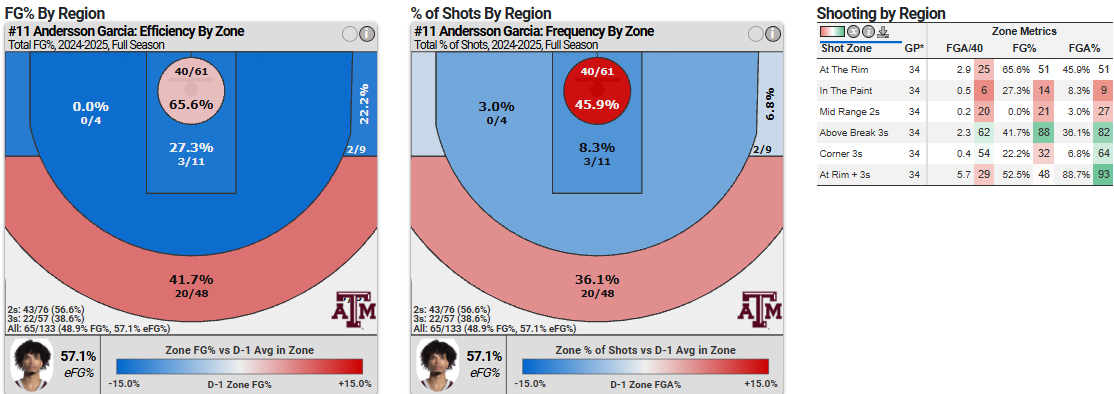
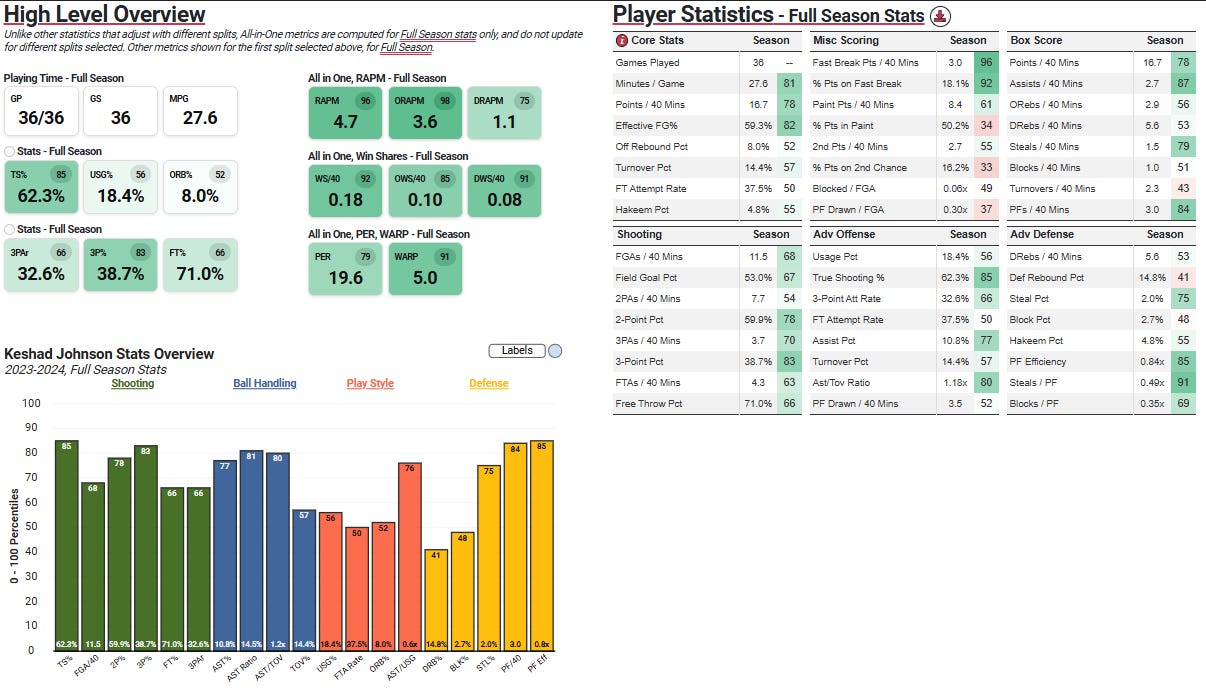
Projected Player Comparison (Stat Based):
Andersson Garcia
Keshad Johnson
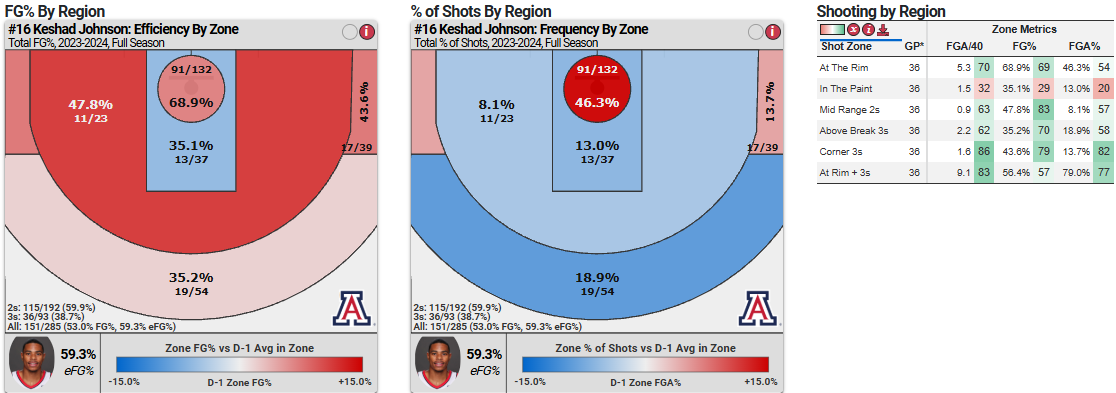
(Provided by Cbbanalytics)
Analysis:
Overall Impact: 12/25
Maliq Brown’s overall impact profile is significantly stronger than his raw scoring production would initially suggest. While traditional offensive statistics paint the picture of a low-usage complementary player, the advanced metrics consistently identify Brown as one of the more impactful role players in college basketball. His value is driven almost entirely by defense, versatility, rebounding, connective playmaking, and winning plays rather than scoring volume.
The first thing that stands out is how much his impact metrics outperform his box-score production.
Brown averaged just 9.8 points per 40 minutes, ranking in only the 23rd percentile nationally, and carried a very modest 12.8 percent usage rate. Normally players with that level of offensive involvement struggle to generate strong overall impact metrics. Brown was the exception. Despite limited offensive responsibility, he posted a 3.34 RAPM (88th percentile), 4.88 WARP (92nd percentile), and an outstanding +272 plus-minus mark that ranked in the 97th percentile nationally.
Those numbers suggest his influence on winning far exceeded his scoring output.
Defensively, Brown was one of the most productive impact players in the country.
His 1.99 Defensive RAPM ranked in the 89th percentile nationally while his Defensive Win Shares ranked in the 99th percentile. Few frontcourt players combined elite steal production, strong rebounding, rim protection, and defensive versatility at the level Brown demonstrated during his final season at Duke.
The defensive event generation is particularly impressive.
Brown averaged 3.53 steals per 40 minutes, ranking in the 100th percentile nationally, while also contributing 1.25 blocks per 40 minutes. Players capable of generating both steals and blocks at high rates often translate well defensively because they impact multiple layers of defensive possessions rather than relying on a single specialty.
The rebounding profile further reinforces the impact.
He averaged over 10 rebounds per 40 minutes while grading in the 80th percentile overall. Despite not possessing elite size for a modern center, Brown consistently created extra possessions through positioning, effort, anticipation, and physicality.
The playmaking impact also quietly exceeded expectations.
While Brown was not a primary creator, his 3.2 assists per 40 minutes ranked in the 93rd percentile. Combined with his defensive impact, that connective passing ability allowed him to positively influence possessions without requiring offensive touches.
The efficiency profile remains highly favorable as well.
Brown converted nearly 77 percent of his two-point attempts and posted a 63.9 percent true shooting percentage. Although the scoring volume was limited, he rarely wasted possessions and consistently converted the opportunities created within Duke’s offense.
However, the offensive limitations continue to cap the overall ceiling.
The lack of perimeter shooting remains a major concern. Brown converted just 16.7 percent from three while attempting very few perimeter shots overall. His offensive value is heavily concentrated around finishing, screening, passing, cutting, and offensive connectivity rather than spacing or shot creation.
The turnover and foul rates also create some volatility.
While his defensive aggressiveness generated elite disruption, it also led to elevated foul rates and only average turnover efficiency offensively. Refining those areas could help maximize his overall impact at the professional level.
Still, the advanced metrics overwhelmingly support the eye test.
Players rarely post top-tier defensive impact numbers, elite plus-minus results, strong RAPM metrics, and high-level win-share production by accident. Brown consistently improved team performance whenever he was on the floor despite carrying one of the lowest offensive usage rates among high-impact players.
Brown projects as the type of player whose value will likely be appreciated more by NBA front offices than traditional box-score evaluations. His combination of defensive versatility, disruptive playmaking, rebounding, connective passing, basketball IQ, and overall winning impact creates a strong foundation for professional contribution. While the offensive ceiling remains limited by the lack of shooting, the overall impact profile strongly supports his projection as a versatile defensive-minded forward capable of elevating lineups through defense, intelligence, and role-player excellence.
Scoring: 2/9
Maliq Brown’s scoring profile is one of the more limited offensive evaluations among NBA forward prospects, as nearly all of his production was generated through opportunistic interior finishing, offensive rebounding, cuts, transition leaks, and play-finishing rather than self-created offense. While the efficiency numbers are outstanding, the overall scoring package remains highly dependent on surrounding talent and offensive ecosystem.
The first thing that stands out is how little offensive volume Brown actually carried.
Despite playing over 20 minutes per game for Duke, Brown averaged just 9.8 points per 40 minutes, ranking in only the 23rd percentile nationally among forwards. His 12.8 percent usage rate ranked in the 16th percentile, reinforcing that he functioned almost exclusively as a complementary offensive piece rather than a featured scorer.
The efficiency itself was exceptional.
Brown converted 62.9 percent from the field overall, ranking in the 90th percentile nationally, while posting a 63.9 percent true shooting percentage and a 64.8 percent effective field goal percentage. Few frontcourt players matched that level of efficiency. However, nearly all of that efficiency originated from extremely favorable shot selection rather than diversified scoring ability.
The shot distribution tells the story.
Over 83 percent of Brown’s total scoring came in the paint, ranking in the 91st percentile nationally. He generated over 8.1 paint points per 40 minutes while converting an elite 76.5 percent of his two-point attempts, ranking in the 99th percentile nationally. Throughout his collegiate career, his offensive profile remained remarkably consistent: finish plays, cut hard, screen effectively, and capitalize on opportunities created by teammates.
The rim finishing is unquestionably an NBA-level strength.
Brown converted nearly 78 percent of his at-rim attempts during his senior season, continuing a trend that persisted throughout his four collegiate years. Whether at Syracuse or Duke, he consistently finished above 74 percent at the basket while generating almost all of his offense within ten feet of the rim. His hands, timing, athleticism, and ability to finish around defenders allowed him to thrive as a play finisher.
Second-chance scoring further boosted the production.
Brown generated nearly 2.6 second-chance points per 40 minutes while posting an elite 11.8 percent offensive rebounding rate. Much of his offense came from creating extra possessions, crashing the glass, and converting put-back opportunities. He consistently created value without requiring designed offensive touches.
However, the offensive limitations are substantial.
Brown attempted only 1.6 three-pointers per 40 minutes and converted just 16.7 percent from deep. His free throw percentage also sat at only 50 percent, both significant red flags for future shooting development. Across four collegiate seasons, there was little evidence of meaningful perimeter growth or shooting scalability.
The half-court scoring profile is extremely narrow.
More than 71 percent of his field-goal attempts came in half-court situations, but almost all of those opportunities were generated through cuts, dump-offs, rolls, and interior finishing rather than post creation or face-up scoring. Brown is not a player who creates offense through isolation play, ball handling, or shot-making versatility.
There is also very little scoring diversity outside the restricted area.
He attempted minimal midrange shots, generated almost no pull-up offense, and provided virtually no perimeter gravity. Defenses are unlikely to view him as a shooting threat, which places additional pressure on his screening, cutting, and play-finishing skills.
The efficiency profile is therefore somewhat deceptive from a projection standpoint.
While a 63.9 percent true shooting percentage is excellent, it is largely driven by elite shot selection and offensive role optimization. NBA defenses will naturally challenge him to score outside the paint far more frequently than college defenses did.
Still, Brown’s scoring does not necessarily need to be expansive to provide value.
Modern NBA teams continue to find rotational minutes for forwards who finish efficiently, screen effectively, create second-chance opportunities, and convert high-value interior attempts. Brown’s offensive value comes from maximizing possessions rather than generating them.
Self Creation: 1/9
Maliq Brown’s self-creation profile is extremely limited and represents one of the primary reasons his offensive projection remains role-dependent despite excellent overall efficiency. While Brown consistently finished plays at a high level and generated positive offensive value through cutting, screening, offensive rebounding, and interior finishing, very little of his scoring was self-generated in a traditional sense.
The unassisted scoring production immediately highlights the limitations.
Brown generated just 3.1 unassisted points per 40 minutes during the 2025-26 season, ranking in only the 14th percentile nationally among forwards. Despite posting strong overall efficiency, the majority of his offense came through opportunities created by teammates rather than his own shot creation.
The assisted-versus-unassisted distribution reinforces that role.
Nearly 75 percent of Brown’s made field goals were assisted, ranking in the 80th percentile nationally for assisted scoring dependency. That number is particularly notable because it demonstrates how heavily his offensive production relied on offensive structure, ball movement, and teammates generating advantages before he finished possessions.
Most of his self-created offense occurred near the basket.
Brown generated just under one unassisted at-rim field goal per 40 minutes, which graded around the 40th percentile nationally. While he occasionally attacked closeouts or finished after offensive rebounds, he was rarely asked to create offense from a standstill or generate scoring opportunities against set defenses.
The rim-finishing profile remains highly efficient.
Even with limited self-creation volume, Brown converted an elite percentage of his interior opportunities. He ranked in the 90th percentile in assisted at-rim field goals and consistently finished plays through cuts, rolls, dump-offs, and transition opportunities. His hands, timing, and ability to finish above the rim allowed him to maximize nearly every scoring opportunity available.
The dunk profile further illustrates his offensive role.
Brown generated nearly 1.9 assisted dunks per 40 minutes, ranking in the 95th percentile nationally. However, he produced only 0.16 unassisted dunks per 40 minutes. Most of his rim production came after teammates created advantages rather than through his own ability to beat defenders off the dribble or manufacture scoring chances.
The perimeter self-creation profile is virtually nonexistent.
Brown generated only 0.05 unassisted three-point field goals per 40 minutes while converting just 16.7 percent from beyond the arc overall. There is little evidence throughout his collegiate career that he can create perimeter offense, attack into pull-up jumpers, or force defenses to respect him outside the paint.
The foul-drawing numbers also remain modest.
Brown ranked near the bottom of national percentiles in self-created foul generation, producing only 0.73 shooting fouls drawn per 40 minutes. Unlike many frontcourt scorers who create value by forcing contact, Brown’s offense was far more dependent on efficient finishing than physical scoring pressure.
This becomes especially important when evaluating NBA scalability.
Modern forwards who lack perimeter shooting often offset those limitations through advanced post scoring, face-up creation, or downhill driving ability. Brown currently offers very little of those offensive counters. His scoring opportunities are largely dependent on offensive flow, screening actions, cuts, transition play, and offensive rebounding.
The offensive value therefore comes from connectivity rather than creation.
Brown is highly effective when functioning as a low-usage finisher who capitalizes on advantages generated by others. He understands spacing, moves intelligently without the ball, and consistently converts high-percentage opportunities. However, he is unlikely to be a player who creates offense late in possessions or carries meaningful scoring responsibility.
Playmaking: 4/9
Maliq Brown’s playmaking profile is quietly one of the more intriguing secondary aspects of his game and represents a meaningful part of his overall value proposition. While he is not a traditional offensive initiator, high-usage creator, or primary facilitator, Brown consistently demonstrated strong connective passing ability within the flow of the offense. His playmaking is built around decision-making, short-roll reads, interior passing, and keeping offensive possessions moving rather than creating advantages off the dribble.
The first thing that stands out is how much creation he generated relative to his offensive role.
Despite posting just a 12.8 percent usage rate, which ranked in only the 16th percentile nationally, Brown still produced 17.6 points created per 40 minutes. That figure graded around the 53rd percentile nationally and highlights that he contributed more offensive creation than his scoring profile alone would suggest.
His assist production was particularly impressive given his role.
Brown recorded 62 assists while accounting for nearly 10 percent of Duke’s total assists despite taking only six percent of the team’s field-goal attempts. That imbalance is notable because it illustrates a player who consistently facilitated offense without needing touches designed for him.
The interior passing profile is where his playmaking value becomes most apparent.
Brown generated 2.86 rim-and-three assists per 40 minutes, ranking in the 93rd percentile nationally. Modern NBA offenses place significant value on players who can create efficient shots at the rim and beyond the arc, and Brown consistently produced those outcomes despite limited offensive responsibility.
His at-rim passing numbers were especially strong.
Brown generated 1.46 assists per 40 minutes directly leading to finishes at the basket, ranking in the 94th percentile nationally. More importantly, nearly 45 percent of his total assists led directly to rim attempts. That level of interior creation is uncommon for a low-usage forward and speaks to his ability to make quick reads around the basket and out of short-roll situations.
The connective nature of his passing translates well to modern offensive systems.
Brown is not a player who pounds the ball or hunts assists. Instead, he consistently makes quick decisions, keeps possessions flowing, and finds cutters, rollers, and shooters when defenses collapse. His game is built around processing speed rather than advanced ball-handling creativity.
The turnover profile does create some concerns.
Despite limited offensive responsibility, Brown committed 45 turnovers while generating 62 assists. His turnover share ranked in just the 28th percentile nationally, suggesting that while he sees the floor well, his execution can occasionally become inconsistent when asked to make more ambitious reads.
The playmaking ceiling remains somewhat limited by role.
Brown rarely initiates offense from the perimeter, creates advantages off the dribble, or functions as a primary facilitator. Much of his passing value comes after advantages have already been created rather than through his own offensive gravity.
The shooting limitations also impact his overall creation upside.
Because defenders do not need to respect him as a perimeter scorer, Brown is unlikely to force the type of defensive rotations that generate high-volume assist opportunities. His passing is valuable, but it functions more as a complementary skill than a primary offensive weapon.
Still, there is meaningful NBA utility in his playmaking profile.
Modern teams increasingly value frontcourt players who can facilitate from the elbows, make short-roll reads, connect actions, and keep offenses flowing without disrupting spacing. Brown consistently demonstrated those traits throughout his collegiate career, particularly during his time at Duke.
Shooting: 1/9
Shooting projects as the weakest area of Maliq Brown’s offensive profile and remains the single largest obstacle to his long-term NBA scalability. While Brown was an extremely efficient scorer overall, virtually all of that efficiency came around the basket. There is very little evidence throughout his collegiate career that he can consistently stretch the floor or force defenses to respect him away from the paint.
The overall efficiency numbers initially appear encouraging.
Brown converted 62.9 percent from the field, ranking in the 90th percentile nationally, while posting a 64.8 percent effective field-goal percentage and a 63.9 percent true shooting percentage. However, those numbers are heavily influenced by elite interior finishing rather than shooting versatility.
The shot distribution is among the most specialized in the class.
An astonishing 96.2 percent of Brown’s total field-goal attempts came either at the rim or from three-point range, ranking in the 99th percentile nationally. While that would typically be viewed positively in modern shot-profile evaluation, almost all of those attempts occurred at the rim rather than from behind the arc.
The interior efficiency is exceptional.
Brown attempted nearly 74 percent of his shots directly at the basket and converted 78.4 percent of those opportunities, ranking in the 93rd percentile nationally. His two-point percentage of 76.5 percent ranked in the 99th percentile nationally, while his average two-point attempt came just 2.3 feet from the basket, also ranking among the most rim-oriented profiles in college basketball.
The finishing consistency was remarkable regardless of game context.
Brown converted over 81 percent of his at-rim attempts early in possessions, nearly 77 percent in standard half-court situations, and over 83 percent late in the shot clock. Those numbers reinforce that his touch, timing, and finishing ability around the basket are legitimate strengths rather than products of a specific offensive environment.
Unfortunately, the perimeter profile tells a completely different story.
Brown converted just 16.7 percent from three-point range during his senior season while attempting only 1.6 threes per 40 minutes. Both the volume and efficiency rank near the bottom of NBA-caliber forward prospects. Defenses consistently ignored him on the perimeter and prioritized protecting the paint.
The lack of shooting extends beyond the three-point line.
Brown attempted virtually no midrange jumpers throughout the season, providing almost no evidence of a developing face-up scoring package. His offensive profile lacks the intermediate shooting counters that often help non-shooting forwards survive against NBA defensive spacing.
The free-throw numbers create additional concern.
Historically, free-throw percentage often serves as one of the strongest indicators of future shooting growth. Brown converted only 50 percent from the free-throw line, ranking in the 16th percentile nationally. Combined with the poor three-point percentages, there is little statistical evidence suggesting major perimeter shooting upside.
This limitation directly impacts his NBA projection.
Modern NBA offenses increasingly prioritize frontcourt players who can either stretch the floor or create advantages with the ball. Brown currently does neither at a high level offensively. Because defenders are unlikely to respect him outside the paint, he will need to provide significant value through defense, passing, screening, and finishing to remain playable in certain lineup constructions.
The encouraging aspect is that his role does not necessarily require high-volume shooting.
Brown’s offensive value is built around screening, cutting, offensive rebounding, connective passing, and finishing. Many successful defensive-minded forwards have carved out NBA roles without becoming floor spacers. However, even modest shooting development would dramatically improve his offensive scalability.
Ultimately, Brown’s shooting profile remains a significant weakness. While he is one of the most efficient interior finishers in the class, there is almost no evidence of perimeter shooting value at this stage of his development. The elite finishing provides an offensive foundation, but until the jumper becomes at least respectable, defenses will continue treating him as a non-shooter and limiting the overall offensive ceiling of the profile.
Defensive Attribution: 9/10
Defense is the foundation of Maliq Brown’s NBA projection and easily the strongest component of his overall profile. While his offensive game remains highly role-dependent, Brown consistently demonstrated elite defensive impact throughout his collegiate career, combining versatility, anticipation, activity, and positional intelligence into one of the most disruptive defensive resumes in college basketball.
The statistical production is exceptional.
Brown posted a remarkable 5.37 percent steal rate, ranking in the 100th percentile nationally among forwards. That number is almost unheard of for a player standing 6-foot-9 and immediately places him among the most disruptive defenders in the country. His ability to generate turnovers through anticipation, active hands, passing-lane awareness, and rotational instincts consistently changed possessions.
The steal production is particularly impressive when viewed through a positional lens.
Most forwards generate defensive value through rebounding or rim protection. Brown generated elite value through perimeter disruption while still maintaining frontcourt defensive responsibilities. His 1.51 steals per turnover ratio ranked in the 97th percentile nationally, reinforcing that he consistently created more defensive possessions than offensive mistakes.
The overall havoc profile further supports the eye test.
Brown posted a 9.24 percent havoc rate, ranking in the 91st percentile nationally. Few players impacted games in as many different defensive ways. Whether generating steals, deflections, blocks, loose balls, or transition opportunities, Brown consistently found methods of disrupting offensive rhythm.
His versatility remains arguably his most valuable trait.
At 6-foot-9 with strong mobility and defensive instincts, Brown routinely defended guards, wings, and frontcourt players throughout his collegiate career. He comfortably switched actions, navigated ball-screen coverages, rotated as a help defender, and functioned within multiple defensive schemes. Modern NBA defenses increasingly prioritize players who can survive across multiple positions, and Brown consistently demonstrated those capabilities.
The rim protection is quietly stronger than many realize.
While not an elite shot blocker by traditional standards, Brown posted a 3.88 percent block rate, grading in the 65th percentile nationally. Combined with his elite steal production, he becomes one of the rare forwards capable of generating defensive events both on the perimeter and around the basket.
The rebounding profile is also solid.
Brown generated a 17.3 percent defensive rebounding rate, ranking in the 67th percentile nationally. While not a dominant rebounder, he consistently finished possessions and prevented second-chance opportunities without sacrificing his aggressive defensive activity elsewhere.
The advanced foul metrics require some context.
Brown committed 5.35 fouls per 40 minutes, which ranks poorly compared to most NBA prospects. However, much of that foul volume stems directly from the hyper-aggressive defensive style that also produced elite steal rates and defensive events. Importantly, his steal-to-foul ratio ranked in the 97th percentile nationally, suggesting the aggression often generated more positive outcomes than negative ones.
There are still some areas for refinement.
Against NBA athletes, Brown will need to improve discipline and avoid unnecessary reach-ins or overaggressive gambles that may be punished more consistently at the professional level. His foul rate is one of the few blemishes on an otherwise outstanding defensive profile.
The overall defensive archetype remains highly valuable.
Modern NBA teams constantly search for forwards who can switch, rotate, generate turnovers, protect space, and impact multiple layers of the defense without requiring offensive touches. Brown checks virtually every box associated with that role.
Off-Ball Offense: 3/9
Off-ball offense represents a functional but limited portion of Maliq Brown’s overall offensive profile. While he consistently created value through cutting, screening, offensive rebounding, and opportunistic finishing, he does not provide many of the off-ball scoring traits that typically generate significant offensive gravity at the NBA level. His effectiveness comes more from efficiency and activity than from spacing or shot-making.
The strongest aspect of Brown’s off-ball game is his cutting and interior movement.
Throughout his career at Syracuse and Duke, Brown consistently found ways to create scoring opportunities without the ball. His elite finishing efficiency was often the result of well-timed cuts, slips to the rim, baseline movement, and intelligent positioning around the basket. He understands how to exploit defensive lapses and consistently puts himself in position to finish plays.
The rim-running value is also notable.
Brown runs the floor well for a forward and frequently generated easy baskets in transition or early offense situations. While he was not a major transition scorer by volume, his willingness to sprint into offensive actions created additional opportunities for both himself and teammates.
His screening provides indirect offensive value.
Brown consistently creates advantages through screen setting, particularly in pick-and-roll and dribble handoff actions. While those contributions do not always appear in traditional box scores, they are an important component of his offensive functionality and help create space for primary creators.
The offensive rebounding profile adds another layer.
Nearly 27 percent of his scoring came from second-chance opportunities, ranking in the 77th percentile nationally. Brown’s activity around the basket allows him to generate offense without designed touches, a valuable trait for low-usage role players.
However, the lack of shooting gravity significantly limits his off-ball ceiling.
Defenders are generally comfortable helping off Brown because he offers very little threat as a perimeter shooter. He converted just 16.7 percent from three and 50 percent from the free-throw line, allowing defenses to prioritize protecting the paint rather than staying attached to him away from the ball.
Unlike elite off-ball forwards, Brown does not consistently stretch defensive structures.
Players who generate high-level off-ball value often force defensive attention through movement shooting, relocation, or perimeter gravity. Brown’s off-ball offense is almost entirely concentrated inside the arc, making him easier for defenses to account for within half-court settings.
The lack of scoring diversity further narrows the profile.
Brown generates very little offense through spot-up shooting, off-screen actions, or perimeter movement. Most of his off-ball production comes through cuts, offensive rebounds, and opportunistic interior finishing rather than scalable perimeter skills.
That becomes particularly important at the NBA level.
Because defenders are unlikely to respect him away from the basket, Brown’s off-ball value will depend heavily on his ability to continue generating efficient interior opportunities through effort, timing, and basketball IQ rather than offensive gravity.
Still, there is meaningful utility in his archetype.
Modern teams value players who screen well, cut hard, finish efficiently, and create extra possessions without requiring touches. Brown consistently demonstrated those traits throughout his collegiate career and provides a baseline level of offensive functionality despite the shooting limitations.
Post (Scoring/Playmaking): 6/9
While Maliq Brown is not a traditional low-post scorer, the post area is actually one of the more functional offensive environments within his overall profile. Much of his offensive value comes from the same skills that modern NBA teams increasingly seek from frontcourt connectors: interior passing, short-roll decision-making, quick processing, and efficient finishing around the basket.
The playmaking component is what elevates this category.
Brown generated 62 assists despite carrying only a 12.8 percent usage rate, an impressive combination for a defense-first forward. More importantly, he produced 2.86 rim-and-three assists per 40 minutes, ranking in the 93rd percentile nationally. A significant percentage of those opportunities originated from interior touches, short-roll situations, and frontcourt facilitation rather than traditional perimeter creation.
His ability to facilitate from the interior stands out.
Brown generated 1.46 assists per 40 minutes directly leading to rim finishes, ranking in the 94th percentile nationally. Nearly 89 percent of his assists created either shots at the rim or three-point attempts, which are the two most valuable outcomes in modern offensive basketball. That level of efficiency reflects a player who understands spacing, timing, and where offensive advantages are most likely to occur.
The short-roll projection is particularly intriguing.
When defenses rotated toward primary creators, Brown consistently demonstrated the ability to catch, process, and deliver quick reads to cutters and shooters. While he is not a high-volume offensive hub, his decision-making allows him to function as a connective frontcourt passer capable of keeping possessions moving.
As a scorer, the profile remains more limited but still effective.
Brown converted 76.5 percent of his two-point attempts and nearly 78 percent of his at-rim opportunities. Much of that production came from interior catches, seals, duck-ins, and opportunistic finishes around the basket. He consistently capitalized on mismatches and defensive rotations when opportunities presented themselves.
The touch around the basket is a legitimate strength.
Brown’s finishing efficiency remained elite throughout all four collegiate seasons, suggesting that his success was driven by skill, timing, and shot selection rather than variance. He consistently finished through traffic and displayed good hands around the rim.
However, he is not a traditional back-to-the-basket scorer.
Brown rarely generated offense through advanced footwork, post counters, turnaround jumpers, or isolation post possessions. Most of his interior scoring came from movement, positioning, and play-finishing rather than deliberate post creation. He is much more comfortable operating as a connector than as a player expected to manufacture offense on the block.
The lack of shooting also impacts post scalability.
Because defenders do not respect him as a perimeter threat, NBA defenses may be more willing to collapse around interior touches. Without a reliable face-up jumper, some of the scoring opportunities he generated in college could become more difficult against professional size and athleticism.
Still, the overall interior offensive skill set remains valuable.
Modern NBA offenses increasingly prioritize frontcourt players who can facilitate from the elbows, make quick short-roll reads, finish efficiently around the basket, and create advantages without dominating possessions. Brown consistently demonstrated many of those traits throughout his career.
Intangibles/Eye Test: 7/11
Maliq Brown’s intangibles profile is one of the strongest aspects of his overall evaluation and plays a major role in why he remains such an intriguing NBA prospect despite offensive limitations. While he lacks the scoring upside of many frontcourt prospects, Brown consistently impacts winning through effort, intelligence, defensive instincts, unselfishness, and role acceptance. The eye test often reveals a player whose influence extends beyond what traditional statistics fully capture.
The first thing that stands out is his understanding of role.
Throughout his career at both Syracuse and Duke, Brown consistently embraced doing the difficult, often unglamorous work required to help winning teams succeed. He never forced offensive responsibility outside of his skill set and instead focused on maximizing possessions through defense, rebounding, screening, cutting, and connective passing. Players with that level of role awareness often transition more smoothly into professional environments.
The basketball IQ is evident on both ends of the floor.
Brown consistently demonstrates advanced anticipation defensively, regularly arriving at rotations early, disrupting passing lanes, and reading offensive actions before they fully develop. Offensively, he makes quick decisions, rarely stalls possessions, and understands how to play within offensive structure. His game is built around processing speed rather than physical dominance.
The defensive motor is a legitimate strength.
Few players in college basketball consistently played with Brown’s level of activity. His elite steal rates, strong help-side rotations, and ability to impact possessions in multiple ways all stem from relentless effort and engagement. Even when not directly involved in the action, he remains active and attentive throughout possessions.
His willingness to sacrifice individual production for team success is particularly noteworthy.
Brown’s offensive numbers never fully reflect his value because much of his contribution comes through screening, defensive communication, rotations, and creating advantages for teammates. He consistently accepted a lower-usage offensive role while focusing on winning plays rather than individual statistics.
The versatility and adaptability also stand out.
Brown successfully transitioned from Syracuse to Duke and immediately fit within a dramatically different system. That ability to adjust roles, responsibilities, and schemes speaks positively to both his coachability and overall basketball intelligence.
The competitiveness consistently shows up on film.
Whether defending guards on switches, battling larger players inside, or chasing loose balls, Brown regularly plays with a level of physical commitment that NBA teams value. His energy level rarely fluctuates and he consistently competes regardless of offensive involvement.
However, there are still limitations within the overall eye-test profile.
Brown’s offensive confidence can occasionally appear somewhat passive. Because he understands his limitations as a scorer, there are stretches where he becomes almost exclusively focused on facilitating and defending rather than looking to create offense. While role acceptance is generally positive, there are times when additional offensive aggression would benefit his overall impact.
The foul rate also reflects some of the aggressiveness.
His defensive activity occasionally borders on overaggression, leading to unnecessary fouls or risky gambles. While those same instincts generate elite defensive events, refining the balance between disruption and discipline will be important against NBA competition.
There are also questions regarding offensive scalability.
Because Brown lacks perimeter shooting and self-creation ability, much of his long-term value depends on the elite defensive instincts, effort, and connective skills continuing to separate him from similarly limited offensive players. Fortunately, the intangibles profile suggests he possesses many of the traits necessary to maximize that pathway.
Complete Evaluation: 45/100
 | A guest post by
|