


Height: 6’7” Weight: 225Lbs Team: Northwestern Class: Senior
Age at Draft: 22.18 Height (Barefoot): 6’6.5 Weight: 223.6 Lbs Wingspan: 82” (+3.5) Standing Reach: 104.5”
Scouting Snapshot
Nick Martinelli projects as a high-usage scoring forward whose professional value will be driven by offensive versatility, shot-making, efficiency, and self-creation rather than defensive impact or overwhelming physical tools. After steadily expanding his role throughout four seasons at Northwestern, Martinelli emerged as one of the most productive offensive players in college basketball, evolving from a complementary rotation piece into the focal point of the Wildcats’ offense.
At 6-foot-7, Martinelli does not possess elite NBA athleticism or exceptional length, but he compensates with advanced scoring instincts, physicality, footwork, touch, and a highly polished offensive skill set. His game is built around creating advantages in the half court, scoring from multiple levels, drawing fouls, and carrying a significant offensive workload without sacrificing efficiency.
The offensive production is among the strongest in the class.
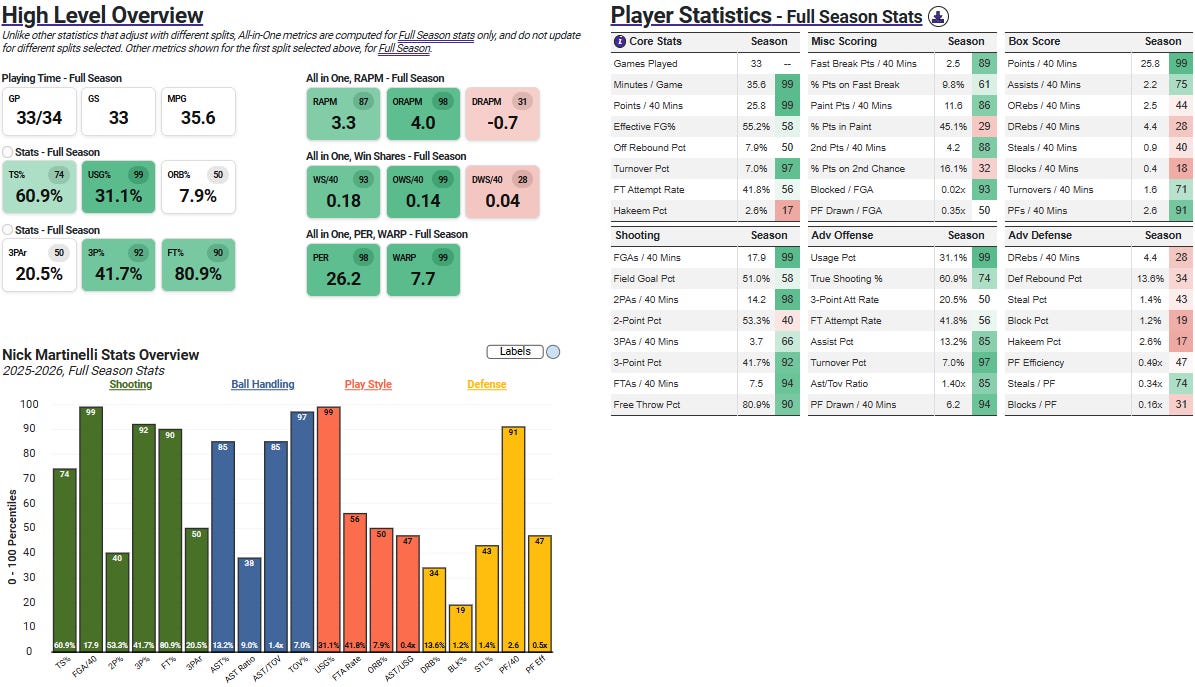
Martinelli averaged 25.8 points per 40 minutes during his senior season while posting a 31.1 percent usage rate, ranking in the 99th percentile nationally. Despite carrying one of the largest offensive burdens in college basketball, he maintained a 60.9 percent true shooting percentage while shooting 41.7 percent from three and 80.9 percent from the free-throw line. Few players combined volume and efficiency at a similar level.
The scoring profile shows substantial growth throughout his career.
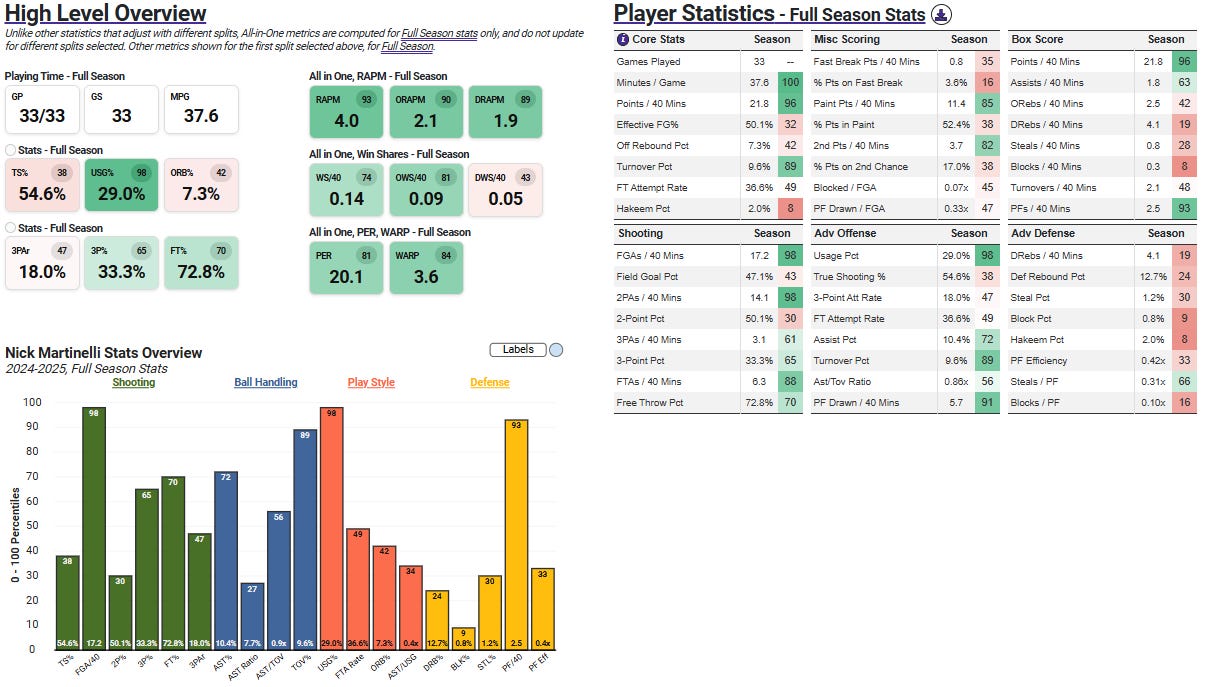
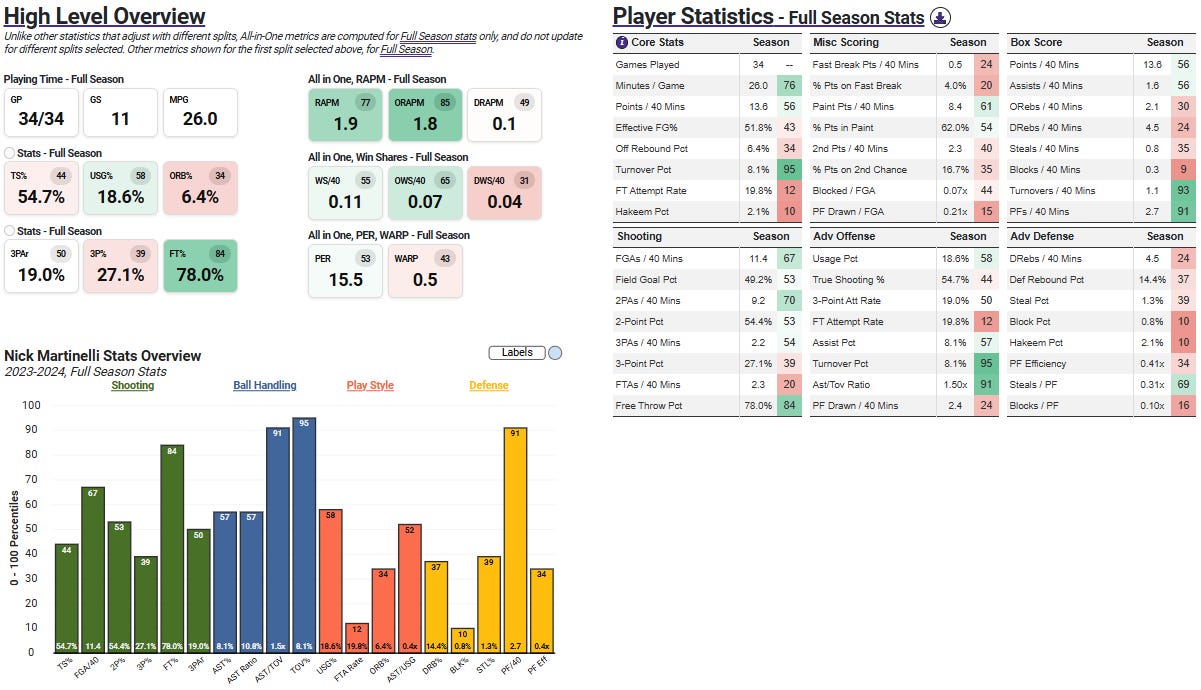
As a freshman, Martinelli was a reserve contributor averaging just 10.3 points per 40 minutes. By his sophomore and junior seasons, he had developed into a reliable rotation scorer, producing 13.6 and 21.8 points per 40 minutes respectively. His senior campaign represented a complete offensive breakout, culminating in one of the most productive scoring seasons in the Big Ten.
His shot-making versatility stands out.
Martinelli can score from the perimeter, attack closeouts, finish through contact, operate in the mid-post, and create offense in isolation situations. His 41.7 percent three-point shooting forces defenses to respect him beyond the arc, while his physicality allows him to punish smaller defenders inside. Unlike many volume scorers, his efficiency remained strong despite commanding significant defensive attention.
The advanced offensive metrics reinforce the eye test.
Martinelli posted a 4.0 Offensive RAPM, ranking in the 98th percentile nationally, while generating 0.14 Offensive Win Shares per 40 minutes and a 26.2 PER, both elite marks. His offensive impact was not simply a product of shot volume. Northwestern’s offense consistently relied upon his ability to create difficult baskets and stabilize possessions late in the shot clock.
The playmaking is functional rather than dynamic.
While not a primary facilitator, Martinelli averaged 4.2 assists per 40 minutes and demonstrated the ability to make basic reads when defenses collapsed. His assist production improved substantially throughout his collegiate career, allowing him to operate as more than simply a scoring specialist. However, his offensive value remains overwhelmingly tied to scoring rather than creation for others.
Defensively, the projection becomes more complicated.
Martinelli posted a negative Defensive RAPM during his senior season despite respectable effort and physicality. He lacks elite lateral quickness, vertical explosiveness, and defensive event creation, producing modest steal and block rates throughout his career. While he competes and generally understands positioning, his defensive ceiling appears considerably lower than his offensive ceiling.
The career impact metrics provide important context.
Despite defensive concerns, Martinelli consistently improved his overall impact profile each season. His RAPM increased from -1.5 as a freshman to 6.1 as a senior. His WARP climbed from replacement-level territory to an elite 7.7 during his final season. Those improvements reflect both offensive growth and an increasing ability to carry winning responsibility within Northwestern’s system.
The archetype is relatively clear.
Martinelli projects as an offense-first forward whose pathway to professional success will depend on whether his scoring efficiency translates against higher levels of athleticism and length. Teams will be evaluating his ability to function as a secondary scoring option, floor spacer, and offensive connector rather than a primary creator.
From an NBA perspective, Martinelli profiles most naturally as a skilled rotational forward capable of providing scoring punch, floor spacing, and offensive versatility. While the defensive limitations likely cap his overall upside, his combination of shot-making, efficiency, physicality, and year-over-year development gives him a realistic pathway toward professional minutes. Few players in college basketball improved more dramatically over the course of their careers, and his senior season demonstrated that high-level offensive production can still drive meaningful winning impact even without elite physical tools.
Statistical Overview By Year:
2025-2026 (Senior Season)
2024-2025 (Junior Season)
2023-2024 (Sophomore Season)
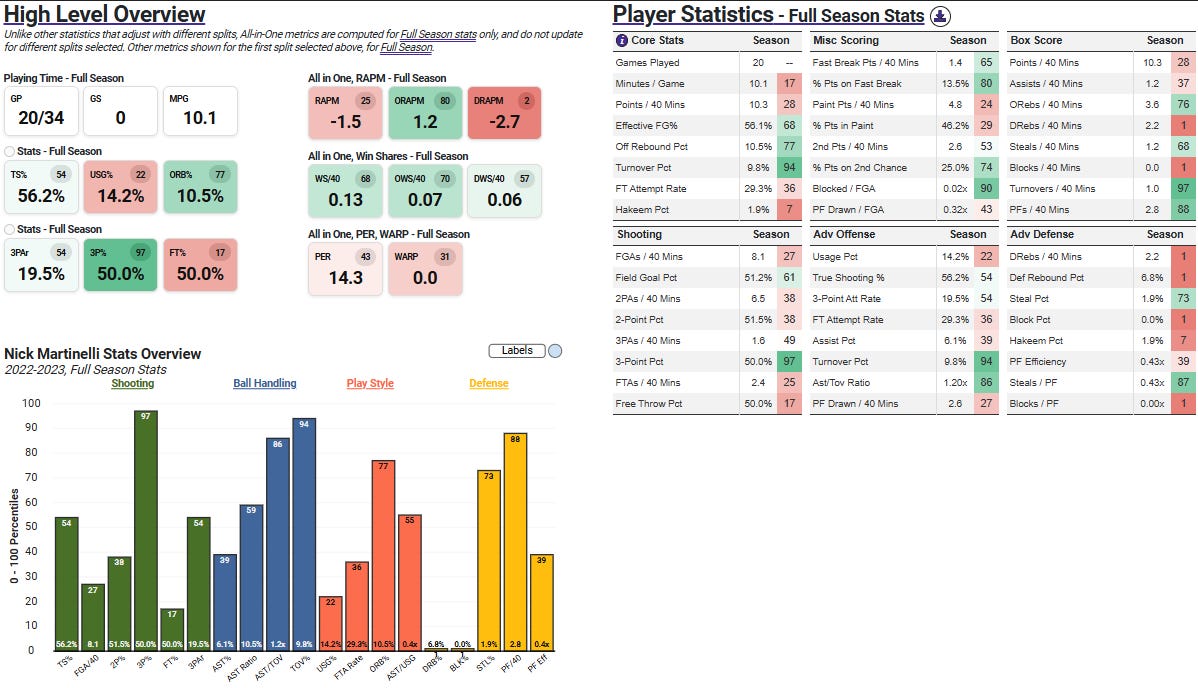
2022-2023 (Freshman Season)
Scoring Context By Year:
2025-2026 (Senior Season)
2024-2025 (Junior Season)
2023-2024 (Sophomore Season)
2022-2023 (Freshman Season)
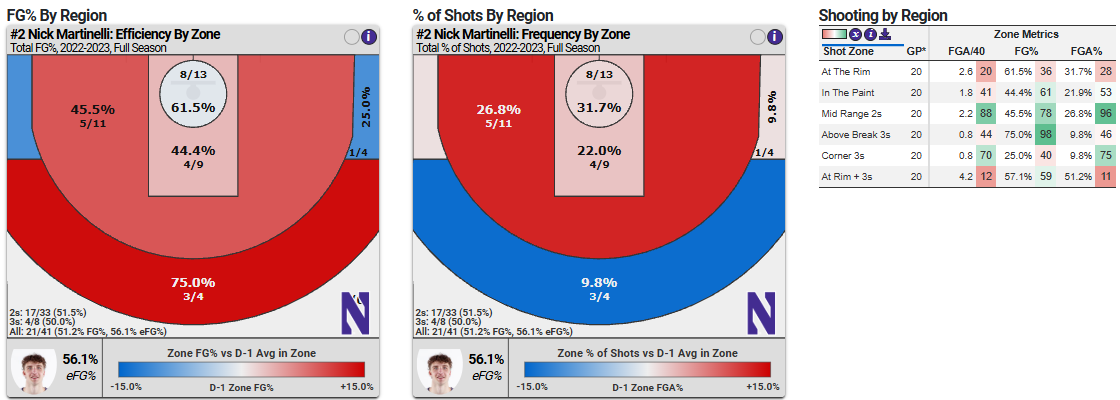
Key Note about Scoring Context: One of the more important contextual factors when evaluating Nick Martinelli’s offensive profile is understanding how dramatically his role evolved throughout his four seasons at Northwestern. Unlike many high-volume collegiate scorers who arrive on campus as featured options, Martinelli steadily climbed from reserve contributor to one of the highest-usage offensive players in college basketball.
The offensive responsibility expanded every season.
As a freshman, Martinelli played a limited role, averaging just 10.3 points per 40 minutes with a 14.2 percent usage rate. By his sophomore season, his scoring climbed to 13.6 points per 40 while his usage increased to 18.6 percent. His junior season marked the beginning of his offensive emergence, producing 21.8 points per 40 minutes on a 29.0 percent usage rate. By his senior year, he had become the centerpiece of Northwestern’s offense, averaging 25.8 points per 40 minutes while carrying a massive 31.1 percent usage rate that ranked among the highest in Division I basketball.
What makes the progression particularly impressive is that the efficiency improved alongside the increased volume.
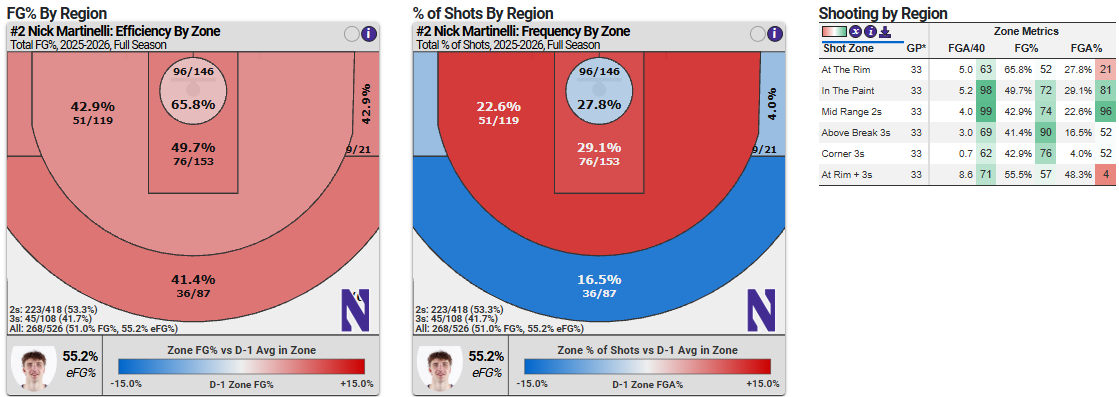
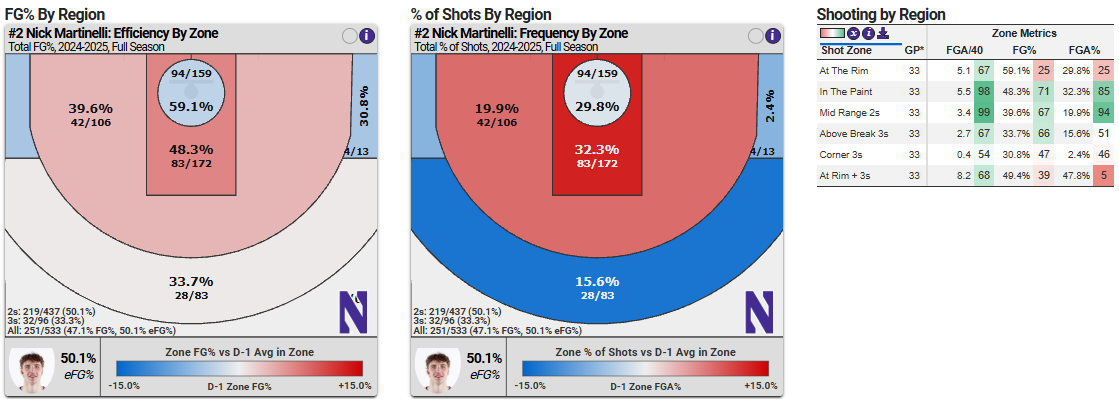
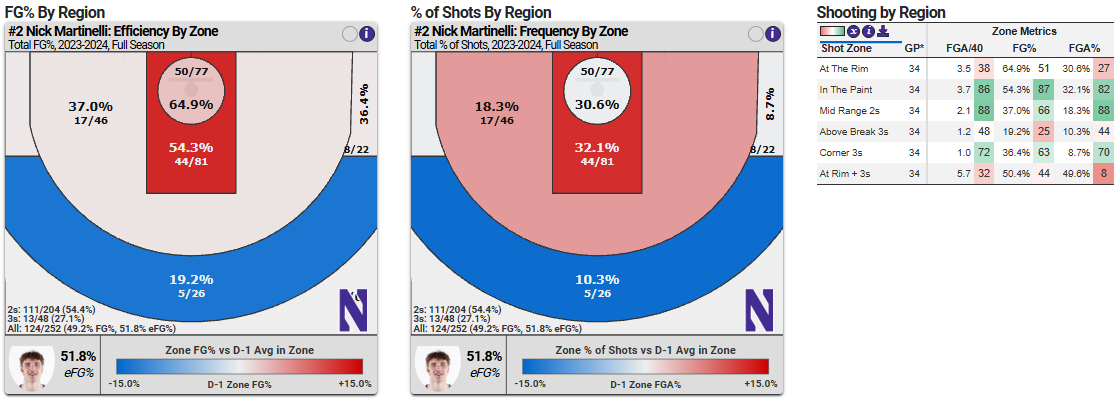
Martinelli posted a 56.1 percent eFG as a freshman, 51.8 percent as a sophomore, 50.1 percent as a junior, and ultimately elevated to 55.2 percent during his senior campaign despite facing significantly greater defensive attention. His true shooting percentage climbed to 60.9 percent while maintaining one of the nation’s largest offensive workloads.
The shot profile reveals a player who became increasingly versatile as his role expanded.
Early in his career, Martinelli relied heavily on interior scoring opportunities and opportunistic offense. By his junior and senior seasons, he developed into a legitimate three-level scorer. His at-rim volume increased from 2.6 attempts per 40 minutes as a freshman to over 5.0 attempts per 40 during his final two seasons, while his perimeter volume expanded significantly as well. During his senior season, he attempted nearly 7.0 three-pointers per 40 minutes while converting 41.7 percent from beyond the arc.
Perhaps most encouraging is how sustainable much of the scoring profile appears.
Martinelli was not dependent upon difficult shot-making alone. He generated offense from a variety of sources including post-ups, transition opportunities, spot-up shooting, straight-line drives, and mid-post isolations. His shot distribution remained balanced throughout his upperclassman seasons, with meaningful scoring production coming from the rim, paint, mid-range, and perimeter.
The free-throw development also supports the offensive growth.
His free-throw percentage improved from 50 percent as a freshman to over 80 percent as a senior. Historically, that type of progression often serves as one of the strongest indicators of genuine shooting development rather than a single-season outlier.
The scoring profile does carry some projection concerns.
While Martinelli became one of the most productive scorers in college basketball, much of his offensive value was generated through physicality, craft, footwork, and shot-making rather than elite burst or overwhelming athletic advantages. NBA evaluators will need to determine how much of his scoring efficiency can translate against longer, faster, and more athletic defenders.
However, the overall developmental trajectory is difficult to ignore.
Few players in college basketball improved their offensive profile more consistently over a four-year span. Martinelli transformed from a low-usage reserve into a high-volume offensive engine while maintaining efficiency and expanding his scoring versatility each season. The combination of improved perimeter shooting, increased offensive responsibility, strong efficiency, and sustained production against Big Ten competition provides significant confidence that his offensive value is real.
That consistency reinforces the broader projection.
Martinelli is not being evaluated as a role-playing specialist whose value is tied to a narrow offensive function. He is being evaluated as an offense-first forward capable of carrying substantial scoring responsibility, spacing the floor, creating mismatches, and generating efficient offense across multiple shot zones. While questions remain regarding defensive scalability and overall athletic upside, his offensive development across four collegiate seasons provides a strong foundation for professional evaluation and suggests a player whose scoring profile may translate better than traditional archetype assumptions would indicate.

(Provided by Cbbanalytics)
Video Reference
(Video Credit: Big Ten Men’s Basketball)
(Video Credit: Charlotte Hornets)
NBA Projection & Player Comparisons
Projected Role: Offensive First Forward
One of the clearest conclusions from Nick Martinelli’s collegiate profile is that his pathway to professional basketball is driven primarily by offensive value. Unlike traditional role-playing forwards who derive most of their impact through defense, rebounding, or specialist functions, Martinelli consistently demonstrated the ability to carry substantial scoring responsibility while serving as the focal point of Northwestern’s offense.
His offensive growth throughout four seasons was remarkable.
Martinelli progressed from a low-usage reserve as a freshman to one of the highest-volume offensive players in college basketball as a senior. His usage rate climbed from 14.2 percent during his first season to 31.1 percent in 2025-26, while his scoring production increased from 10.3 points per 40 minutes to 25.8 points per 40 minutes. More importantly, the efficiency remained strong despite the dramatic increase in workload, culminating in a 60.9 percent true shooting percentage during his senior campaign.
The scoring profile is significantly more versatile than traditional volume scorers.
Martinelli proved capable of generating offense from multiple areas of the floor. During his senior season, he converted 65.8 percent of his rim attempts, 49.7 percent of his paint attempts, 42.9 percent of his mid-range attempts, and 41.7 percent of his three-point attempts. Few forwards in college basketball demonstrated that level of scoring diversity while carrying such a large offensive burden.
His role was not limited to scoring.
Martinelli also developed into an effective offensive facilitator. He posted 4.3 assists per 40 minutes during his senior season, ranking in the 98th percentile nationally, while generating 111 assists overall. His passing numbers were particularly impressive given the degree of defensive attention he faced as Northwestern’s primary offensive option. While he is not a primary creator in the traditional sense, he consistently made reads out of drives, post touches, and offensive actions designed around his scoring gravity.
The advanced impact metrics reinforce the offensive projection.
Martinelli produced a 4.0 Offensive RAPM during his senior season, ranking in the 98th percentile nationally. Across his final three seasons, he maintained elite offensive impact numbers while consistently ranking among the nation’s leaders in usage, scoring volume, and offensive responsibility. His 7.7 WARP, 26.2 PER, and 0.18 Win Shares per 40 all reflect a player whose offensive contributions directly translated to winning.
The defensive profile remains the primary area of concern.
While Martinelli improved as a team defender and rebounder throughout his career, his overall defensive impact remained inconsistent relative to his offensive production. His senior season DRAPM of -0.7 contrasts sharply with the elite offensive metrics and highlights why his projection is largely centered on offensive value. He competes, rebounds adequately, and generally understands team concepts, but he is unlikely to derive significant professional value as a defensive stopper or positional versatility piece.
Athletic limitations also create some projection questions.
Martinelli wins with skill, touch, footwork, physicality, and feel rather than elite explosiveness or high-end vertical athleticism. At the professional level, the lack of elite physical tools may reduce some of the scoring advantages he enjoyed in college. Evaluators will need to determine whether his offensive versatility and shooting development can compensate for average athletic traits against NBA-level defenders.
The encouraging aspect is that his offensive skill set continued to expand every season.
His three-point percentage improved from 27.1 percent as a sophomore to 41.7 percent as a senior. His scoring volume nearly doubled over that span while his playmaking responsibilities increased substantially. Few players in college basketball displayed a more consistent year-over-year offensive progression.
Ultimately, Martinelli projects most naturally as an offensive-first forward whose value is tied to scoring versatility, floor spacing, secondary playmaking, and offensive efficiency. He may never become a high-level defensive contributor, but his ability to generate offense from multiple levels, operate within high-usage environments, and consistently improve throughout his collegiate career gives him a realistic pathway toward carving out a professional role as a scoring-oriented rotational forward.
Projected Player Comparison (Stat Based):
Eric Dixon
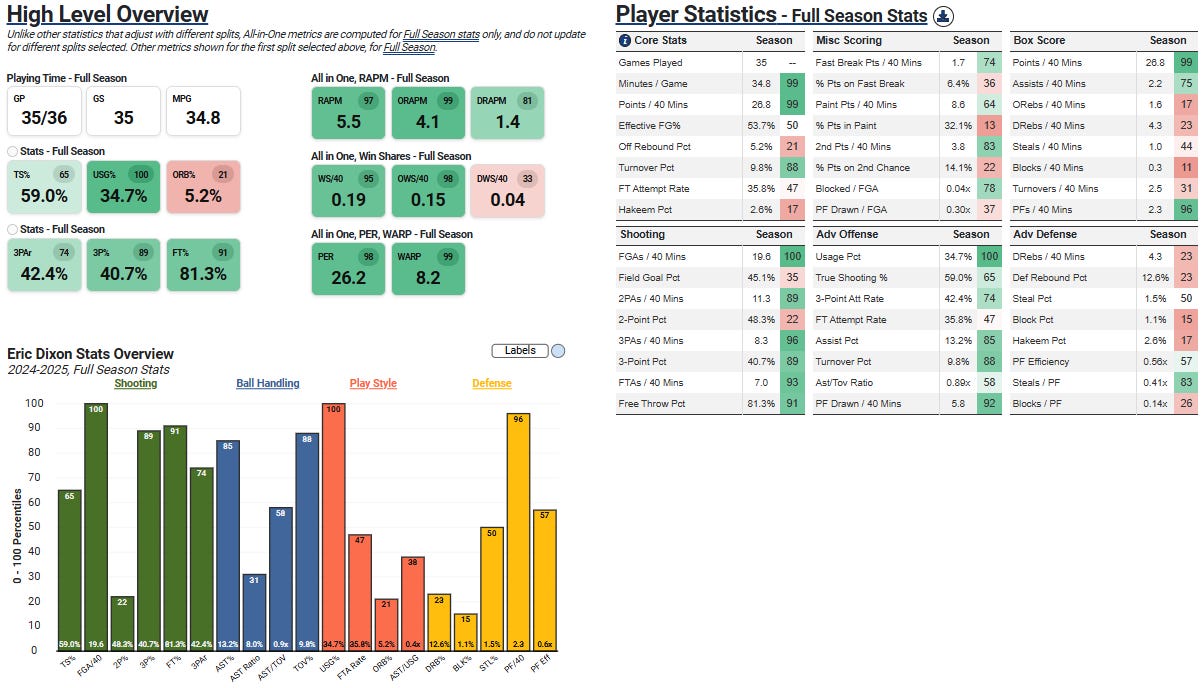
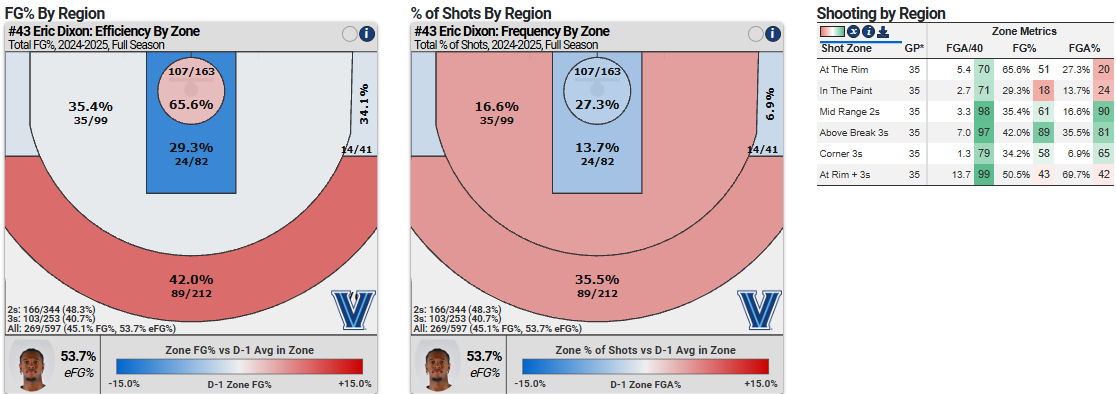
(Provided by Cbbanalytics)
Analysis:
Overall Impact: 16/25
Martinelli’s overall impact profile presents one of the more interesting evaluations among upperclassmen in this class. On one hand, the statistical production is undeniably impressive. Few players in college basketball combined his scoring volume, shooting efficiency, offensive responsibility, and winning production. On the other hand, the defensive limitations, positional questions, and reliance on offensive value create a profile that is somewhat narrower than the raw numbers initially suggest.
The offensive production is elite.
Martinelli averaged 25.8 points per 40 minutes, ranking in the 99th percentile nationally, while shooting 41.7 percent from three and maintaining a 60.9 percent true shooting percentage despite carrying a massive 31.1 percent usage rate. Very few players in the country were asked to shoulder a larger offensive burden while remaining as efficient. His ability to function as a primary scoring option was the driving force behind Northwestern’s offense throughout the season.
The advanced metrics remain highly favorable.
Martinelli posted a 4.0 Offensive RAPM, ranking in the 98th percentile nationally, illustrating just how much offensive value he generated when on the floor. His overall 3.3 RAPM ranked in the 87th percentile despite a negative Defensive RAPM, reinforcing that much of his impact was concentrated on the offensive end of the floor. The offensive engine component of his profile is very real.
The winning metrics further support the evaluation.
He produced 7.7 WARP, ranking in the 99th percentile nationally, along with 5.0 Offensive Win Shares and a 0.18 Win Shares per 40 minutes mark that ranked in the 93rd percentile. Those metrics consistently identify players who positively influence team success, and Martinelli’s production compares favorably with many of the most productive forwards in college basketball.
The scoring translated directly into team offense.
His combination of three-level scoring, foul generation, offensive rebounding, and secondary playmaking allowed him to create value in a variety of ways. Whether operating in isolation, attacking mismatches, spacing the floor, or creating second-chance opportunities, Martinelli consistently found avenues to generate offense.
However, the overall profile becomes more complicated once defensive impact is incorporated.
While the offensive metrics were outstanding, the defensive metrics remained below average throughout much of his career. His rebounding numbers were modest for a forward, his defensive playmaking was limited, and his overall defensive RAPM fell into negative territory during his senior season. As a result, much of his total value becomes dependent upon maintaining a high level of offensive production.
The career arc provides useful context.
Martinelli’s overall RAPM improved from -1.5 as a freshman to 1.9 as a sophomore, 4.0 as a junior, and 3.3 as a senior. Similarly, his WARP climbed from essentially replacement level early in his career to 7.7 during his final season. The trajectory reflects a player who steadily developed into one of the premier offensive forwards in the country while expanding his role each year.
One important contextual factor is Northwestern’s supporting cast during his senior season.
While Martinelli posted some of the best offensive numbers of his career, the overall team environment was not as strong as some of the Northwestern teams from previous seasons. The Wildcats lacked the depth, offensive balance, and overall talent that surrounded him during earlier stages of his career. As a result, certain impact metrics, particularly plus-minus based evaluations, may slightly understate his individual performance. His raw plus-minus ranked only in the 60th percentile despite elite offensive production, a figure that likely reflects team context as much as individual value.
That distinction is important because Martinelli was frequently asked to create offense in difficult situations without the benefit of multiple high-level creators around him. Defenses were able to load up against him more aggressively, yet his efficiency and production largely held steady. Had Northwestern possessed a stronger supporting cast, it is reasonable to believe some of his on-court impact metrics would have appeared even more favorable.
The professional projection ultimately comes down to role translation.
Martinelli possesses the offensive production, shooting ability, and advanced metrics that suggest a player capable of contributing offensively at higher levels. However, the defensive concerns, positional questions, and average athletic profile limit the overall ceiling compared to more complete two-way prospects. At 6-foot-7, he occupies somewhat of a tweener role, creating additional uncertainty regarding where he fits defensively at the professional level.
Scoring: 7/9
Martinelli’s offensive production was one of the most impressive scoring profiles in college basketball during the 2025-26 season. While he may not possess elite NBA athleticism, the combination of volume, efficiency, versatility, and shot-making allowed him to emerge as one of the nation’s premier offensive forwards. His scoring profile reflects a player capable of carrying a significant offensive burden while maintaining strong efficiency across multiple play types.
The volume alone stands out.
Martinelli scored 759 points while averaging 25.8 points per 40 minutes and carrying a 31.1 percent usage rate. Northwestern’s offense frequently flowed through him, whether operating from the perimeter, attacking mismatches, posting smaller defenders, or serving as the primary late-clock scoring option. Few forwards in the country were asked to shoulder a larger offensive workload.
The interior scoring production was particularly impressive.
He generated 11.6 paint points per 40 minutes, ranking in the 86th percentile nationally. Despite developing into a dangerous perimeter shooter, Martinelli continued to pressure defenses inside, scoring nearly 45 percent of his total points in the paint. His combination of strength, footwork, body control, and touch allowed him to consistently create efficient scoring opportunities around the basket.
The transition game added another layer to his offensive value.
Martinelli produced 2.5 fast-break points per 40 minutes while converting over 70 percent of his transition two-point attempts. Although he is not an explosive open-floor athlete, he runs hard, fills lanes effectively, and consistently creates scoring opportunities by beating opposing forwards down the floor.
Second-chance scoring also became a meaningful part of his production.
He generated 4.15 second-chance points per 40 minutes, ranking in the 88th percentile nationally. His offensive rebounding instincts, physicality, and motor allowed him to create additional possessions and convert them efficiently. Those extra opportunities frequently helped offset periods when Northwestern’s offense stalled in the half court.
The half-court scoring profile is what ultimately elevates the evaluation.
Martinelli converted 50.5 percent of his two-point attempts and an outstanding 42.7 percent of his half-court three-point attempts. More than 82 percent of his field-goal attempts came in half-court settings, highlighting that his production was not dependent upon transition opportunities or easy baskets. He consistently generated offense against set defenses, which is one of the most translatable indicators for professional scoring prospects.
His ability to draw contact further strengthened the profile.
Martinelli drew 3.23 shooting fouls per 40 minutes, ranking in the 94th percentile nationally, while also generating elite floor-foul numbers. He consistently leveraged strength, balance, and physicality to force defenders into difficult situations. While he is not an elite vertical athlete, he understands how to use angles and body positioning to create contact and earn trips to the free-throw line.
What makes the scoring profile particularly intriguing is the versatility.
Unlike many collegiate forwards who rely heavily on one offensive avenue, Martinelli can score from the post, mid-post, perimeter, transition, offensive rebounds, and straight-line drives. Defenses cannot simply remove one area of his game and expect to neutralize his offensive impact. His scoring toolkit expanded significantly throughout his collegiate career and culminated in one of the most complete offensive seasons among high-major forwards.
The primary concern revolves around athletic translation.
Many of Martinelli’s scoring advantages were created through strength, craft, footwork, and shot-making rather than elite burst or separation ability. NBA defenders will be bigger, longer, and more athletic, which may limit some of the isolation and mismatch opportunities he enjoyed at Northwestern.
Even with those concerns, the overall production is difficult to dismiss.
Self Creation: 4/9
While Martinelli projects primarily as an offensive-forward rather than a pure shot creator, his self-creation numbers reveal considerably more on-ball scoring ability than many players at his position. Unlike traditional play-finishing forwards who rely heavily on teammates to generate offense, Martinelli demonstrated the ability to create his own scoring opportunities both inside and outside the arc while carrying one of the largest offensive workloads in the country.
The raw self-creation production is extremely strong.
Martinelli generated 336 unassisted points, averaging 11.4 unassisted points per 40 minutes, which ranked in the 92nd percentile nationally. That figure is particularly impressive when viewed alongside his elite scoring volume and usage rate. Northwestern frequently relied on him to manufacture offense late in possessions, attack mismatches, and generate quality looks when offensive structure broke down.
His ability to create two-point offense stands out most.
Martinelli produced 2.48 unassisted two-point field goals per 40 minutes, ranking in the 75th percentile nationally. Much of this production came through post-ups, face-up attacks, straight-line drives, and physical finishes around the basket. He consistently leveraged strength, balance, and footwork to create separation rather than relying on elite burst or athleticism.
The rim-finishing profile further supports the evaluation.
He generated 1.26 unassisted makes at the rim per 40 minutes, ranking above average nationally. For a player without elite vertical explosiveness, this reflects a strong ability to create angles, absorb contact, and finish through traffic. Martinelli frequently used patience and body control to create scoring opportunities in crowded areas.
The scoring versatility is perhaps the most encouraging aspect.
While over 71 percent of his made field goals were assisted overall, that figure can be somewhat misleading. High-volume scorers often benefit from assisted opportunities generated through offensive gravity, movement, and actions designed around them. Martinelli simultaneously ranked in the 99th percentile in assisted field goals per 40 minutes while still generating strong unassisted scoring numbers. This combination suggests a player who can function both on and off the ball.
His perimeter self-creation remains more limited.
Only 0.14 unassisted three-pointers per 40 minutes were converted during the season, reflecting that most of his perimeter production came through spot-up opportunities, relocation shooting, and offensive actions created within the flow of Northwestern’s offense. While he became a highly effective three-point shooter, he was not consistently generating difficult pull-up threes or creating significant separation off the dribble.
The athletic limitations do place some constraints on the projection.
Martinelli wins through skill, timing, footwork, strength, and shot-making rather than elite quickness. Against NBA athletes, some of the self-created opportunities he generated in college may become more difficult to access. He is unlikely to profile as a primary isolation scorer or offensive engine at the professional level.
However, the overall self-creation profile remains stronger than many offensive forwards entering the draft process.
The ability to generate over 11 unassisted points per 40 minutes while maintaining efficiency and carrying a massive offensive workload speaks to legitimate scoring instincts and offensive polish. Martinelli may not possess the dynamic creation package of a primary wing initiator, but he consistently demonstrated the ability to create quality offense for himself when defenses focused their attention on him.
Playmaking: 5/9
While Martinelli’s primary value comes from scoring, his playmaking profile is considerably stronger than many offensive forwards who carry comparable scoring burdens. He is not a traditional offensive initiator or primary point-forward, but he consistently demonstrated the ability to create opportunities for teammates while operating as the focal point of Northwestern’s offense.
The offensive responsibility was enormous.
Martinelli posted a 31.1 percent usage rate, ranking in the 99th percentile nationally, while accounting for 28.2 percent of Northwestern’s field-goal attempts and 34.1 percent of the team’s free-throw attempts. Players carrying that type of offensive workload often see their passing efficiency suffer, yet Martinelli remained a productive facilitator throughout the season.
The raw passing production is encouraging.
He recorded 66 assists while generating 31.2 points created per 40 minutes, ranking in the 98th percentile nationally. His assist totals are particularly impressive when viewed alongside his scoring volume, as defenses frequently prioritized stopping him first. Rather than functioning solely as a scorer, he regularly made the correct read when help defenders committed.
Much of his playmaking originated from scoring gravity.
Defenses often sent additional attention toward Martinelli in the post, on drives, and in isolation situations. His ability to recognize rotations allowed him to create quality opportunities for teammates. He generated 159 points directly from assists and produced 1.84 rim-and-three assists per 40 minutes, reflecting an understanding of where the most efficient shots are created.
The distribution profile reflects a balanced offensive connector.
Approximately 59 percent of his assists led to two-point baskets, while 41 percent created three-point opportunities. That balance suggests he was not simply dumping the ball off to bigs around the rim, but was actively creating perimeter opportunities for shooters as well. His ability to generate both interior and perimeter assists adds versatility to his offensive profile.
His passing from scoring actions stands out.
Martinelli generated 27 assists at the rim and another 27 assists leading directly to three-point baskets. Those numbers indicate a player capable of making reads after drawing defensive attention rather than merely moving the ball within offensive flow. He consistently punished defenses that overcommitted to his scoring.
The turnover profile provides additional context.
Despite his massive offensive role, Martinelli accounted for only 16.7 percent of Northwestern’s turnovers, ranking in just the 8th percentile for turnover share relative to usage. For a player carrying one of the nation’s largest offensive burdens, that reflects strong decision-making and ball security. He generally played under control and rarely forced high-risk passes.
There are limitations that prevent a higher playmaking grade.
While productive, Martinelli is not a primary creator in the mold of a point-forward or offensive hub. Most of his assists are generated as secondary reads rather than advanced manipulation of defenses. He lacks the elite handle, burst, and passing creativity typically associated with high-level initiators. At the professional level, he is unlikely to be asked to organize offenses or consistently create advantages from the perimeter.
However, the playmaking value is still meaningful.
Martinelli projects as the type of offensive forward who can keep the ball moving, punish help defenders, make reads from the post, and generate efficient offense for teammates when defenses collapse. Combined with his scoring gravity, that passing ability increases his offensive versatility and raises his overall floor as a professional prospect.
Shooting: 7/9
Shooting is one of the most important swing skills in Martinelli’s professional projection, and his senior season provided substantial evidence that he has evolved into a legitimate perimeter threat while maintaining the interior scoring versatility that has always been central to his game. Although he is not a pure movement shooter or high-volume floor spacer, the combination of three-level scoring, efficiency, and shot-making versatility creates a far more complete shooting profile than many forwards entering the professional ranks.
The perimeter efficiency immediately stands out.
Martinelli converted 41.7 percent of his three-point attempts during his senior season, ranking in the 91st percentile nationally. More impressively, he shot 41.4 percent on above-the-break threes and 42.9 percent on corner threes, demonstrating that his shooting success was not dependent on a single shot location. Defenses were forced to respect him anywhere along the perimeter.
The shot distribution reflects genuine three-level scoring ability.
Unlike many modern forwards who heavily prioritize either rim attempts or three-pointers, Martinelli operated comfortably throughout the entire floor. Roughly 28 percent of his attempts came at the rim, 29 percent came in the paint, 23 percent originated from the mid-range, and approximately 21 percent came from beyond the arc. Few collegiate forwards maintained that level of offensive balance while carrying such a significant scoring burden.
The mid-range production is particularly noteworthy.
Martinelli attempted nearly a quarter of his shots from mid-range while converting 42.9 percent, ranking in the 74th percentile nationally. While mid-range efficiency is often viewed skeptically in modern analytics, the ability to generate and convert difficult shots remains valuable for forwards who project as secondary scoring options. His comfort operating from the elbows and short corners frequently allowed Northwestern to create offense late in possessions.
His touch around the basket remains strong as well.
Martinelli converted 65.8 percent of his at-rim attempts while also shooting nearly 50 percent on non-rim paint attempts. That combination reflects a player who can score both through physical finishes and through touch-based interior scoring. He is not solely dependent on athleticism near the basket and has developed a variety of finishing counters.
The shooting versatility becomes even more impressive when considering the offensive workload.
Martinelli carried one of the highest usage rates in college basketball while still maintaining strong efficiency from multiple levels. Defenses consistently geared their game plans toward stopping him, yet he continued to convert difficult perimeter shots and self-created scoring opportunities throughout the season.
The shot-clock data provides additional context.
Martinelli remained effective throughout possessions, converting nearly 79 percent of his at-rim attempts late in the shot clock while maintaining respectable efficiency across all phases of offensive possessions. His ability to generate quality offense when possessions became stagnant was a major reason Northwestern relied on him so heavily.
There are still limitations that prevent an elite shooting grade.
While the percentages are excellent, Martinelli is not a high-volume specialist shooter in the mold of elite NBA floor spacers. Only about 21 percent of his total shot attempts came from beyond the arc, and much of his offensive value remains tied to his broader scoring package rather than pure shooting gravity. Additionally, many of his perimeter attempts came within structured offensive actions rather than advanced off-the-dribble shot creation.
At the NBA level, Martinelli may face greater difficulty creating separation for jump shots against longer and more athletic defenders. Some of the contested mid-range opportunities that fell consistently in college may become lower-efficiency looks professionally.
Still, the overall shooting profile remains highly encouraging.
The combination of 41.7 percent three-point shooting, strong mid-range efficiency, reliable interior touch, and genuine three-level scoring versatility provides a strong foundation for offensive translation. Martinelli may never be viewed as a pure shooting specialist, but he has developed into a legitimate perimeter threat whose scoring package forces defenses to account for him at multiple levels.
Defensive Attribution: 2/10
Defense is clearly the weakest area of Martinelli’s overall evaluation and represents the primary obstacle between his highly productive collegiate profile and a seamless professional projection. While his offensive impact consistently ranked among the best in the country, the defensive metrics and film evaluation paint a far less encouraging picture. Martinelli competes and generally understands team concepts, but he lacks the defensive playmaking, physical tools, and disruptive presence that typically elevate forwards into positive two-way contributors.
The defensive event production is modest.
Martinelli posted a 1.4 percent steal rate and a 1.2 percent block rate, both of which ranked below average nationally for his position. He generated just 26 steals and 12 blocks across the season despite playing over 1,175 minutes. Those numbers suggest a player who rarely creates extra possessions through defensive playmaking and does not consistently alter offensive actions with length or athleticism.
The rebounding profile is similarly underwhelming relative to his size.
Despite standing 6-foot-7 and playing significant frontcourt minutes, Martinelli posted only a 13.6 percent defensive rebounding rate, ranking in the 34th percentile nationally. While he is capable of securing rebounds within his area, he is not an impact rebounder who consistently erases possessions or dominates the glass.
The lack of defensive versatility shows up statistically.
Unlike many modern forwards who generate value through steals, blocks, rotations, and switchability, Martinelli’s defensive profile is largely absent of standout indicators. His Hakeem Percentage ranked in just the 17th percentile nationally, reflecting limited combined steal and block production relative to minutes played. Simply put, there are very few defensive metrics that suggest high-level disruption.
The physical profile contributes to some of these concerns.
Martinelli wins offensively through skill, touch, footwork, and strength rather than elite athleticism. That same reality creates challenges defensively. He does not possess exceptional lateral quickness, vertical explosiveness, or recovery speed, which can make defending quicker wings and more explosive forwards difficult. Against high-level athletes, he occasionally struggles to contain penetration or recover after defensive breakdowns.
To his credit, he generally plays under control.
Martinelli committed only 2.6 fouls per 40 minutes, ranking in the 91st percentile nationally for foul avoidance. He rarely puts himself in foul trouble and generally understands positional responsibilities. His defensive issues are more often tied to physical limitations than poor effort or lack of awareness.
The foul-drawing differential provides some positive context.
He drew over 6.2 fouls per 40 minutes while committing just 2.6 himself, creating a substantial positive foul margin. While not directly a defensive skill, it highlights his ability to avoid costly mistakes while simultaneously creating advantages offensively.
The concern is that many of his defensive metrics remained modest despite carrying a relatively stable role throughout the season.
Unlike some offensive stars who sacrifice defensive production because of overwhelming offensive workloads, Martinelli’s defensive limitations appear more structural than situational. The lack of event creation, modest rebounding numbers, and average physical tools create legitimate questions regarding how much defensive value he can provide at higher levels.
Fortunately, his NBA pathway does not depend on becoming a defensive stopper.
Martinelli is being evaluated as an offensive-first forward whose value is tied to scoring, shot-making, spacing, and secondary playmaking. Many successful offensive forwards have carved out professional roles despite defensive shortcomings. The key question becomes whether his offensive value is strong enough to offset the defensive concerns.
Off-Ball Offense: 5/9
While Martinelli generated much of Northwestern’s offense through on-ball scoring responsibilities, his off-ball value is often overlooked. He is not a pure movement shooter or elite vertical athlete, but he consistently found ways to create offense through spacing, timing, offensive rebounding, transition awareness, and intelligent positioning. His off-ball effectiveness was driven more by feel and scoring instincts than by explosive athleticism.
The offensive rebounding production provides one of the clearest indicators of his off-ball impact.
Martinelli generated 4.15 second-chance points per 40 minutes, ranking in the 88th percentile nationally, while producing over 2.4 offensive rebound field goals per 40 minutes. He consistently found opportunities to create extra possessions and convert them into points. His anticipation and willingness to attack the glass frequently generated easy offense without requiring designed actions.
His ability to score without dominating the ball also deserves recognition.
Despite carrying a massive offensive workload, nearly 71 percent of his made field goals were assisted. He ranked in the 99th percentile nationally in assisted field goals per 40 minutes, demonstrating that he remained active and effective within the flow of the offense. Martinelli did not simply stand and wait for isolation opportunities. He relocated, cut, sealed defenders, and positioned himself to capitalize on opportunities created by teammates.
The perimeter shooting significantly enhances the off-ball projection.
Martinelli converted 41.7 percent of his three-point attempts, including over 42 percent on both above-the-break and corner threes. Defenses could not completely ignore him away from the ball, and his shooting forced opponents to account for his positioning on the perimeter. While he is not a high-level movement shooter, his spot-up efficiency provides legitimate floor-spacing value.
His understanding of spacing consistently showed up on film.
Martinelli demonstrated a strong feel for finding gaps in defensive coverages, relocating after drives, and creating passing windows for teammates. Many of his easiest scoring opportunities came from recognizing where help defenders were positioned and adjusting accordingly. That type of basketball IQ often translates well to higher levels.
The transition profile adds another positive layer.
He generated 2.5 fast-break points per 40 minutes while ranking in the 89th percentile nationally in transition scoring production. Martinelli runs the floor well, understands lane responsibilities, and consistently places himself in advantageous positions during early offense situations. Although not an elite open-floor athlete, he maximizes his opportunities through awareness and timing.
However, there are limitations that prevent a higher grade.
Martinelli is not the type of off-ball weapon who bends defenses through constant movement. He does not possess the elite movement-shooting profile of a specialist floor spacer, nor does he provide the vertical gravity associated with athletic lob threats. Much of his off-ball success comes through skill and instincts rather than creating constant defensive stress.
The athletic profile also slightly limits his ceiling.
Because he lacks elite burst and explosiveness, Martinelli is unlikely to become a high-volume cutter or transition finisher at the professional level. Some of the off-ball opportunities he consistently found in college may be more difficult to generate against faster and more athletic defenders.
Still, the overall profile remains solid.
Martinelli provides value through floor spacing, offensive rebounding, transition awareness, intelligent movement, and a strong understanding of offensive spacing. He consistently found ways to contribute when the ball was not in his hands and avoided becoming a stationary scorer who required touches to remain effective.
Post (Scoring/Playmaking): 5/9
Martinelli’s post game serves as an important component of his offensive profile and helps distinguish him from many modern perimeter-oriented forwards. While he is not a traditional low-block scorer who dominates possessions through sheer size or athleticism, he consistently leveraged strength, footwork, touch, and scoring instincts to create advantages against mismatches. His post effectiveness stems from skill and physicality rather than overwhelming physical tools.
The scoring production from interior areas was substantial.
Nearly 57 percent of Martinelli’s two-point attempts came from either the paint or mid-range, reflecting how frequently Northwestern utilized him in interior scoring situations. His ability to operate from the mid-post, short corners, and elbows became a major source of offense, particularly against smaller defenders who struggled to match his strength.
The footwork and touch stand out on film.
Martinelli consistently demonstrated patience when attacking defenders with his back to the basket. Rather than relying on explosive first steps or vertical athleticism, he created scoring opportunities through pivots, shoulder fakes, balance, and body control. His 42.9 percent mid-range conversion rate further reflects the touch that allowed him to score from difficult areas of the floor.
His physicality created consistent advantages.
Martinelli drew 3.2 shooting fouls per 40 minutes, ranking in the 94th percentile nationally. Many of those opportunities originated from post touches and interior isolations where he was able to force defenders into compromised positions. His willingness to absorb contact and play through physicality became one of the defining traits of his offensive profile.
The playmaking component is more functional than dynamic.
Martinelli generated 66 assists and ranked in the 98th percentile nationally in points created per 40 minutes. When defenses sent additional attention toward his post touches, he generally made the correct read and kept the offense moving. His passing improved significantly throughout his collegiate career and prevented defenses from simply loading up against his scoring attempts.
The passing numbers suggest real offensive value.
Over 59 percent of his assists led directly to two-point baskets, while another 41 percent created three-point opportunities. His ability to recognize double teams and find open shooters added an important layer to his offensive game and prevented him from becoming a purely score-first post player.
The size profile creates an additional layer of uncertainty when projecting his post game forward.
At 6-foot-7, Martinelli occupies somewhat of a tweener archetype. In college, he was often able to leverage strength, skill, and experience to create advantages against both wings and traditional forwards. Against smaller defenders, he could utilize his physicality and post scoring, while against larger frontcourt players he often relied on footwork, touch, and offensive versatility. The question becomes whether those same advantages will translate against professional competition.
While Martinelli consistently matched up well against Big Ten frontcourts, NBA power forwards are generally bigger, longer, stronger, and considerably more athletic than the players he faced collegiately. At 6-foot-7, he does not possess prototypical size for a full-time interior four, particularly when paired with below-average rim protection, modest rebounding production, and limited defensive versatility. Many of the physical advantages he enjoyed in college may be significantly reduced at the next level.
That reality may force him into an unconventional role.
Offensively, his skill set resembles many modern scoring forwards and stretch-fours, but defensively he may struggle to consistently handle larger frontcourt assignments on the interior. At the same time, he does not possess elite lateral quickness or perimeter athleticism that would make a full-time wing role an obvious solution. As a result, much of his professional evaluation revolves around positional scalability and identifying where he can survive defensively while maximizing his offensive strengths.
Still, the overall post profile remains a meaningful offensive strength.
Martinelli demonstrated the ability to punish mismatches, generate efficient interior offense, draw fouls, and create opportunities for teammates when defenses collapsed. He is not a player offenses will run through exclusively on the block, but his ability to score and facilitate from interior areas adds versatility to his offensive package.
Intangibles/Eye Test: 6/11
Nick Martinelli’s intangibles profile is somewhat unique compared to many prospects in this class. He lacks the elite physical tools, defensive versatility, or overwhelming athletic upside that often drive draft conversations, yet he consistently produced at a high level because of his competitiveness, offensive feel, skill development, and understanding of how to generate efficient offense. The eye test frequently reveals a player whose impact is driven more by basketball ability than raw physical gifts.
The first thing that stands out is how polished his offensive game became throughout his collegiate career.
Martinelli steadily transformed from a low-usage reserve into one of the most productive offensive players in college basketball. That type of development rarely happens by accident. His improvement as a shooter, scorer, and decision-maker suggests a player who has invested heavily in skill development and consistently expanded his game over multiple seasons.
His confidence as an offensive focal point is evident.
Many high-volume scorers struggle when defenses prioritize them as the primary scouting concern. Martinelli embraced that responsibility. Northwestern repeatedly relied on him to generate offense late in possessions, attack mismatches, and create difficult shots in high-leverage situations. He never appeared uncomfortable carrying a significant offensive burden and routinely delivered despite facing the full attention of opposing defenses.
The feel for scoring is arguably his most translatable trait.
Martinelli has a strong understanding of pace, angles, timing, and how to create advantages without elite athleticism. He consistently finds ways to get to preferred spots on the floor and understands how to manipulate defenders through footwork and positioning. Players with that level of offensive feel often outperform expectations relative to their physical tools.
His toughness also shows up throughout the evaluation.
He willingly absorbed contact, ranked among the nation’s leaders in foul generation, and consistently produced against physical Big Ten competition. Martinelli never relied on finesse alone and frequently sought out difficult scoring opportunities in traffic. That physical mindset became an important part of his offensive identity.
The leadership and responsibility factors deserve recognition as well.
By his senior season, he became the centerpiece of Northwestern’s offense and embraced the pressure that accompanied that role. Carrying a 31 percent usage rate while maintaining efficiency requires a significant level of mental discipline and competitive confidence. Teammates clearly trusted him to deliver in important moments.
However, the athletic limitations remain impossible to ignore.
Unlike many NBA prospects, Martinelli does not immediately stand out physically when watching film. He lacks elite burst, vertical explosiveness, length, or lateral quickness. Those limitations create a smaller margin for error because so much of his success depends on skill and execution rather than physical dominance.
The defensive effort generally appears adequate, but the physical tools cap the ceiling.
While he competes and understands team concepts, there are stretches where his lack of athleticism becomes apparent against quicker or more explosive opponents. This contributes to many of the defensive concerns that appear throughout his statistical profile.
The positional fit creates additional uncertainty.
At 6-foot-7, Martinelli often operated as a forward in college, but he occupies somewhat of a tweener space professionally. He was skilled enough to consistently exploit college matchups, yet questions remain regarding whether he can defend larger fours or stay in front of quicker wings. That uncertainty places additional importance on his offensive translation.
The eye test reflects a player whose success has been built on skill, toughness, offensive feel, and continual development rather than overwhelming physical traits. Martinelli may never possess the athletic upside of many prospects in his class, but few players improved more over the course of their collegiate careers.
Complete Evaluation: 57/100
 | A guest post by
|