


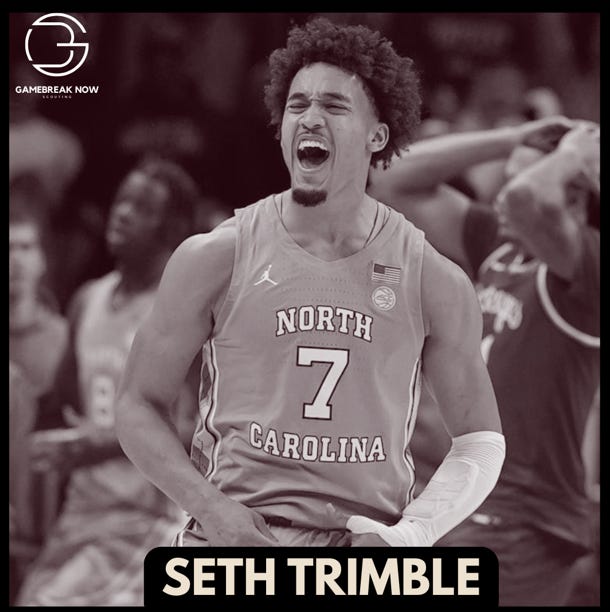
Height: 6’3” Weight: 205Lbs Team: North Carolina Class: Senior
Age at Draft: 21.88 Height (Barefoot): 6’1.5 Weight: 200.6Lbs Wingspan: 79.75” (+6.25) Standing Reach: 97”
Scouting Snapshot
Seth Trimble quietly developed into one of the more impactful two-way guards in the ACC during his senior season at North Carolina. After spending the early portion of his collegiate career largely as an energy guard and rotational defender, Trimble gradually expanded his offensive responsibilities each season before finally stepping into a featured role during 2025-26. The statistical progression reflects a player who steadily improved his scoring volume, ball-handling responsibility, efficiency as a downhill attacker, and overall offensive confidence throughout his four-year development arc.
At 6-foot-3 and roughly 200 pounds, Trimble possesses a strong physical frame for a combo guard and consistently leveraged his athleticism, burst, and downhill pressure to create offense. His game is heavily built around straight-line driving, transition pressure, point-of-attack defense, and physical perimeter play rather than advanced perimeter shot creation or high-level pull-up shooting versatility. That archetype became increasingly evident during his senior season, where he averaged roughly 14 points, 3.8 rebounds, and 3 assists while playing over 32 minutes per game for the Tar Heels.
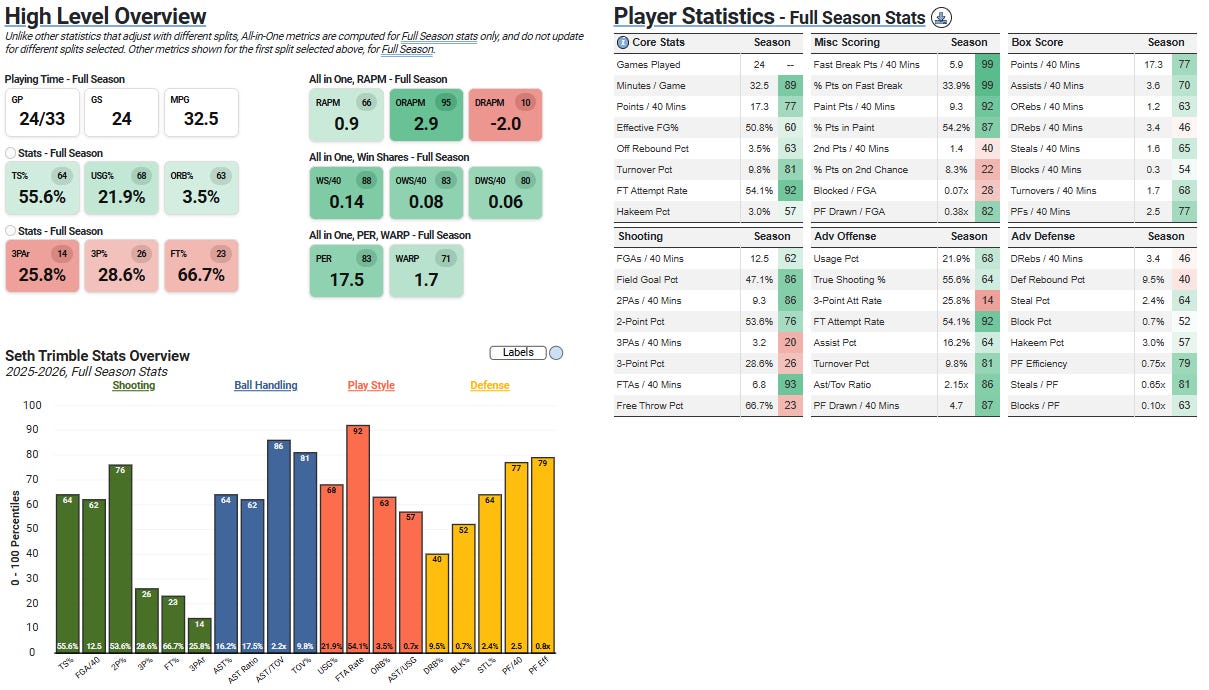
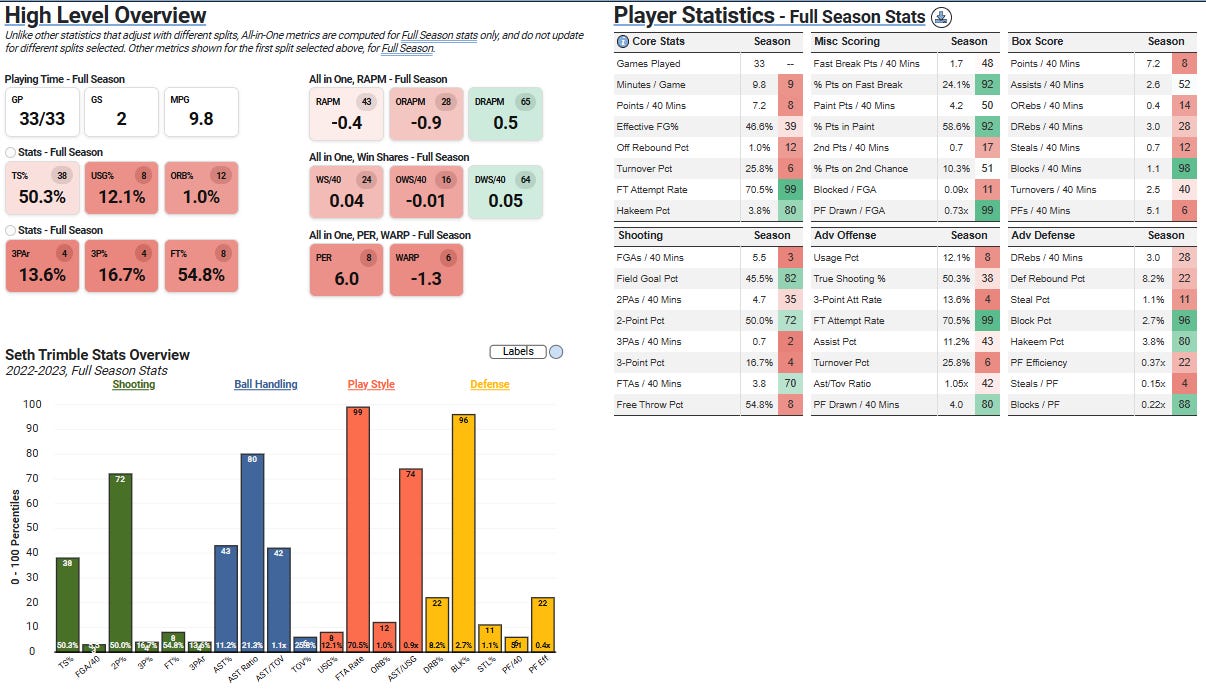
The biggest offensive improvement throughout Trimble’s career came in his ability to handle larger creation responsibility without sacrificing efficiency. His assist production climbed every season, peaking at 3.6 assists per 40 minutes in 2025-26, while his turnover rate remained relatively controlled at under 10 percent. The statistical profile suggests a guard capable of secondary initiation duties, attacking closeouts, and functioning within movement-heavy offensive systems without needing to dominate possessions.
Where Trimble consistently generated value offensively was through rim pressure and transition offense. Nearly 34 percent of his scoring came in transition situations during his senior season, ranking among the elite percentile nationally in fastbreak scoring efficiency. He repeatedly punished defenses in open floor situations, using his speed and physicality to attack rotating defenders before defenses could get organized. His first-step burst and willingness to absorb contact made him one of UNC’s more reliable downhill threats. The strong free throw generation profile further reinforces that play style, as he posted an elite free throw attempt rate north of 54 percent.
However, the long-term offensive ceiling remains somewhat tied to the jumper development. Despite offensive growth elsewhere, Trimble’s perimeter shooting remained inconsistent throughout his collegiate career. During the 2025-26 season, he shot just 28.6 percent from three on relatively modest volume, while both his three-point attempt rate and free throw percentage remained below average for NBA-caliber combo guards. The shooting mechanics are not broken, but the overall shot profile still creates questions regarding floor spacing translation at the professional level.
Defensively, Trimble projects far more favorably.
His combination of strength, lateral quickness, effort level, and physicality allowed him to consistently disrupt opposing guards at the point of attack. He generated strong steal metrics throughout his career while regularly defending difficult perimeter assignments within ACC play. Even as his offensive workload expanded, the defensive competitiveness remained relatively stable, which is a positive indicator for NBA role scalability.
The advanced impact metrics also paint an interesting picture. Trimble posted strong offensive RAPM numbers during his senior year, reflecting his positive offensive influence within North Carolina’s lineups, though the defensive RAPM metrics were more mixed. Still, his overall impact indicators remained positive throughout his career, particularly once he transitioned into a larger role. His senior season PER, win shares, and offensive impact metrics all graded comfortably above average among ACC guards.
From an NBA projection standpoint, Trimble currently profiles most cleanly as a defensive-minded rotational combo guard whose value comes through athletic pressure, transition offense, perimeter defense, and secondary creation. The archetype resembles many modern backup guards who survive through toughness, physicality, and defensive versatility rather than primary scoring creation.
The swing skill remains perimeter shooting consistency. If the jumper stabilizes closer to league-average efficiency, Trimble’s athleticism, defensive intensity, and downhill pressure could allow him to carve out a meaningful NBA rotation role. Without reliable perimeter spacing, however, the offensive fit becomes much more situational against professional defenses that will aggressively shrink driving lanes. Still, the overall trajectory of his collegiate development, combined with his physical tools and defensive competitiveness, gives him a legitimate pathway toward professional contribution.
Statistical Overview By Year:
2025-2026 (Senior Season)
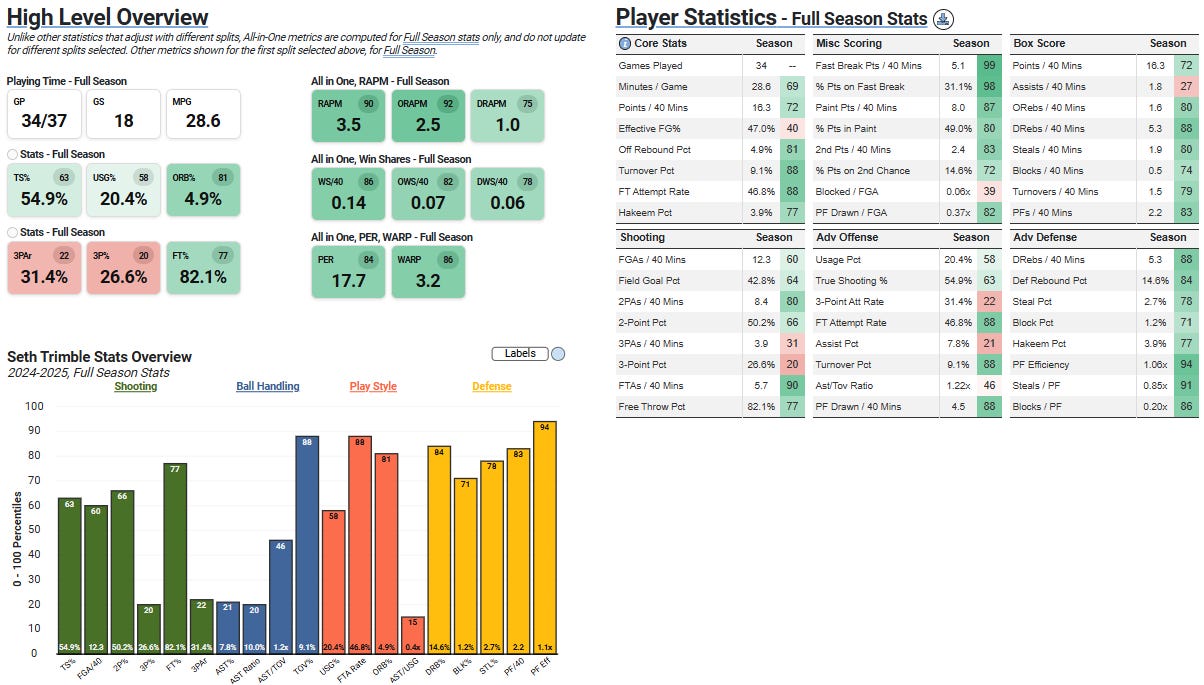
2024-2025 (Junior Season)
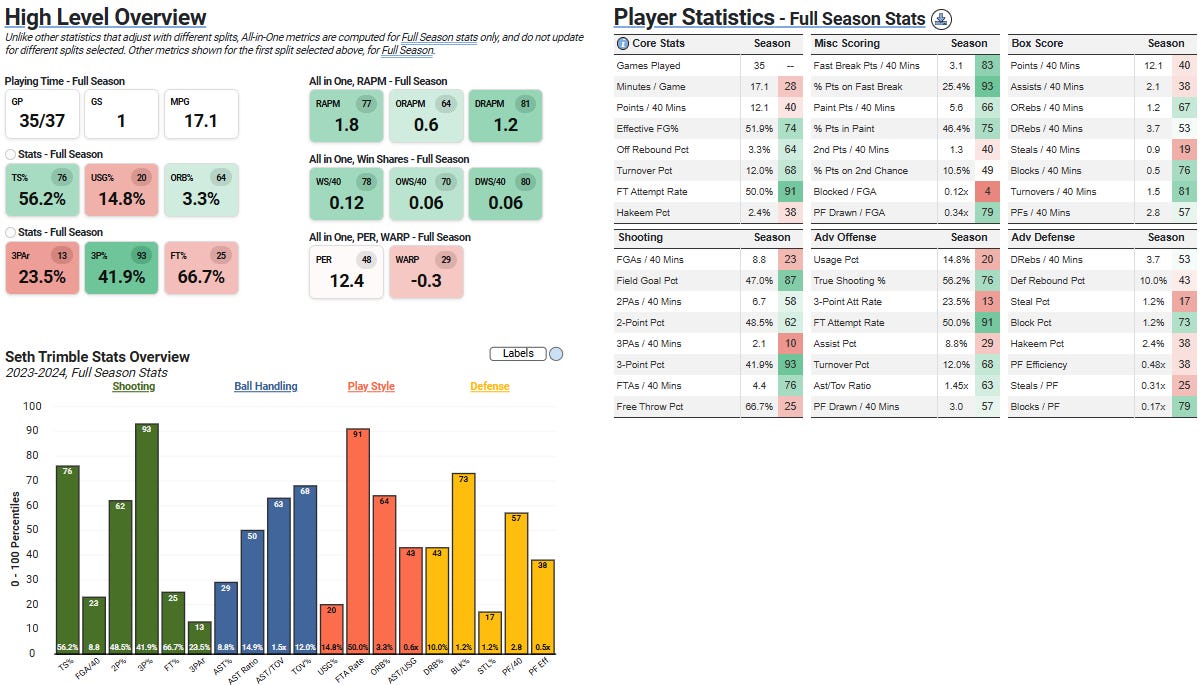
2023-2024 (Sophomore Season)
2022-2023 (Freshman Season)
Scoring Context By Year:
2025-2026 (Senior Season)
2024-2025 (Junior Season)
2023-2024 (Sophomore Season)
2022-2023 (Freshman Season)
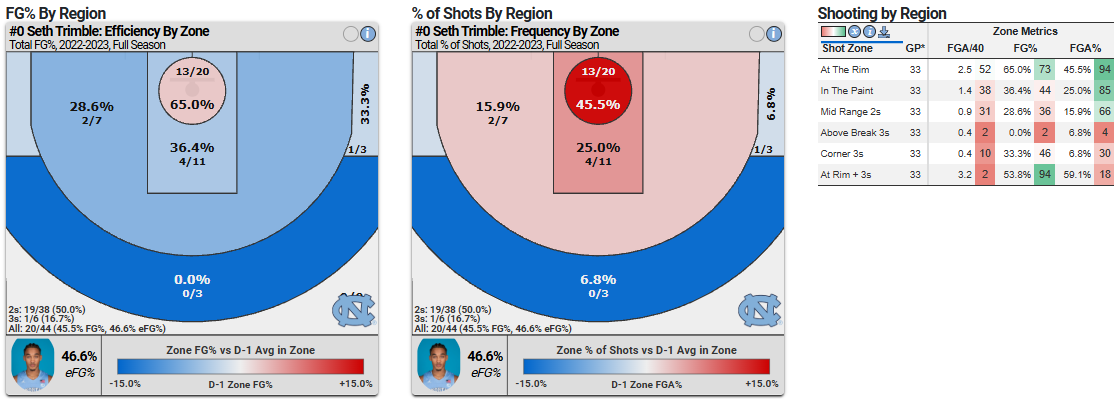
Key Note about Scoring Context: One of the most important contextual elements when evaluating Seth Trimble’s offensive profile is understanding where his scoring efficiency actually originated throughout his four-year career at North Carolina while also questioning how scalable that archetype becomes at the NBA level given his physical profile. Unlike many modern scoring guards whose production is heavily tied to perimeter shot creation or pull-up shooting versatility, Trimble’s offensive value was overwhelmingly driven by downhill pressure, transition scoring, rim finishing, and physical straight-line attacking.
That trend remained remarkably consistent throughout his collegiate development.
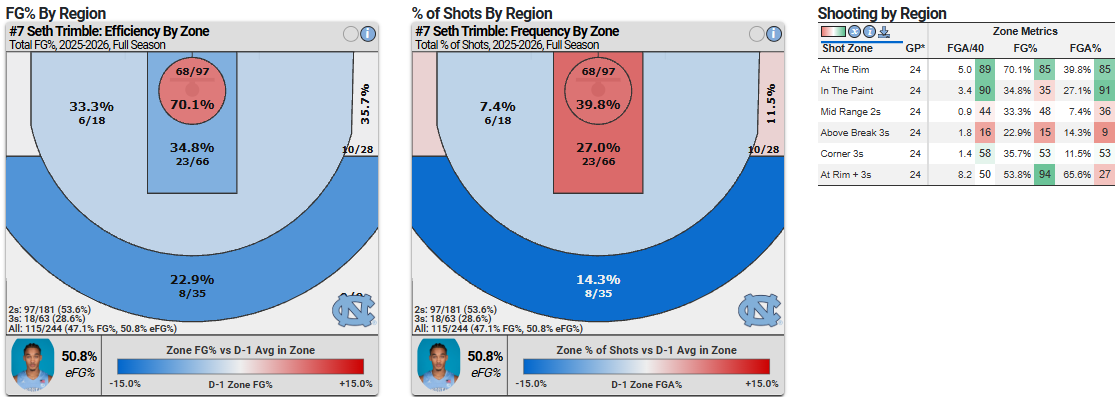
Across every season, the majority of Trimble’s shot diet came at the rim and inside the arc. By his senior season in 2025-26, nearly 54 percent of his total field goal attempts came directly at the basket or in the paint area, while he converted over 70 percent of his rim attempts. That level of interior efficiency is extremely impressive for a 6-foot-3 guard and reflects both his athletic burst and physicality attacking downhill.
The transition scoring profile further reinforces the archetype.
Trimble consistently generated elite transition efficiency throughout his career, culminating in nearly 34 percent of his total scoring coming in fastbreak situations during his senior season. North Carolina frequently leveraged his speed and explosiveness in the open floor, where he was at his best attacking unsettled defenses before half-court rotations could fully develop.
The evolution of his rim pressure is especially notable year over year.
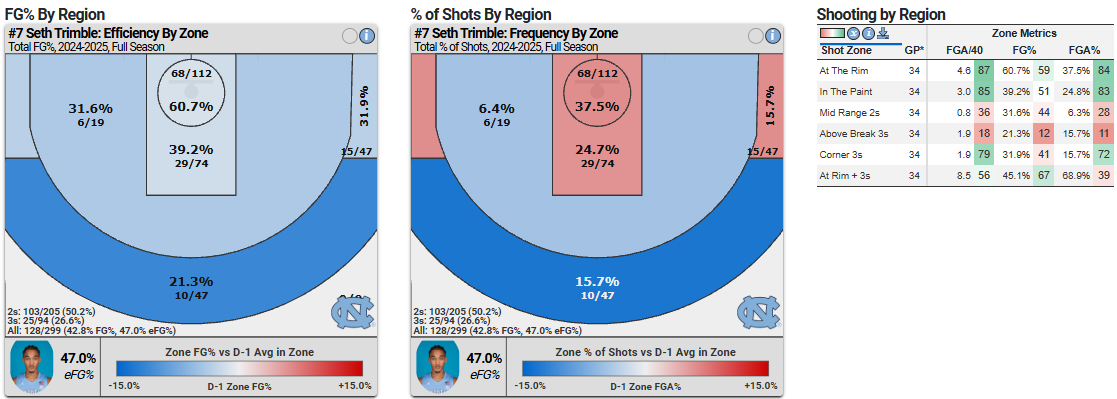
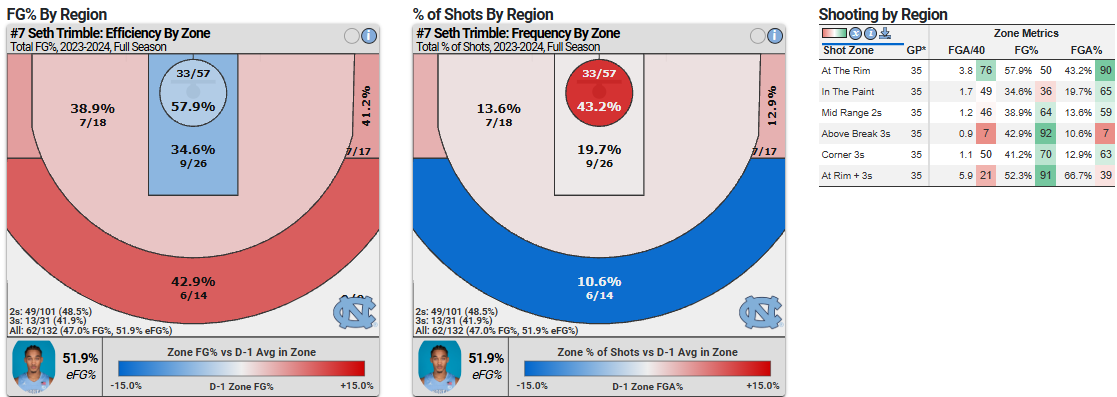
As a freshman, nearly 46 percent of his shots already came at the basket. That number climbed to over 43 percent as a sophomore before stabilizing around 38 to 40 percent during his final two seasons despite carrying significantly larger offensive responsibility. Even as his role expanded, he remained heavily reliant on interior attacking rather than settling into a perimeter-oriented scoring profile.
The finishing progression itself was strong.
Trimble improved from roughly 65 percent finishing at the rim early in his career to over 70 percent by his senior season. That is a significant indicator because it demonstrates both improved decision-making and greater physical comfort finishing through contact against high-major competition.
However, the perimeter shooting profile remained inconsistent throughout his collegiate career, and that is where the long-term scalability questions begin to surface.
Despite gradual improvements in overall offensive responsibility, Trimble never developed into a high-volume or highly efficient perimeter shooter. During his senior season, he converted just 28.6 percent from three while generating a relatively modest three-point attempt rate overall. More importantly, much of his perimeter offense remained concentrated in catch-and-shoot opportunities rather than advanced off-the-dribble shot creation.
The shot distribution also highlights some important offensive limitations.
Trimble generated very little offense from midrange areas or difficult pull-up situations. Most of his half-court scoring came through attacking gaps, transition opportunities, cuts, and straight-line drives rather than advanced isolation creation. Defenses were generally more concerned with containing his downhill burst than contesting difficult perimeter jumpers.
That becomes especially important when projecting him forward because Trimble does not possess overwhelming positional size for an NBA scoring guard.
At 6-foot-3, much of his current offensive success is still heavily dependent on athletic pressure, rim access, and physical straight-line driving. In college, Trimble was frequently able to overwhelm defenders with his burst, strength, and transition speed advantages. At the NBA level, however, those athletic gaps naturally shrink considerably against longer, stronger, and more disciplined perimeter defenders.
Because so much of Trimble’s offense was generated at the rim, in transition, or through physical drives, his overall efficiency becomes somewhat tied to his ability to consistently create paint touches. Against NBA defenses with superior length, athleticism, and rim protection, some of those driving lanes naturally become more difficult to access without reliable perimeter gravity.
That creates a somewhat narrower margin for offensive scalability compared to larger guards or perimeter creators with more advanced shot-making versatility.
Without a dependable perimeter jumper, defenses may feel increasingly comfortable playing underneath screens, shrinking driving gaps, and forcing Trimble into half-court pull-up situations that have not consistently been strengths throughout his collegiate career. Guards of his size who rely heavily on rim pressure generally need either elite shooting, advanced live-dribble playmaking, or exceptional scoring craft to fully scale offensively against NBA defensive athletes.
Still, the overall scoring context remains encouraging within his projected NBA role.
Modern NBA teams continue to value guards capable of collapsing defenses, applying rim pressure, defending physically, and thriving in transition environments. Trimble’s scoring profile may not project as a primary offensive engine, but his ability to create efficient pressure at the rim, finish through contact, and weaponize athleticism gives him a pathway toward functioning as an energy-based rotational guard at the professional level.

(Provided by Cbbanalytics)
Video Reference
(Video Credit: ACC Digital Network)
(Video Credit: ACC Digital Network)
NBA Projection & Player Comparisons
Projected Role: Energy and Effort Rotational Guard
For Seth Trimble, the projection begins with understanding the specific ways his athleticism, defensive intensity, downhill pressure, and transition scoring translated into winning impact at North Carolina. Unlike larger offensive engines or high-level perimeter shot creators, Trimble’s value consistently came through pace, physicality, defensive activity, rim pressure, and complementary offensive functionality.
Throughout his collegiate career, Trimble steadily evolved into one of the ACC’s more disruptive backcourt athletes.
His offensive profile was heavily centered around straight-line driving, transition offense, rim finishing, and pressure creation rather than advanced perimeter shot-making. By his senior season, nearly 54 percent of his shot attempts came at the rim or inside the paint while converting over 70 percent of his rim attempts. That level of interior efficiency is impressive for a 6-foot-3 guard and reflects the explosiveness, physicality, and downhill burst that consistently defined his offensive identity.
The transition component of his game is especially important for projection purposes.
Trimble generated nearly 34 percent of his scoring in transition situations during his final collegiate season, thriving in open-floor environments where his speed and athleticism could create immediate advantages. NBA teams consistently value guards capable of applying pace pressure, attacking unsettled defenses, and generating energy possessions without requiring structured half-court creation.
Defensively, the tools remain highly intriguing.
Trimble consistently displayed strong point-of-attack competitiveness, lateral quickness, effort level, and physical toughness throughout his career. His defensive profile projects cleanly into rotational NBA guard responsibilities because he plays with high activity, embraces physical assignments, and can pressure opposing ball handlers while generating disruptive events in passing lanes and transition situations.
The broader projection, however, still raises some important scalability questions offensively.
One of the most important contextual elements when evaluating Trimble’s offensive profile is understanding where his scoring efficiency actually originated. Unlike many modern scoring guards whose production is heavily tied to perimeter shot creation or pull-up shooting versatility, Trimble’s offensive value was overwhelmingly driven by downhill pressure, transition scoring, rim finishing, and physical straight-line attacking.
That trend remained remarkably consistent throughout his collegiate development.
Across every season, the majority of Trimble’s shot diet came at the rim and inside the arc. Even as his offensive role expanded, he remained heavily reliant on interior attacking rather than developing into a perimeter-oriented shot creator. While the finishing progression itself was highly encouraging, the perimeter shooting profile remained inconsistent throughout his career.
During his senior season, Trimble converted just 28.6 percent from three while maintaining relatively modest perimeter volume overall. More importantly, much of his perimeter offense came through catch-and-shoot opportunities rather than advanced off-the-dribble creation.
That becomes especially important when projecting him forward because Trimble does not possess overwhelming positional size for an NBA scoring guard.
At 6-foot-3, much of his current offensive success is tied heavily to athletic pressure, rim access, and straight-line driving. In college, Trimble could frequently overwhelm defenders with burst, strength, and transition speed advantages. At the NBA level, however, those athletic gaps naturally shrink against longer, stronger, and more disciplined perimeter defenders.
Because so much of his offense was generated at the rim, in transition, or through physical drives, his efficiency becomes somewhat dependent on his ability to consistently create paint touches. Without reliable perimeter gravity, NBA defenses may increasingly play underneath screens, shrink driving gaps, and force him into half-court pull-up situations that have not consistently been strengths throughout his collegiate career.
That creates a narrower offensive scalability pathway compared to larger guards or perimeter creators with advanced shooting versatility.
Still, the overall archetype remains valuable within modern rotational basketball.
NBA teams continue to prioritize guards who defend aggressively, apply pace pressure, create transition offense, attack downhill, and bring consistent energy to second units. Trimble’s game may not project toward primary offensive initiation, but his athleticism, motor, defensive competitiveness, and rim pressure give him a realistic pathway toward becoming an energy-based rotational guard capable of impacting games through effort, tempo, and defensive intensity.
Projected Player Comparison:
Jahmai Mashack
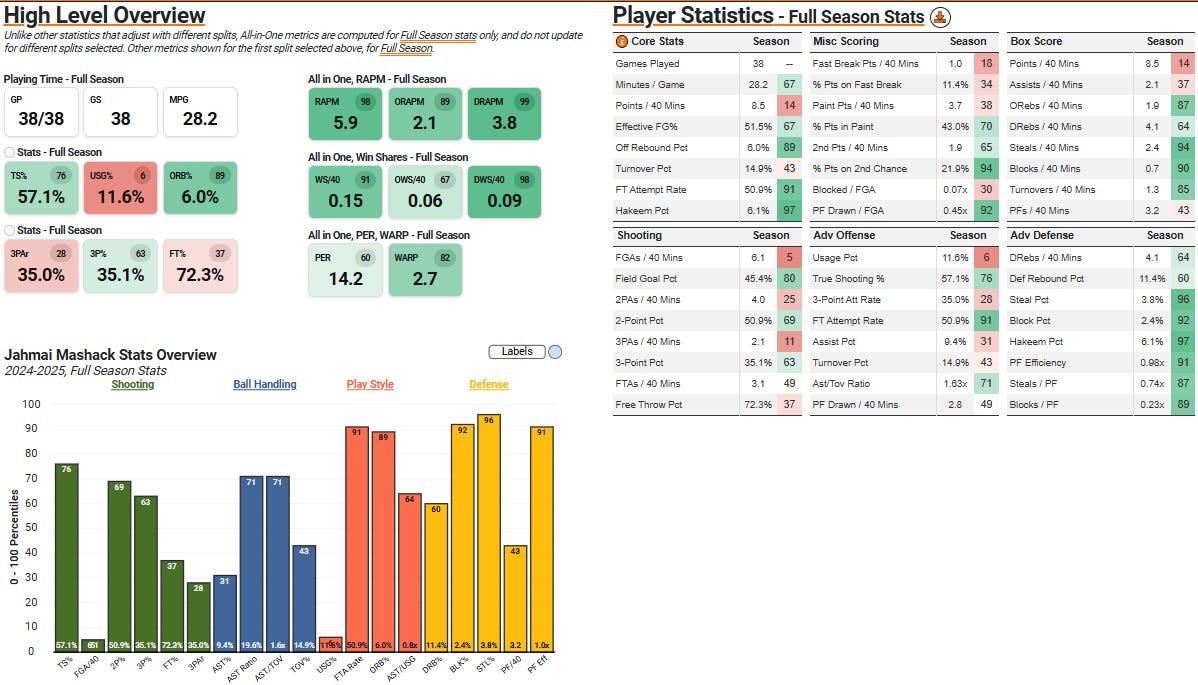
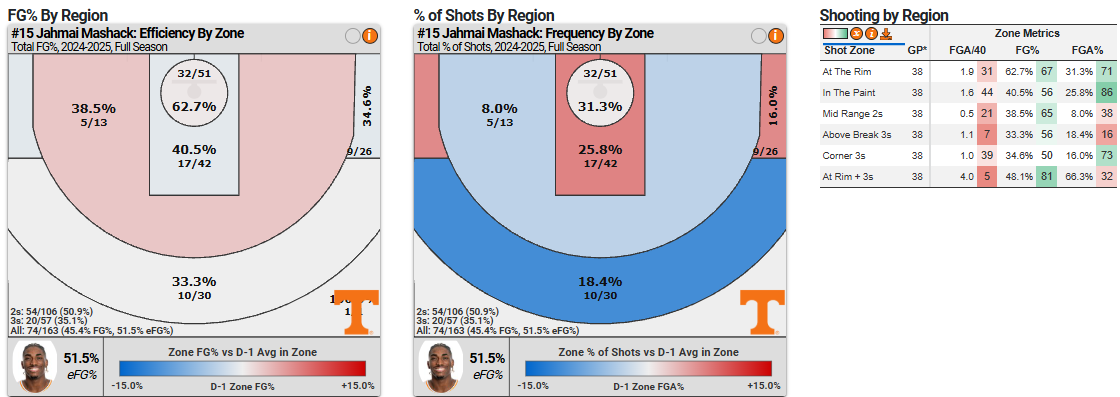
De’Anthony Melton
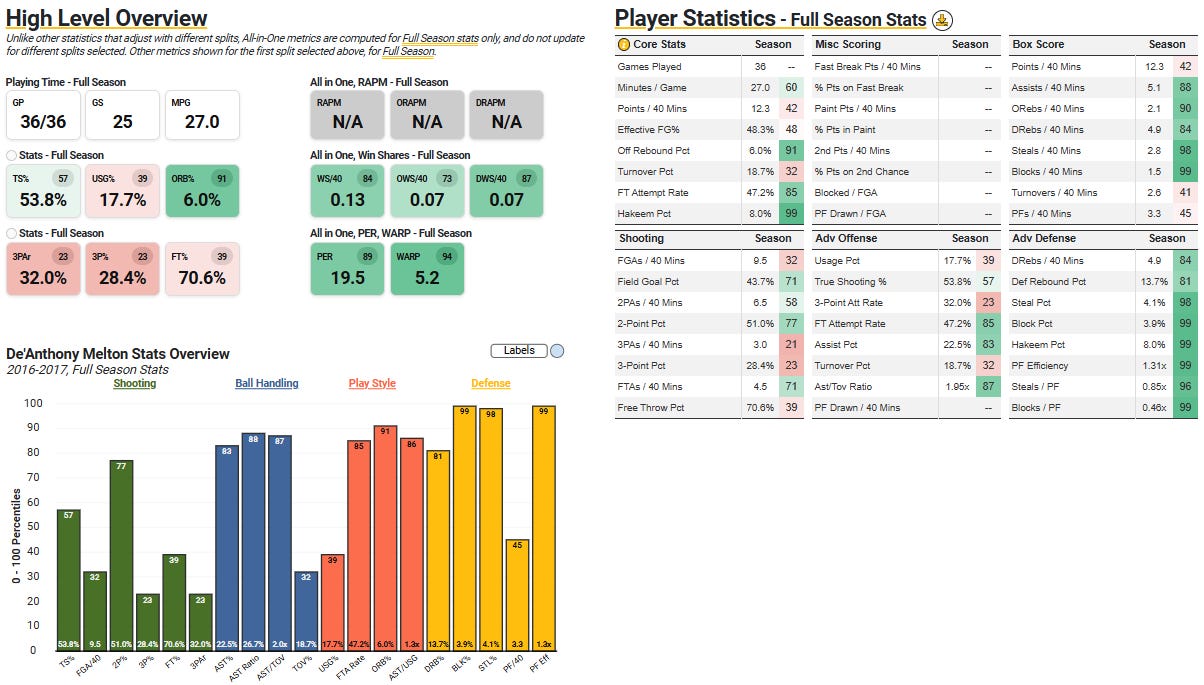
(Provided by Cbbanalytics)
Analysis:
Overall Impact: 14/25
Seth Trimble’s overall impact profile presents one of the more difficult projection balances among rotational guard prospects because many of the traits that made him highly effective at the collegiate level do not automatically scale cleanly into NBA environments without continued offensive development. The athleticism, downhill pressure, transition impact, and defensive competitiveness are all very real strengths, but the long-term translation still appears heavily role-dependent.
From a pure production standpoint, Trimble was unquestionably effective.
During the 2025-26 season, he posted strong overall impact indicators across multiple advanced models, including positive offensive RAPM metrics, solid win share production, and efficient two-point scoring. His offensive impact consistently came through rim pressure, transition play, foul generation, and energy-driven possessions rather than perimeter shot creation or heliocentric offensive responsibility.
The transition pressure was especially impactful.
Trimble generated nearly 34 percent of his total scoring in fastbreak situations, ranking in the 99th percentile nationally. That level of open-floor production dramatically boosted his offensive efficiency and reflected how dangerous he became when attacking unsettled defenses with speed and explosiveness.
The rim pressure profile also translated positively throughout his career.
He consistently finished efficiently at the basket while maintaining strong free throw generation rates. Even during his senior season, over half of his scoring still came inside the paint despite expanded offensive responsibilities. That combination of athletic burst and physical downhill aggression gave North Carolina consistent offensive pressure without requiring highly advanced isolation creation.
The defensive competitiveness further strengthened the profile.
Trimble’s energy level, point-of-attack pressure, steal generation, and foul discipline all supported the projection of a functional rotational perimeter defender. He consistently impacted games through pace, effort, and physicality even when the offensive production fluctuated.
However, the broader scalability questions remain substantial.
The biggest issue within the projection is that many of Trimble’s best collegiate strengths become harder to consistently replicate against NBA size, athleticism, and spacing discipline. His offensive efficiency relied heavily on rim access, transition opportunities, and straight-line burst rather than perimeter gravity or advanced self-created half-court scoring.
That becomes especially important given the shooting profile.
Trimble converted just 28.6 percent from three during his senior season while posting a relatively modest three-point attempt rate overall. More concerning, the above-the-break shooting remained particularly inconsistent, limiting his ability to scale comfortably into off-ball NBA guard roles where spacing reliability becomes critical.
The overall offensive archetype remains somewhat narrow because of that limitation.
At 6-foot-3, guards who are not high-level shooters or advanced primary creators often face tighter pathways toward stable NBA rotation roles. While Trimble’s athleticism and defensive energy provide a foundation, the lack of consistent perimeter gravity creates lineup optimization challenges offensively.
The advanced impact metrics also reflect some of that tension.
His offensive impact remained strong overall, but the defensive RAPM indicators fluctuated more significantly, and the overall impact profile settled closer to “valuable college guard” than clear NBA difference-maker territory. Much of his impact was contextually tied to pace, athletic pressure, and transition environments that may not fully translate at the same level professionally.
Still, the role-player pathway remains realistic.
Modern NBA teams consistently value guards capable of defending aggressively, applying downhill pressure, creating transition offense, and bringing consistent energy to second-unit lineups. Trimble’s athleticism and competitiveness give him a functional baseline that many fringe guard prospects simply do not possess.
Ultimately, the projection likely depends heavily on one swing skill: perimeter shooting consistency.
If Trimble can stabilize the jumper closer to league-average efficiency, many of the concerns surrounding offensive scalability become substantially easier to manage. His downhill athleticism, defensive pressure, and transition explosiveness would fit much more naturally into complementary NBA guard roles with improved spacing gravity.
Without that development, however, the offensive role may remain somewhat limited against NBA defenses capable of shrinking driving lanes and neutralizing straight-line athletic pressure more effectively than collegiate competition.
Scoring: 3/9
Seth Trimble’s scoring profile is heavily built around athletic pressure, transition offense, rim finishing, and physical downhill attacking rather than perimeter shot-making versatility or advanced half-court shot creation. While the overall offensive production improved significantly by his senior season at North Carolina, the scoring archetype remains somewhat specialized and heavily dependent on pace, burst, and paint access.
The raw scoring production itself was solid overall.
Trimble generated 17.3 points per 40 minutes during the 2025-26 season while maintaining a respectable 55.6 true shooting percentage. His overall field goal efficiency graded favorably as well, converting 47.1 percent from the floor while posting strong interior scoring numbers for a 6-foot-3 guard.
The interior pressure was clearly the driving force behind the profile.
Trimble generated over 9.3 paint points per 40 minutes, ranking in the 92nd percentile nationally among guards, while nearly 54 percent of his total scoring came directly inside the paint. That is an extremely high percentage for a perimeter player and reinforces how heavily his offense revolved around rim pressure, transition attacks, cuts, and straight-line driving.
The transition scoring profile was arguably the most impressive element of the entire offensive evaluation.
Trimble generated nearly 5.9 fastbreak points per 40 minutes, ranking in the 99th percentile nationally. More importantly, over 33 percent of his total scoring came in transition situations, also ranking near the top nationally. North Carolina consistently weaponized his speed, explosiveness, and open-floor athleticism, allowing him to thrive before defenses could fully organize.
The finishing ability itself improved steadily throughout his collegiate career.
Trimble converted nearly 54 percent of his two-point attempts overall while carrying very strong two-point volume for a guard. His ability to absorb contact and finish through physicality became a major component of his offensive growth during his later seasons at North Carolina.
The free throw generation further supports the downhill scoring archetype.
Trimble averaged nearly 6.8 free throw attempts per 40 minutes, ranking in the 93rd percentile nationally among guards. That number is extremely encouraging because it reflects a player consistently putting pressure on the rim and forcing defensive collapses through aggression rather than settling for low-efficiency perimeter offense.
However, the perimeter shooting profile remains the largest limiting factor within the projection.
Trimble attempted just 3.2 three-pointers per 40 minutes while converting only 28.6 percent from beyond the arc. Both the volume and efficiency graded poorly relative to NBA-caliber rotational guards. More importantly, only about 26 percent of his total shot diet came from three-point range, placing him near the bottom percentile among modern perimeter prospects.
That lack of perimeter gravity creates important scalability concerns offensively.
At 6-foot-3, Trimble does not possess overwhelming positional size for a non-shooting NBA guard. Because so much of his offense is generated through athletic pressure, transition scoring, and straight-line rim attacks, the long-term offensive translation becomes heavily dependent on whether he can consistently access driving lanes against longer and more disciplined NBA defenders.
The half-court shot creation profile also remains somewhat limited.
Trimble generated very little scoring from pull-up jumpers, advanced shot creation, or difficult perimeter situations. Most of his offense came through advantage attacking, transition opportunities, cuts, and direct downhill pressure rather than manipulation-based creation or high-level scoring craft.
The second-chance scoring numbers were relatively modest as well.
Only about 8 percent of his scoring came through second-chance opportunities, reinforcing that his offensive value came far more through pace and athletic pressure than physical offensive rebounding or off-ball interior activity.
Still, the overall scoring profile retains functional NBA value within the proper role.
Modern NBA teams consistently value guards capable of applying rim pressure, collapsing defenses in transition, generating free throws, and creating athletic pace. Trimble’s ability to pressure the basket and create efficient interior offense gives him a realistic pathway toward functioning as an energy-based rotational guard, particularly if the perimeter jumper becomes more reliable over time.
The long-term offensive ceiling remains closely tied to shooting development. If Trimble can elevate the perimeter jumper toward league-average consistency, the downhill athleticism and transition scoring become significantly easier to scale within NBA spacing environments.
Self Creation: 5/9
Seth Trimble’s self-creation profile is heavily tied to athletic downhill pressure, straight-line burst, and transition scoring rather than advanced perimeter shot creation or manipulation-based half-court offense. While the overall offensive archetype remains somewhat limited stylistically, the data does reinforce that Trimble was capable of generating a meaningful amount of his own offense through physical rim attacks and aggressive driving pressure.
The unassisted scoring production stands out immediately.
Trimble generated over 12.3 unassisted points per 40 minutes during the 2025-26 season, ranking in the 85th percentile nationally among guards. That number is important contextually because it shows his scoring was not purely dependent on being spoon-fed opportunities within North Carolina’s offense. A large percentage of his production came through self-generated downhill attacks and transition pressure.
The two-point self-creation profile was especially impressive.
Trimble generated nearly 3.65 unassisted two-point field goals per 40 minutes, ranking in the 88th percentile nationally. That metric strongly reinforces the eye test, as much of his offensive success came through beating defenders off the dribble, attacking gaps aggressively, and finishing through physical contact near the basket.
The rim pressure numbers further support that archetype.
Trimble generated over 2.3 unassisted at-rim field goals per 40 minutes, ranking in the 92nd percentile nationally. For a 6-foot-3 guard, that is an extremely strong indicator of burst, athleticism, and driving aggression. His ability to consistently create paint touches without needing advanced screening advantages became one of the defining traits of his offensive profile.
The transition self-creation also boosted the overall production significantly.
Because of his explosiveness in the open floor, Trimble was frequently able to manufacture offense simply by forcing tempo and attacking before defenses became organized. Many of his easiest self-created scoring opportunities came in early offense situations where his straight-line speed created immediate pressure on retreating defenders.
The finishing craft around the basket improved steadily throughout his collegiate career as well.
Trimble converted a strong percentage of his self-created interior opportunities while consistently absorbing contact. His physicality and willingness to attack the paint aggressively allowed him to generate efficient offense despite not possessing elite positional size.
However, the perimeter self-creation profile remains much more concerning.
Trimble generated very little unassisted perimeter offense overall, producing only modest unassisted three-point scoring volume while converting under 30 percent from beyond the arc. More importantly, much of his perimeter offense lacked advanced separation creation, pull-up shot-making versatility, or manipulation-based scoring counters.
The assisted versus unassisted distribution highlights the broader offensive limitations.
Only about 36 percent of his total made field goals were assisted, meaning he created a fair amount of his own offense overall. However, much of that creation still came through direct athletic pressure rather than advanced offensive nuance. The majority of his self-created offense was heavily concentrated at the rim and inside the arc rather than through scalable perimeter shot creation.
That becomes especially important when projecting him forward given the size profile.
At 6-foot-3, guards who rely heavily on athletic downhill creation often face more difficult offensive scalability pathways at the NBA level unless paired with reliable perimeter shooting or elite playmaking feel. Against NBA length and athleticism, some of the driving windows Trimble consistently exploited in college naturally become much tighter.
The lack of advanced pull-up shooting and half-court manipulation limits some of the offensive ceiling.
Trimble is not currently the type of creator who consistently generates difficult offense late in possessions through hesitation creation, step-backs, advanced pacing, or high-level shot diversity. Much of his self-creation success still depends heavily on burst, transition opportunities, and direct downhill attacking.
Still, the overall self-creation profile remains functional within the proper role.
Modern NBA teams continue to value guards capable of pressuring the rim, forcing rotations, and creating athletic downhill offense without needing heavy offensive usage. Trimble’s ability to generate self-created paint pressure and transition offense gives him a workable offensive baseline as a rotational energy guard.
Playmaking: 4/9
Seth Trimble’s playmaking profile reflects a guard who can function as a secondary offensive connector and downhill advantage creator, but not necessarily a primary initiator capable of consistently orchestrating half-court offense. Much of his passing value came through transition reads, drive-and-kick opportunities, and reactive playmaking generated by athletic pressure rather than advanced manipulation or high-level pick-and-roll orchestration.
The overall creation volume was solid within his offensive role.
Trimble generated 26.6 points created per 40 minutes during the 2025-26 season, grading around the 78th percentile nationally among guards. He also posted an assist rate responsible for nearly 18.4 percent of North Carolina’s total assists while carrying a respectable 21.9 usage rate. Those numbers reinforce that he contributed meaningful secondary offensive creation without fully functioning as a primary ball-dominant engine.
The rim pressure passing translated best within the profile.
Trimble generated over 3.1 assists per 40 minutes directly leading to rim or three-point opportunities, a strong indicator of functional downhill creation. As defenses collapsed toward his driving pressure, he increasingly showed the ability to identify corner shooters, cutters, and interior dump-off opportunities.
The transition playmaking also boosted the overall evaluation.
Because of his open-floor explosiveness, Trimble consistently created early offense advantages before defenses became organized. Many of his assists came through pace pressure and quick-reacting reads in transition environments rather than structured half-court manipulation.
The above-the-break passing profile was especially encouraging.
Trimble generated nearly 1.6 above-the-break three assists per 40 minutes, grading in the 84th percentile nationally. That is an important contextual number because it shows he was capable of generating efficient perimeter offense for teammates once defenses collapsed into the paint against his downhill attacks.
The drive-and-kick component of his game improved steadily throughout his collegiate career.
Earlier in his development, Trimble primarily functioned as an athletic scorer and transition guard. By his senior season, however, he appeared increasingly comfortable reading second-level defenders and making quicker passing decisions once driving lanes opened.
The turnover profile also remained relatively stable.
Despite increased offensive responsibility, Trimble maintained reasonable turnover numbers overall, committing only about 14.5 percent of North Carolina’s total turnovers while carrying meaningful creation responsibility. That reflects a player who generally played under control and avoided reckless decision-making.
However, the broader half-court orchestration profile remains somewhat limited.
Trimble is not currently an advanced pace manipulator or elite pick-and-roll operator capable of consistently dictating offensive tempo possession-to-possession. Much of his playmaking still comes reactively after defenses are forced to respond to his athletic pressure rather than proactively controlling defenses through advanced reads or timing manipulation.
The shot creation gravity limitations also impact the passing scalability somewhat.
Because defenders were often more concerned with containing his downhill burst than respecting perimeter shot creation, some passing windows were generated through athletic advantages that may naturally shrink against NBA athletes and longer defensive recoveries.
The assist distribution itself reinforces the archetype.
Much of Trimble’s passing production came toward rim attempts and transition opportunities rather than highly advanced live-dribble perimeter manipulation. He functioned effectively as a connective creator but not necessarily as a full offensive organizer.
That distinction becomes especially important given the size profile.
At 6-foot-3, guards without elite perimeter shot creation often need high-level playmaking feel to fully scale offensively in the NBA. Trimble currently projects more comfortably as a secondary creator who can attack advantages, generate pace, and keep offenses moving rather than carrying primary initiation responsibilities.
Still, the overall playmaking profile remains functional within the projected NBA role.
Shooting: 2/9
Seth Trimble’s shooting profile remains the largest swing skill within his overall NBA projection because while the athletic pressure, rim finishing, and transition scoring all translate functionally, the perimeter shot still lacks the consistency and gravity needed to fully unlock his downhill game against NBA defenses.
The interior efficiency numbers themselves were highly encouraging.
Trimble converted over 70 percent of his at-rim attempts during the 2025-26 season, ranking in the 85th percentile nationally among guards. More importantly, nearly 40 percent of his total shot attempts came directly at the rim, an extremely high number for a 6-foot-3 guard. That reflects both elite straight-line burst and strong finishing physicality through contact.
The rim finishing progression throughout his collegiate career was one of the clearest offensive growth areas overall.
Trimble became increasingly comfortable attacking downhill and finishing in traffic, particularly during his later seasons at North Carolina. His touch around the basket improved significantly, and the combination of athleticism, body control, and aggression consistently created efficient interior offense.
The shot distribution profile heavily reinforces the offensive archetype.
Over 65 percent of Trimble’s total field goal attempts came either at the rim or from three-point range, illustrating a relatively modern shot profile structurally. However, unlike most modern perimeter guards, the efficiency balance between those two zones was extremely uneven.
The three-point shooting remains highly inconsistent.
Trimble converted just 28.6 percent from beyond the arc overall while producing very low above-the-break three-point efficiency at only 22.9 percent. That is a major concern contextually because above-the-break shooting is often one of the most important scalability indicators for smaller NBA guards operating in pick-and-roll or secondary creation roles.
The corner shooting numbers were somewhat better but still not overwhelming.
Trimble converted roughly 35.7 percent on corner threes, which at least provides some indication that stationary catch-and-shoot development remains possible long term. However, the overall perimeter volume remained relatively low, particularly for a guard whose offensive scalability already raises size-related concerns.
The lack of pull-up shooting versatility also limits the projection.
Trimble generated very little offense from midrange creation or difficult self-created jump shooting. Only about 7 percent of his total shot diet came from midrange areas, and much of his half-court offense relied heavily on direct downhill pressure rather than advanced shot-making counters.
The efficiency profile itself is highly dependent on paint access.
Because Trimble does not currently possess reliable perimeter gravity, defenses were often more comfortable going underneath screens or shrinking driving lanes aggressively. At the college level, his athleticism and burst frequently allowed him to overcome those disadvantages anyway. At the NBA level, however, the combination of size limitations and inconsistent shooting naturally creates a tighter offensive margin for error.
The shot timing distribution also reflects how much he relied on rhythm and momentum-based scoring.
Trimble was extremely effective attacking later-clock rim opportunities, converting nearly 78 percent of his at-rim attempts late in possessions. That reinforces both his confidence attacking downhill and his ability to pressure rotating defenses. However, it also highlights how dependent much of his offense remained on burst and interior athletic pressure rather than perimeter shot creation versatility.
The directional shooting splits are relatively stable overall.
Trimble showed decent balance attacking both sides of the floor while generating strong center-lane efficiency around the basket. Much of his best scoring came directly downhill through the middle of the defense where his speed and physicality could create direct rim pressure.
Still, the overall shooting projection remains highly uncertain.
At 6-foot-3, guards who rely heavily on athletic rim pressure generally need either reliable perimeter shooting or elite playmaking to fully scale offensively at the NBA level. Right now, Trimble’s jumper remains inconsistent enough that defenses may continue prioritizing paint containment over perimeter closeouts.
Defensive Attribution: 7/10
Defense projects as one of the more realistic pathways for Seth Trimble to maintain long-term NBA rotational value because his athleticism, effort level, physicality, and point-of-attack pressure consistently translated positively throughout his collegiate career. While there are still some limitations tied to size and overall defensive versatility, the competitive foundation, disruptive activity, and defensive motor remain highly encouraging.
The first thing that stands out statistically is the disruptive activity.
Trimble posted a 2.35 steal percentage during the 2025-26 season while generating nearly one steal per turnover committed, both strong indicators for a rotational guard prospect. His steal-to-foul efficiency was also highly encouraging, ranking in the 81st percentile nationally. That balance is important because it reflects a defender capable of creating disruption without constantly compromising possessions through excessive gambling or reckless aggression.
The point-of-attack pressure consistently translated on film as well.
Trimble played with strong lateral quickness, physical toughness, and active hands defensively. He routinely pressured opposing ball handlers aggressively, fought over screens competitively, and embraced difficult perimeter assignments within North Carolina’s defensive structure. The overall defensive energy level remained highly consistent even as his offensive role expanded later in his career.
The athletic profile naturally supports defensive functionality.
Trimble’s burst, body control, and physical frame allowed him to absorb contact well against opposing guards while still maintaining strong recovery ability laterally. He frequently disrupted offensive rhythm simply through pace, pressure, and effort rather than relying on overwhelming positional size alone.
An additional layer of context within the profile comes from the foul discipline and defensive efficiency metrics.
Despite playing an aggressive perimeter defensive role, Trimble committed just 2.47 fouls per 40 minutes, grading in roughly the 77th percentile nationally among guards. That is an important indicator because it reflects a defender capable of consistently applying pressure without constantly placing himself or the defense in compromised foul situations.
Even more encouraging was the balance between defensive disruption and foul management.
Trimble generated 31 steals while posting an excellent 0.646 steals per foul ratio. His overall foul efficiency profile graded positively as well, ranking near the 79th percentile nationally. Those numbers help reinforce that his defensive activity was not purely reckless gambling. Much of his success came through anticipation, timing, active hands, and disciplined aggression rather than constantly overextending possessions.
The physicality translated offensively and defensively.
Trimble also generated nearly 4.7 fouls drawn per 40 minutes offensively, ranking in the 87th percentile nationally. That further reinforces the broader identity of his game overall: physical, aggressive, downhill-oriented, and built around constant pressure on both ends of the floor.
The overall havoc generation was solid as well.
While not elite in terms of blocks or extreme weak-side event creation, Trimble consistently generated defensive possessions through deflections, ball pressure, transition disruption, and active perimeter containment. His defensive impact came more through constant pressure and competitiveness than highlight-level playmaking from the help side.
However, the broader defensive projection still carries some scalability questions tied to physical profile.
At 6-foot-3, Trimble lacks the overwhelming positional size and length that many elite multi-positional NBA defenders possess. While he competes hard physically, larger NBA wings and bigger scoring guards may still be capable of shooting over him or forcing mismatches within switching environments.
The rebounding profile also remained fairly modest.
Trimble’s defensive rebounding percentage graded closer to average for NBA guard prospects, reinforcing that his defensive value comes far more through perimeter pressure and point-of-attack energy than physical rebounding versatility.
The block production naturally remained limited due to size.
Trimble generated minimal rim protection or weak-side shot-blocking value overall, which narrows some lineup versatility compared to larger defensive guards capable of impacting multiple layers defensively.
There are also occasional concerns regarding overaggression.
Because so much of his defensive success comes through energy and athletic pressure, there are moments where Trimble can become slightly overextended chasing plays or applying aggressive ball pressure. NBA offensive guards may occasionally exploit some of those recovery windows at the next level.
Still, the overall defensive archetype remains highly functional within modern NBA rotations.
Teams consistently value guards who compete defensively, pressure the ball, play with energy, and survive at the point of attack without needing heavy offensive usage. Trimble already demonstrates many of those foundational traits at a strong level.
Off-Ball Offense: 2/9
Off-ball offense is not currently a primary strength within Seth Trimble’s overall offensive profile because so much of his value comes with the ball in his hands attacking downhill, applying transition pressure, and creating straight-line rim opportunities through athleticism. Unlike guards whose offensive impact scales heavily through perimeter gravity, relocation shooting, or advanced movement scoring, Trimble’s game remains far more dependent on direct athletic engagement with the defense.
The scoring profile itself reinforces that reality clearly.
Only about 26 percent of Trimble’s total shot diet came from three-point range during the 2025-26 season, placing him near the lower percentile range among modern perimeter guard prospects. More importantly, he converted just 28.6 percent from deep overall, which naturally limits the amount of defensive attention he commands away from the basketball.
That lack of perimeter gravity significantly impacts the scalability of his off-ball projection.
NBA off-ball guards typically create value through some combination of movement shooting, relocation gravity, spacing pressure, cutting versatility, or connective offensive feel. Trimble currently provides only portions of that equation consistently. Defenders are often more comfortable helping off him or shrinking driving lanes because the perimeter jumper has not yet developed into a reliable punishment mechanism.
The above-the-break shooting profile especially raises concerns.
Trimble converted only 22.9 percent on above-the-break threes, which is particularly important because those are often the exact perimeter shots role-playing NBA guards must consistently make when operating away from primary creators. Without reliable above-the-break shooting gravity, defenses may continue prioritizing paint containment over aggressive closeouts.
The movement shooting volume was also fairly limited overall.
Much of Trimble’s perimeter offense came through stationary catch-and-shoot opportunities rather than advanced movement shooting, relocation actions, or off-screen shot creation. He does not currently project as a guard defenses must constantly track around the perimeter in the way elite off-ball shooters force defensive rotations.
However, there are still functional off-ball traits present within the profile.
Trimble is an explosive cutter and transition mover who generates efficient offense when attacking defensive gaps aggressively. His athleticism allows him to capitalize on broken plays, backdoor opportunities, and open-floor situations effectively. Nearly 34 percent of his total scoring came in transition situations, illustrating how dangerous he becomes when operating in motion rather than stagnant half-court environments.
The rim finishing also provides some complementary off-ball utility.
Because Trimble is such an explosive downhill athlete, he can still generate offense as a slasher when defenses become overly focused elsewhere. His ability to attack rotating defenses and finish through contact gives him some secondary off-ball functionality despite the shooting limitations.
Still, the broader archetype remains somewhat difficult to optimize fully without jumper progression.
At 6-foot-3, guards who are not high-level perimeter shooters often face tighter offensive spacing constraints when playing away from the ball. Unlike larger wings who can contribute through screening, rebounding, or positional versatility offensively, smaller guards generally need some level of perimeter gravity to scale consistently in complementary offensive roles.
There are also occasional concerns regarding lineup fit offensively.
Because Trimble’s best offensive moments come attacking downhill with momentum, his off-ball value can become more limited alongside non-shooting lineups or cramped half-court spacing environments. NBA defenses may be more willing to help aggressively off him until the jumper proves capable of consistently punishing rotations.
Still, the athleticism and energy provide a workable baseline.
Post (Scoring/Playmaking): 2/9
Post offense is a very limited component of Seth Trimble’s overall offensive profile and projects as a relatively insignificant part of his long-term NBA role. Unlike larger guards or physical wings who can consistently leverage size mismatches on the block, Trimble’s offensive value is built far more around downhill athleticism, transition pressure, and straight-line attacking than back-to-the-basket creation or interior facilitation.
At 6-foot-3, Trimble simply does not possess the positional size or strength profile to consistently generate efficient offense through traditional post-up situations against NBA defenders.
Most of his interior scoring came through speed, rim pressure, cuts, and direct downhill attacks rather than methodical post creation. Even when operating near the basket, his offense was generally created facing the defense rather than playing with his back to the rim.
The statistical shot distribution supports that clearly.
A substantial percentage of Trimble’s scoring came directly at the basket, but very little originated from post isolations, turnaround jumpers, hook shots, or advanced interior footwork sequences. His offensive identity remained heavily guard-oriented despite the physicality he played with.
The playmaking element from the post was also fairly limited overall.
Trimble showed functional drive-and-kick passing ability and some reactive reads when collapsing defenses downhill, but he was rarely utilized as a stationary post facilitator or mismatch initiator within North Carolina’s offense. Most of his creation came dynamically off penetration rather than through controlled interior orchestration.
There are still some situational strengths that translate positively.
Because of his athleticism and physical aggression, Trimble can occasionally punish smaller guards on switches when attacking quickly before help rotates. He also finishes effectively through contact and can absorb physicality around the rim despite lacking elite positional size.
However, those situations are better categorized as downhill attacking advantages rather than true post scoring versatility.
The broader scalability concerns tied to size become especially relevant here as well.
Smaller guards who do not possess advanced post skill, elite strength advantages, or highly polished footwork rarely generate substantial NBA value through interior mismatch offense. Trimble’s offensive game is much more naturally suited toward pace, transition pressure, rim attacks, and energy scoring than half-court post functionality.
Intangibles/Eye Test: 7/11
Seth Trimble’s intangibles profile is somewhat polarizing because while the competitiveness, effort level, and physical intensity consistently stand out positively, there are still meaningful questions regarding overall offensive scalability, feel consistency, and long-term role optimization at the NBA level.
The energy and motor are unquestionably strengths.
Trimble consistently played with aggression, pace, and competitiveness throughout his career at North Carolina. His willingness to defend, attack downhill, sprint in transition, and apply physical pressure on both ends of the floor gave him a noticeable impact even in games where the scoring production fluctuated. Coaches generally value guards who consistently compete at high intensity levels, and Trimble reliably brought that element.
The toughness also translated clearly on film.
Despite lacking overwhelming positional size, Trimble routinely embraced physicality offensively and defensively. He absorbed contact well around the basket, competed hard at the point of attack defensively, and rarely looked uncomfortable playing through aggressive environments. His willingness to play through contact and maintain physical pressure became one of the defining characteristics of his game.
The athletic confidence and downhill mentality were highly evident as well.
Trimble consistently trusted his burst and explosiveness attacking gaps aggressively rather than playing passively. Even when the perimeter jumper was inconsistent, he remained willing to pressure defenses physically and attack the paint, which helped maintain offensive pressure within North Carolina’s system.
There are also encouraging signs regarding role acceptance.
Unlike many athletic guards who struggle adapting to complementary responsibilities, Trimble generally played within team structure and embraced energy-oriented contributions. Much of his value came through transition play, defensive pressure, cutting, and effort-based offense rather than hunting difficult isolation possessions constantly.
However, the overall offensive feel still appears somewhat inconsistent at times.
While the athletic tools are obvious, there are stretches where the offensive processing can become overly reliant on straight-line aggression rather than pace manipulation or advanced read progression. Trimble occasionally predetermines drives, overcommits downhill, or struggles adjusting once initial driving lanes are cut off by stronger defensive rotations.
The perimeter confidence also fluctuated throughout his collegiate career.
Because the jumper never fully stabilized, there were moments where defenders visibly shrunk the floor against him in half-court settings. At times, that impacted his offensive decisiveness operating away from the ball or within tighter spacing environments.
The broader archetype also creates natural projection questions.
Energy-based athletic guards without elite shooting or advanced primary playmaking often face narrower NBA role margins. Much of Trimble’s collegiate success was tied heavily to pace, effort, athletic pressure, and transition opportunities. Determining how consistently those advantages scale against NBA athletes remains one of the larger projection variables.
There are also some occasional overaggression tendencies.
Trimble’s competitiveness can sometimes work against him when he speeds possessions up unnecessarily, forces difficult drives into congestion, or overextends defensively chasing disruptive plays. NBA offensive discipline may punish some of those mistakes more aggressively than collegiate competition did.
Still, the overall competitive makeup remains encouraging.
Players with Trimble’s athleticism, toughness, motor, and willingness to embrace physical roles often give themselves opportunities to stick professionally even when the offensive ceiling remains somewhat role-dependent. He consistently impacted games through effort, energy, and defensive competitiveness regardless of scoring variance.
Complete Evaluation: 46/100
 | A guest post by
|