

Height: 6’9” Weight: 230Lbs Team: UCLA Class: Senior
Age at Draft: 22.19 Height (Barefoot): 6’7.25 Weight: 228.2 Lbs Wingspan: 84.75” (+5.5) Standing Reach: 107”
Scouting Snapshot
Tyler Bilodeau developed into one of the most efficient offensive forwards in college basketball over the course of his four-year career. After beginning at Oregon State as a rotational contributor, he steadily expanded his offensive responsibility before emerging as a featured scoring option at UCLA. His profile is built around efficient shot-making, floor spacing, offensive versatility, and strong decision-making rather than overwhelming athleticism or defensive playmaking.
The offensive progression is evident throughout his career.
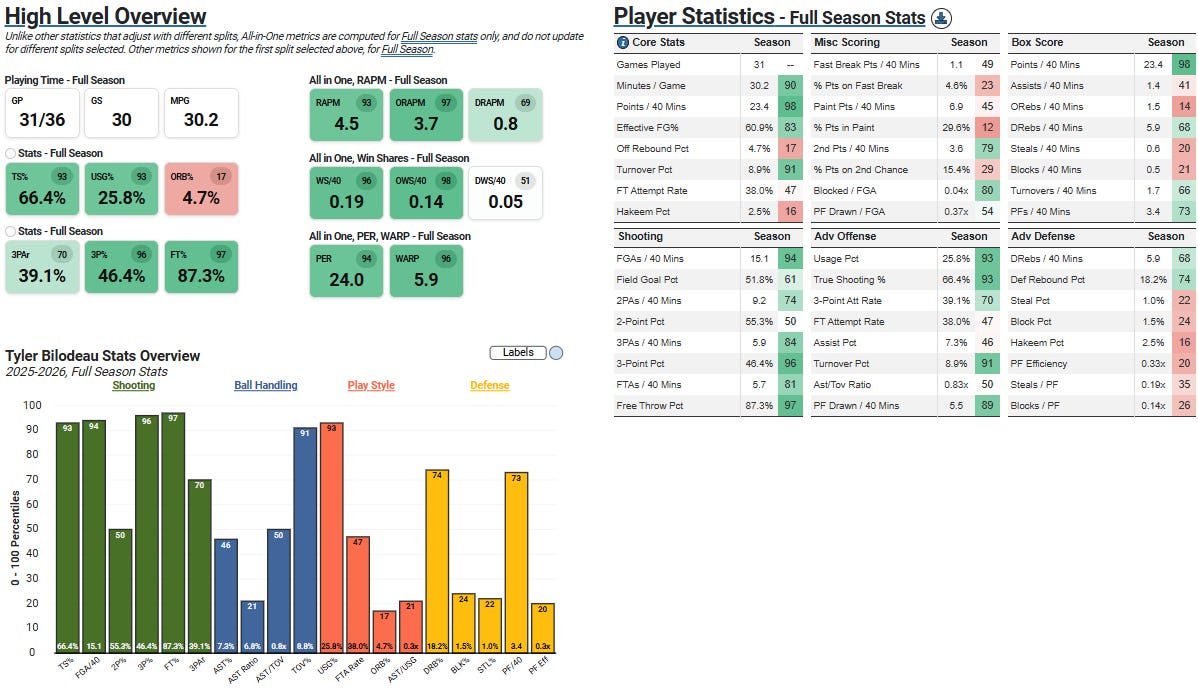
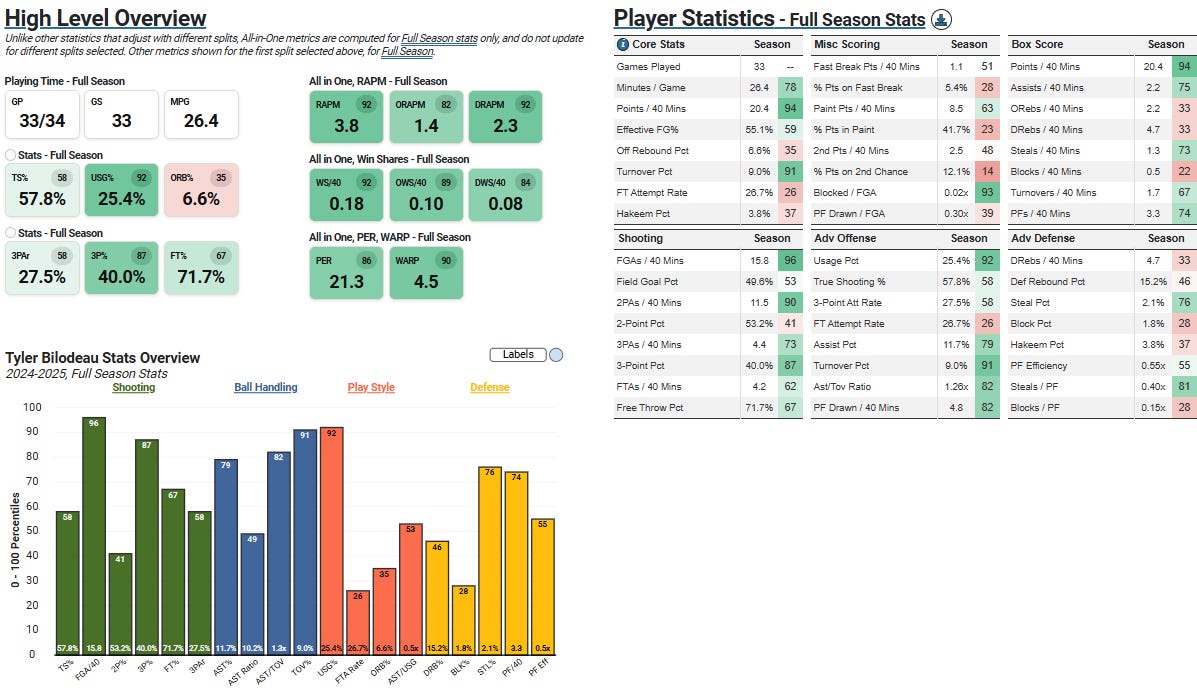
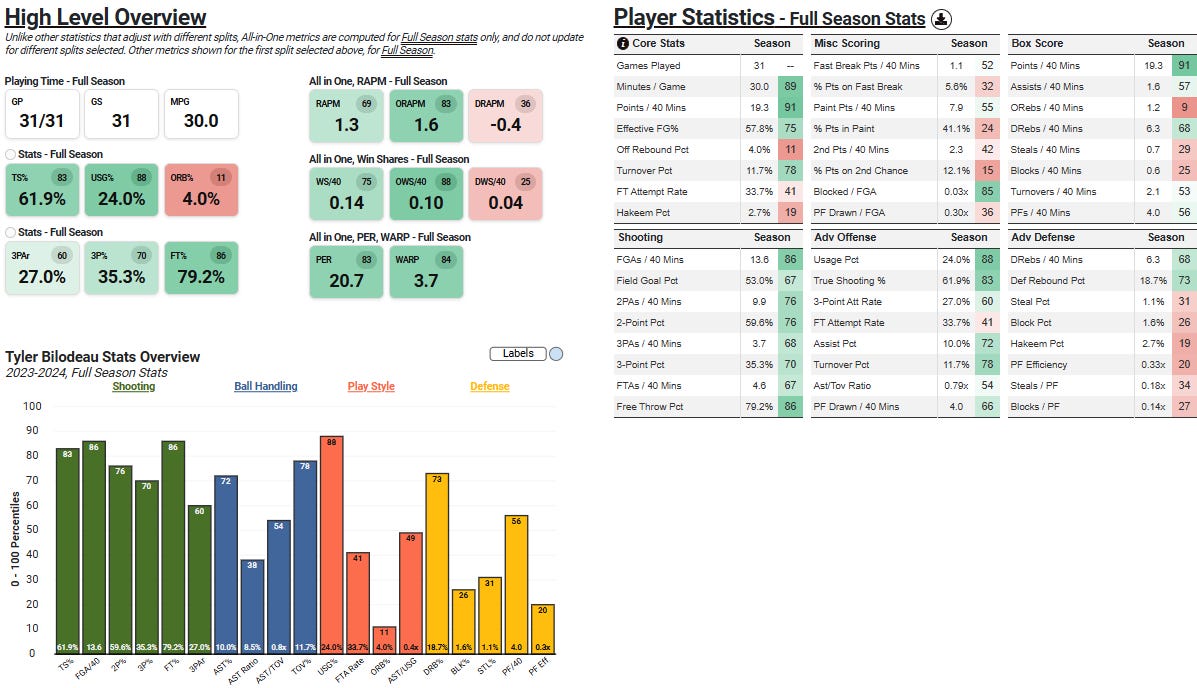
Bilodeau improved his RAPM from -1.2 as a freshman to 1.3 as a sophomore, 3.8 as a junior, and 4.5 as a senior. His WARP similarly climbed from 0.5 to 3.7, then 4.5, before reaching 5.9 during his final season. The trajectory reflects a player who consistently added offensive value while successfully transitioning from a rebuilding Oregon State program to a winning UCLA team.
The shooting development is arguably the most encouraging aspect of the profile.
As a freshman, Bilodeau shot 30.0 percent from three. That improved to 35.3 percent as a sophomore, 40.0 percent as a junior, and 46.4 percent during his senior season. His free-throw percentage simultaneously climbed from 82.4 percent to 87.3 percent, reinforcing the legitimacy of the shooting projection. By his final year, he ranked in the 96th percentile nationally in three-point percentage while maintaining strong volume.
The efficiency profile is outstanding.
Bilodeau posted a 66.4 percent true shooting percentage during his senior season while carrying a 25.8 percent usage rate. Few frontcourt players combined that level of offensive responsibility with such efficient production. His 24.0 PER, 5.9 WARP, and 0.19 Win Shares per 40 minutes all ranked well above national averages and support the notion that he was one of the most impactful offensive forwards in the country.
The scoring package is more diverse than many stretch forwards.
Unlike pure spot-up shooters, Bilodeau can score from multiple levels. He converted 55.3 percent of his two-point attempts while also shooting 46.4 percent from three. His scoring profile includes post touches, face-up opportunities, pick-and-pop actions, transition scoring, and secondary creation. While he is not a primary shot creator, he consistently punished defensive mistakes and provided spacing that opened the floor for teammates.
The advanced offensive metrics are particularly strong.
His 3.7 Offensive RAPM ranked in the 97th percentile nationally during his senior season. He generated 23.4 points per 40 minutes while maintaining elite efficiency and low turnover rates. His offensive impact consistently exceeded what traditional box-score statistics alone would suggest.
Defensively, the evaluation becomes more complicated.
Bilodeau’s defensive impact improved significantly after transferring to UCLA, but he still projects as more of a neutral defender than a true defensive difference-maker. His rebound rates remained modest for a 6-foot-9 forward, and he never generated high steal or block numbers. While his Defensive RAPM improved to positive territory as an upperclassman, much of his overall value remains tied to offensive production.
The positional fit will be one of the key questions for professional evaluators.
At 6-foot-9, Bilodeau possesses the size to play power forward, but he does not consistently provide the rebounding, rim protection, or physicality traditionally associated with the position. Offensively, his shooting and skill set clearly fit modern NBA spacing principles, but defensively he may require a specific frontcourt partner capable of handling more interior responsibilities.
The encouraging aspect is that his offensive game appears highly translatable.
Elite shooting, efficient scoring, strong free-throw indicators, low turnovers, and positive offensive impact metrics are all traits that tend to translate well across levels. Bilodeau does not need high usage to be effective, and his ability to function both on and off the ball should make him easier to integrate into professional systems.
Bilodeau projects as a modern offensive-minded stretch forward whose value will be driven by shooting, efficiency, and offensive versatility. While he may never become a high-end defensive contributor, the combination of elite shot-making, strong advanced metrics, consistent year-over-year improvement, and scalable offensive skills gives him a realistic pathway to carving out a professional role as a floor-spacing frontcourt contributor.
Statistical Overview By Year:
2025-2026 (Senior Season)
2024-2025 (Junior Season)
2023-2024 (Sophomore Season)
2022-2023 (Freshman Season)
Scoring Context By Year:
2025-2026 (Senior Season)
2024-2025 (Junior Season)
2023-2024 (Sophomore Season)
2022-2023 (Freshman Season)
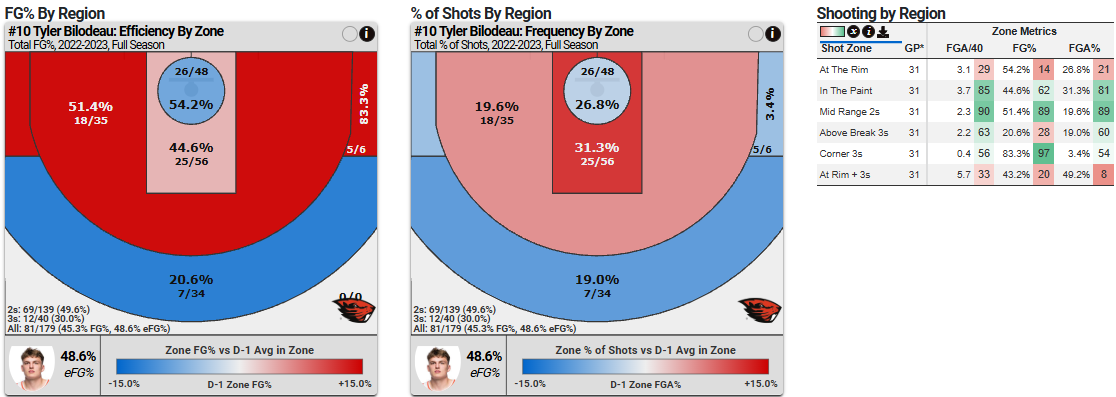
Key Note about Scoring Context: One of the most important contextual factors when evaluating Tyler Bilodeau’s offensive profile is understanding how dramatically his role evolved throughout his collegiate career. Unlike many upperclassmen who maintain a relatively stable offensive identity, Bilodeau steadily expanded both his scoring volume and offensive versatility from Oregon State to UCLA.
The offensive growth is visible in both shot selection and scoring responsibility.
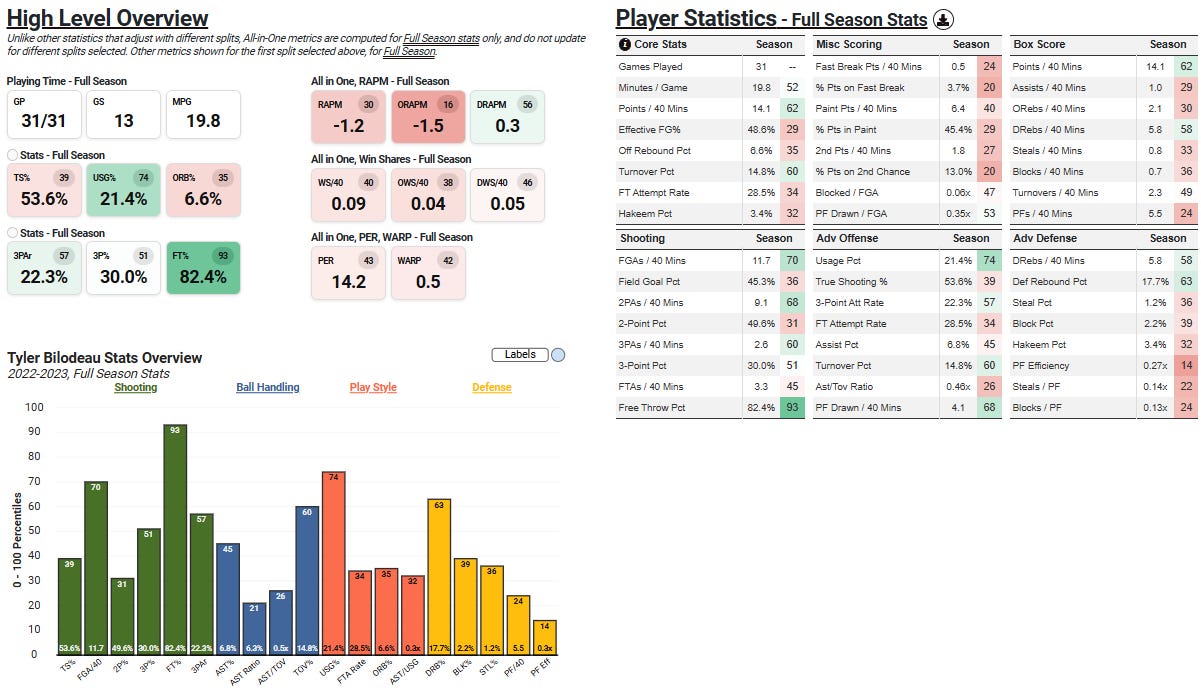
As a freshman at Oregon State, Bilodeau operated primarily as a complementary frontcourt scorer. Nearly 52 percent of his attempts came at the rim or in the paint, while his perimeter game was still developing. He shot just 30.0 percent from three and posted a modest 14.1 points per 40 minutes. At that stage, much of his value came from finishing opportunities created by others and converting efficient interior looks.
By his sophomore season, the scoring profile became more balanced.
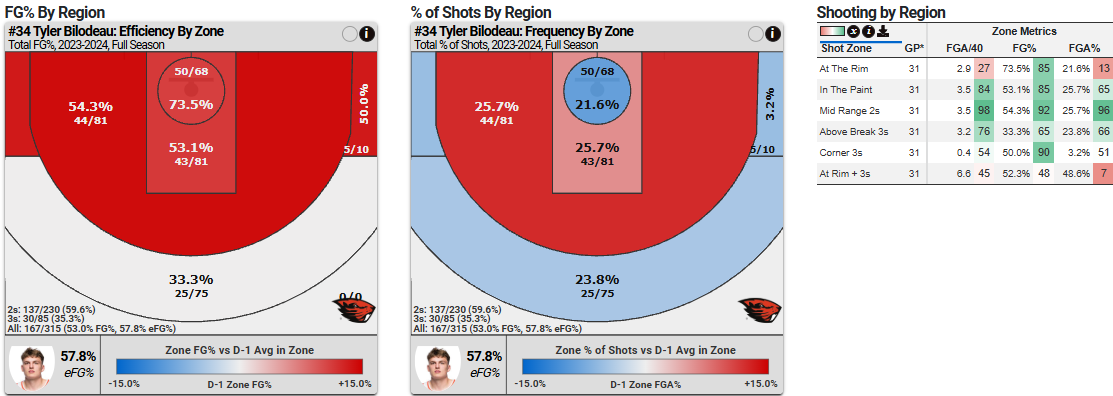
His paint usage remained strong, but his efficiency around the basket improved significantly, converting nearly 74 percent of his rim attempts while increasing his overall scoring volume. His three-point percentage climbed to 35.3 percent, giving Oregon State a more versatile offensive weapon capable of stretching defenses beyond the paint.
The transition to UCLA accelerated that development even further.
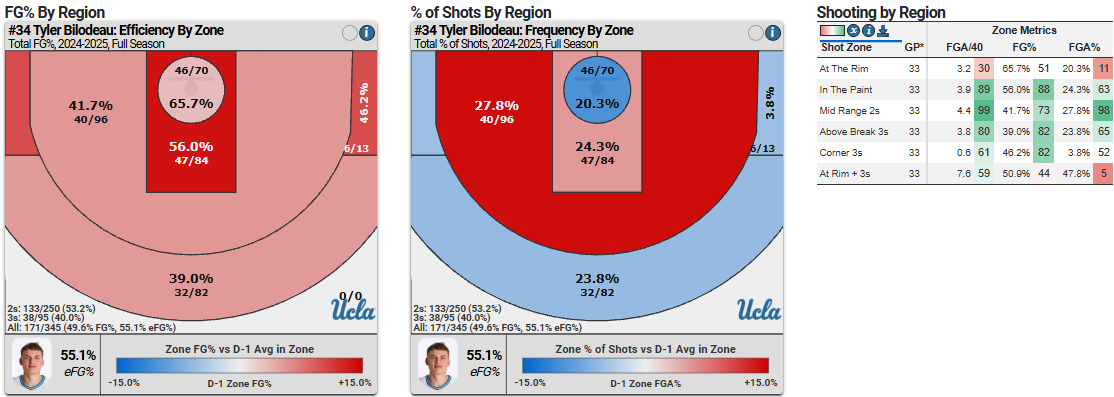
During his junior season, Bilodeau emerged as one of the Bruins’ primary offensive options. His three-point percentage jumped to 40.0 percent while maintaining efficient interior scoring. Rather than functioning strictly as a stretch forward, he developed into a true three-level scorer capable of generating offense from the post, midrange, and perimeter.
His senior season represented the most complete version of that evolution.
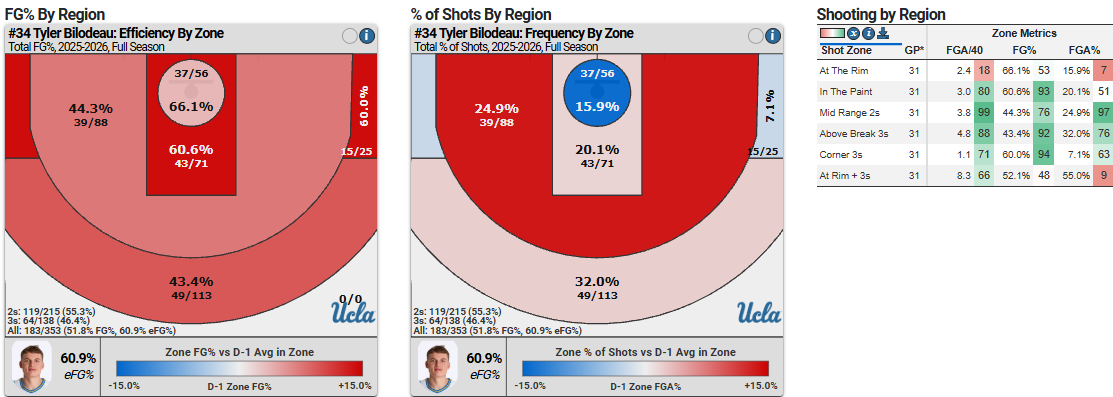
Bilodeau averaged 23.4 points per 40 minutes while posting a 66.4 percent true shooting percentage and a 46.4 percent mark from three. Unlike many high-volume shooters whose production becomes heavily dependent on perimeter attempts, Bilodeau maintained a remarkably balanced shot profile. Approximately 55 percent of his attempts still came inside the arc, while 45 percent originated from beyond the three-point line.
The midrange development may be the most overlooked aspect of the profile.
Most modern stretch forwards either finish at the rim or space the floor from three. Bilodeau consistently generated meaningful scoring volume from the midrange throughout his career. By his senior season, nearly one-quarter of his total attempts came from midrange areas where he converted 44.3 percent of his shots, ranking in the 97th percentile nationally for midrange volume. That additional layer makes him far more difficult to scheme against than a traditional spot-up specialist.
The perimeter shooting progression appears sustainable.
His three-point percentage improved from 30.0 percent as a freshman to 35.3 percent, then 40.0 percent, and ultimately 46.4 percent as a senior. Combined with free-throw percentages ranging from 79 to 87 percent during his final three seasons, the shooting indicators strongly support legitimate long-term floor-spacing potential rather than a one-year shooting outlier.
Perhaps most encouraging is that his efficiency improved despite increasing offensive responsibility.
Many players experience declining efficiency as usage rises. Bilodeau accomplished the opposite. His usage rate increased substantially throughout his career while his true shooting percentage climbed from 53.6 percent as a freshman to 66.4 percent as a senior. That combination of volume and efficiency is typically associated with high-level offensive players.
The scoring profile ultimately reinforces his professional projection.
Bilodeau is not simply a stretch forward who survives offensively because he can shoot. He is a legitimate three-level scorer who has demonstrated the ability to score inside, punish defenses from midrange, and space the floor at an elite level from beyond the arc. The continuous improvement over four collegiate seasons provides additional confidence that his offensive game can continue scaling at higher levels of competition.

(Provided by Cbbanalytics)
Video Reference
(Video Credit: Big Ten Men’s Basketball)
(Video Credit: Video Coordinator Mixes)
NBA Projection & Player Comparisons
Projected Role: Stretch 4 Potential
One of the more intriguing aspects of Tyler Bilodeau’s projection is that he possesses a skill set that aligns closely with what NBA teams seek from modern offensive-minded power forwards. At 6-foot-9, Bilodeau offers legitimate frontcourt size while combining floor spacing, shot-making versatility, and offensive efficiency that continued to improve throughout his collegiate career.
The shooting profile is the foundation of the projection.
Bilodeau increased his three-point percentage every season, climbing from 30.0 percent as a freshman to 46.4 percent as a senior. More importantly, the improvement came alongside increased volume and offensive responsibility. His combination of elite shooting percentages, strong free-throw indicators, and proven production against Big Ten competition suggests the perimeter shooting is likely translatable to higher levels.
The offensive versatility extends beyond simple floor spacing.
Unlike many stretch forwards who operate almost exclusively as spot-up shooters, Bilodeau demonstrated the ability to score from multiple areas of the floor. By his senior season, nearly one-quarter of his attempts came from the midrange while another 40 percent originated inside the arc. He can attack closeouts, operate from the elbows, score from the post against mismatches, and punish defenses that overcommit to his perimeter shooting.
His offensive efficiency remained remarkably stable despite role expansion.
As his usage rate increased from 21.4 percent as a freshman to 25.8 percent as a senior, his true shooting percentage improved from 53.6 percent to 66.4 percent. Players who can simultaneously increase volume and efficiency are uncommon, particularly in major conference basketball.
The offensive impact metrics reinforce the projection.
Bilodeau finished his senior season with a 3.7 Offensive RAPM, 5.9 WARP, 24.0 PER, and 0.19 Win Shares per 40 minutes. Those numbers consistently place him among the most impactful offensive forwards in college basketball and suggest his value extends beyond traditional scoring totals.
The primary questions center on the defensive side of the floor.
While Bilodeau has adequate size for the power forward position, he is not a traditional interior defender. His rebounding numbers remained relatively modest throughout his career, and he never developed into a significant rim protector. Teams evaluating him will need to determine whether he can adequately defend NBA fours while avoiding difficult matchups against more physical frontcourt players.
That said, the modern NBA has increasingly prioritized offensive versatility from the power forward position.
Many successful stretch fours are valued more for their ability to create spacing, maintain offensive flow, and complement primary creators than for their traditional interior defensive presence. Bilodeau’s offensive profile fits naturally within that archetype.
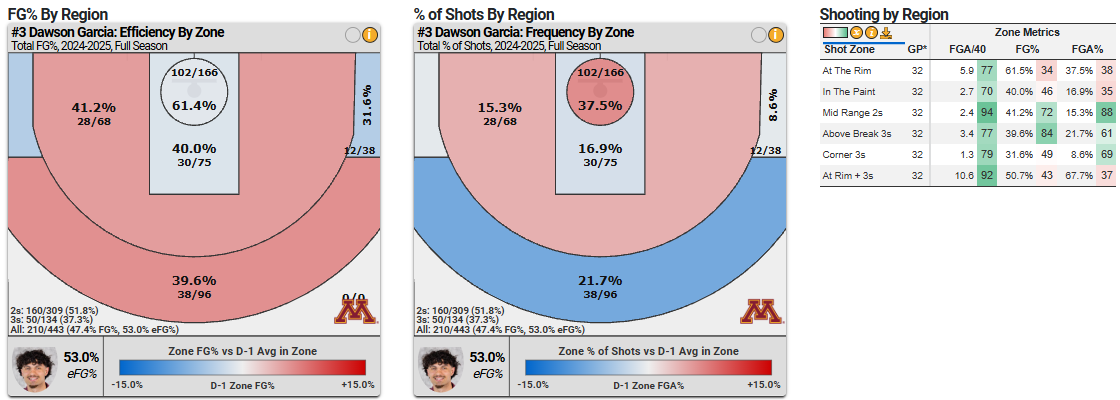
Projected Player Comparison (Stat Based):
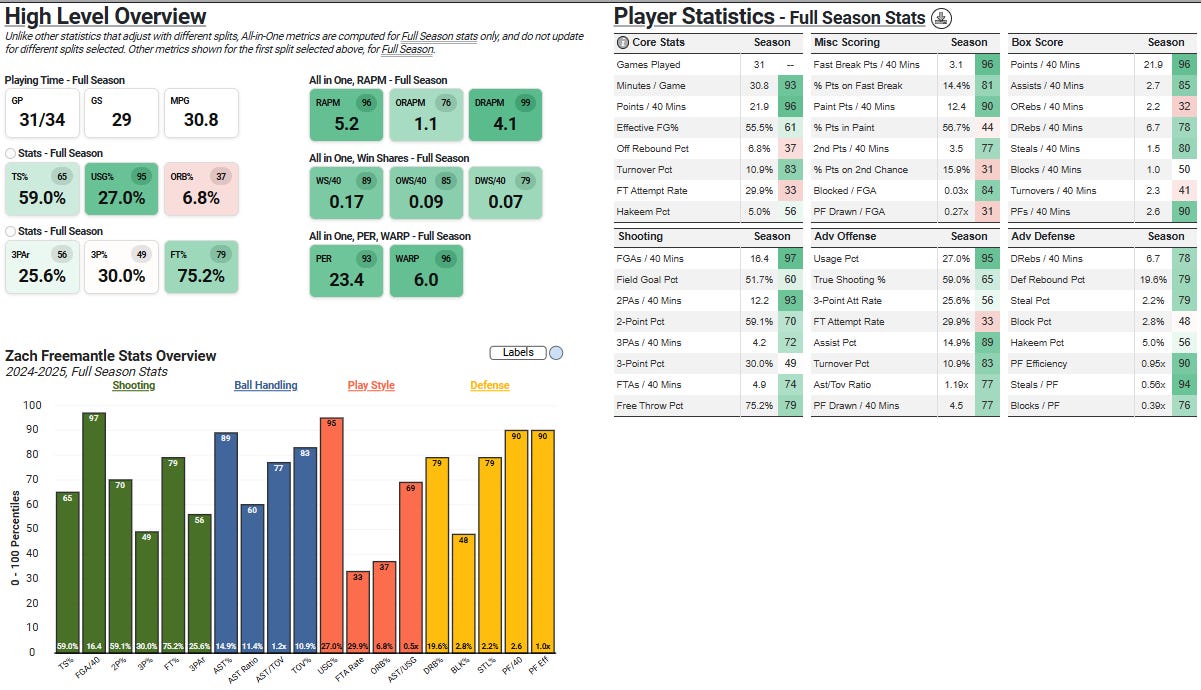
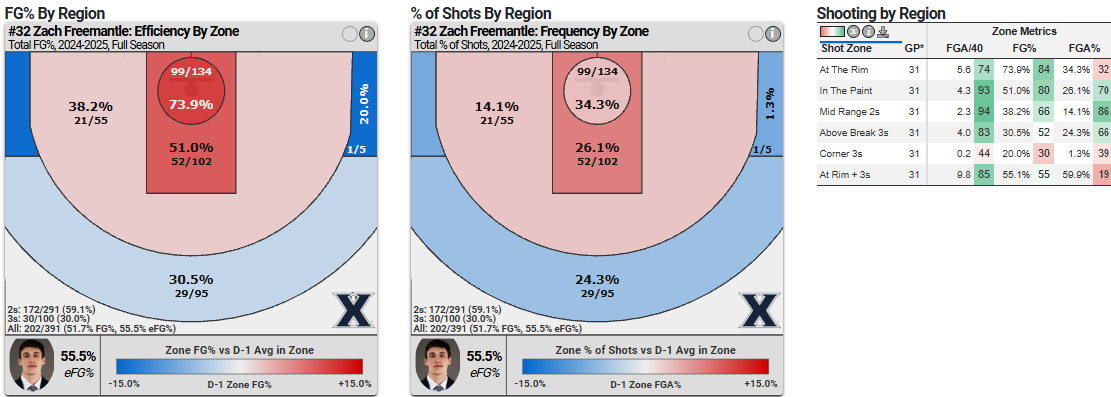
Zach Freemantle
Dawson Garcia
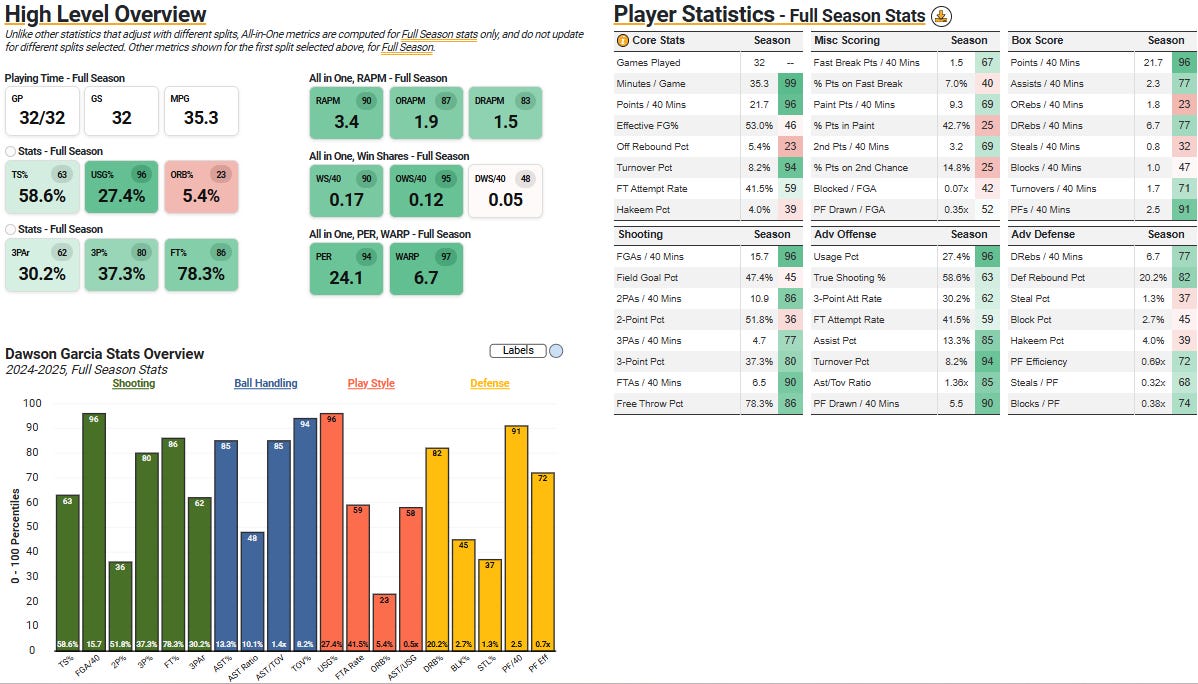
(Provided by Cbbanalytics)
Analysis:
Overall Impact: 13/25
Bilodeau’s overall impact profile reflects a player whose value is driven heavily by offensive efficiency and floor spacing rather than complete two-way contributions. The offensive production is unquestionably NBA-caliber in several areas, but limitations in defensive impact, playmaking, athletic tools, and rebounding ultimately temper the overall projection.
The scoring production stands out immediately.
Bilodeau averaged 23.4 points per 40 minutes, ranking in the 98th percentile nationally, while converting 46.4 percent from three and posting a 66.4 percent true shooting percentage. Few frontcourt players in college basketball combined that level of scoring volume with comparable efficiency. His offensive value was consistently evident throughout UCLA’s season and frequently served as a stabilizing force within the half-court offense.
The advanced metrics largely support the offensive impact.
Bilodeau posted a 4.5 RAPM, including a strong 3.7 ORAPM, while generating a 24.0 PER and a 5.9 WARP. UCLA consistently performed better offensively with him on the floor, reflecting both his scoring gravity and his ability to fit within winning offensive structures.
The offensive profile is relatively easy to project.
Elite shooting from a 6-foot-9 forward always creates value. Bilodeau’s ability to stretch defenses, score from multiple levels, and operate efficiently without dominating the ball provides a clear pathway toward contributing at higher levels of basketball.
However, the overall impact profile becomes more mixed once the evaluation expands beyond scoring.
The rebounding numbers were adequate but not exceptional for a player of his size, ranking only in the 40th percentile for total rebounds per 40 minutes. The defensive playmaking metrics were similarly underwhelming, with steals and blocks both ranking near the bottom quarter nationally among comparable players. Those limitations reduce his ability to impact games when his shot is not falling.
The playmaking profile also limits his ceiling.
Bilodeau generated only 1.4 assists per 40 minutes despite carrying a significant offensive role. While he generally makes the correct read, he is not a player who consistently elevates teammates through creation or passing vision.
The supporting cast context is important when evaluating some of the impact metrics.
UCLA’s roster during Bilodeau’s senior season was not as strong offensively as some of the teams he played on earlier in his career, which may partially suppress certain lineup-based and plus-minus indicators. Despite that, he still posted a plus-minus figure that ranked in the 92nd percentile nationally, suggesting his presence remained highly beneficial to team success even without elite surrounding talent.
The projection ultimately comes down to specialization versus completeness.
Bilodeau possesses a clearly translatable NBA skill in shooting and enough offensive versatility to potentially carve out a role as a stretch-four. At the same time, he does not provide significant defensive playmaking, rebounding dominance, creation ability, or athletic upside. Many of his pathways to success are dependent upon maintaining elite shooting efficiency.
Ultimately, Bilodeau projects as a role-dependent offensive forward whose value is built around spacing, scoring efficiency, and offensive intelligence. The shooting gives him a legitimate opportunity to contribute at higher levels, but the lack of impact in several secondary areas prevents the profile from reaching starter-level territory.
Scoring: 5/9
Bilodeau’s scoring profile is built around efficiency, versatility, and shot-making rather than overwhelming athleticism or downhill rim pressure. He finished his senior season averaging 23.4 points per 40 minutes while maintaining a 66.4 percent true shooting percentage, demonstrating the ability to produce high-level offensive value without requiring elite burst or creation ability.
The half-court scoring profile is particularly impressive.
Over 90 percent of his field-goal attempts came in half-court settings, ranking in the 96th percentile nationally. Within those possessions, he converted 56.4 percent of his two-point attempts and an elite 45.2 percent of his three-point attempts, placing him in the 95th percentile nationally as a half-court three-point shooter. Few frontcourt players combined that level of volume with that degree of perimeter efficiency.
The scoring versatility separates him from many traditional stretch forwards.
Bilodeau is capable of scoring from all three levels. He can punish defenders from beyond the arc, operate comfortably in the midrange, attack closeouts, and finish efficiently around the basket. His scoring profile became increasingly balanced throughout his collegiate career, allowing him to contribute offensively in a variety of ways rather than relying exclusively on spot-up opportunities.
The foul-drawing metrics provide additional value and help explain some of his offensive efficiency.
He generated 2.27 shooting fouls drawn per 40 minutes, ranking in the 76th percentile nationally, while posting strong marks in floor fouls drawn and offensive fouls drawn that ranked in the 90th percentile or better. His 0.86 and-ones per 40 minutes ranked in the 93rd percentile nationally, illustrating an ability to absorb contact and complete plays despite not being an overwhelming physical force.
What makes those numbers particularly noteworthy is that they were not generated through elite rim pressure. Unlike many forwards who accumulate free throws through constant downhill attacks, Bilodeau produced foul-drawing value through polished footwork, shot fakes, closeout attacks, post scoring, and strong positional awareness. He consistently forced defenders into difficult decisions and created contact opportunities without needing to dominate the ball or live at the rim.
The offensive foul-drawing numbers are also an underappreciated aspect of his profile. Ranking in the 90th percentile in offensive fouls drawn reflects strong anticipation, feel, and basketball IQ. While those plays do not directly appear in scoring totals, they created extra possessions and contributed positively to overall offensive impact.
The efficiency remained strong in multiple scoring environments.
Bilodeau converted 56.4 percent of his half-court two-point attempts and shot over 58 percent on transition three-pointers, showcasing both shot-making versatility and strong offensive decision-making. He consistently punished defensive breakdowns and capitalized on opportunities created by team offensive flow.
However, the scoring profile is not without limitations.
Only 29.6 percent of his points came in the paint, ranking in the 12th percentile nationally. His paint scoring volume similarly ranked in just the 45th percentile. While he is capable of finishing around the basket, he does not consistently pressure the rim or generate easy interior offense at the rate typically associated with high-level NBA forwards.
The transition scoring profile is also relatively limited.
Only 4.6 percent of his total scoring came in transition, and his fast-break production ranked below average nationally. Much of his offensive value comes from skill, spacing, shot-making, and offensive polish rather than open-floor athleticism.
Self Creation: 1/9
Self-creation is clearly the weakest area of Bilodeau’s offensive profile and represents one of the primary reasons he projects more comfortably as a complementary offensive piece rather than a primary scoring option at the professional level.
The assisted scoring dependency is extremely high.
Over 81 percent of Bilodeau’s made field goals were assisted, ranking in the 91st percentile nationally. While that speaks positively to his ability to move without the ball and capitalize on opportunities created by teammates, it also highlights how infrequently he was asked to manufacture offense independently.
The same trend appears throughout every scoring zone.
Nearly 71 percent of his two-point makes were assisted, ranking in the 87th percentile nationally. More notably, 100 percent of his made three-pointers were assisted. Despite shooting 45.2 percent from beyond the arc, there is virtually no evidence of self-created perimeter scoring. His three-point production came almost entirely through catch-and-shoot opportunities generated by offensive structure and playmakers around him.
The rim-finishing data tells a similar story.
Nearly 73 percent of his made shots at the rim were assisted, while his unassisted rim finishing volume ranked in just the 11th percentile nationally. Rather than creating advantages off the dribble, Bilodeau primarily scored through cuts, relocations, pick-and-pop actions, transition spacing, and interior positioning.
The unassisted scoring volume is modest relative to his overall production.
Although he generated 7.9 unassisted points per 40 minutes, ranking in the 71st percentile nationally, much of that production came from attacking secondary closeouts or exploiting mismatches rather than consistently breaking down defenders in isolation. His unassisted field-goal creation rate remained well below that of primary scoring forwards.
This does not necessarily diminish his offensive value.
Many successful stretch forwards derive their value from elite off-ball movement, spacing, and finishing rather than self-generated offense. Bilodeau consistently demonstrated the ability to play within offensive structure and punish defensive mistakes without monopolizing possessions.
However, the projection ceiling is somewhat limited by the lack of creation upside.
There is little evidence suggesting he can consistently create separation off the dribble, generate pull-up offense, or function as a late-clock shot creator. Against NBA athletes and defensive schemes, the ability to generate offense independently becomes increasingly valuable, and Bilodeau’s profile offers limited proof in that area.
Bilodeau projects as an offensive connector and floor spacer rather than a creator. His scoring efficiency is highly attractive, but much of that production is dependent upon offensive ecosystem, ball movement, and surrounding playmakers.
Playmaking: 2/9
While Bilodeau was a highly productive offensive player, much of his value came from scoring rather than facilitating. His playmaking profile reflects a forward capable of making the correct read within offensive structure, but not one who consistently creates offense for others or functions as an offensive hub.
The usage profile highlights his scoring-oriented role.
Bilodeau posted a 25.8 percent usage rate, ranking in the 93rd percentile nationally, while accounting for nearly 20 percent of UCLA’s field-goal attempts and over 22 percent of the team’s free-throw attempts. Despite carrying a substantial offensive workload, he generated only 6.6 percent of team assists, illustrating that his primary responsibility was finishing possessions rather than initiating them.
The assist volume remained modest.
Bilodeau recorded just 33 assists across 31 games, producing roughly 1.4 assists per game. While he occasionally demonstrated the ability to find cutters or make basic kick-out reads, there is limited evidence suggesting advanced creation ability or consistent manipulation of defenses as a passer.
The scoring gravity did create some secondary playmaking value.
He generated 26.7 points created per 40 minutes, ranking in the 92nd percentile nationally, largely because of his scoring efficiency and offensive involvement. However, much of that value stemmed from his own scoring production rather than direct setup opportunities for teammates.
There are some encouraging connective-passing indicators.
Bilodeau produced strong percentile rankings for assists generated in paint and midrange areas, ranking in the 87th percentile for paint assists per 40 minutes and the 92nd percentile for midrange assists per 40 minutes. Those numbers suggest he is capable of making reads when defenses collapse and generally understands offensive flow.
However, the broader profile remains that of a finisher rather than a creator.
Nearly 71 percent of his two-point field goals were assisted, while 100 percent of his three-point makes were assisted. Those numbers reinforce the reality that Bilodeau was far more comfortable operating as the recipient of offensive actions than as the player initiating them.
The passing reads are generally functional but not dynamic.
He can make the extra pass, identify open shooters, and keep the ball moving within a system, but he rarely creates advantages through passing vision alone. Most of his assists came as a byproduct of defensive attention generated by his scoring rather than advanced playmaking instincts.
The turnover profile does provide some positive context.
Despite carrying a significant offensive role, Bilodeau accounted for only 14.6 percent of team turnovers, ranking in the 15th percentile for turnover share. While he is not creating many opportunities for teammates, he generally avoids forcing plays and understands his offensive limitations.
Shooting: 5/9
Shooting is one of the more intriguing aspects of Bilodeau’s offensive profile because his shot distribution does not necessarily align with what his physical profile would suggest. At 6-foot-9 with a solid frame, Bilodeau often looks like a player who would generate a larger portion of his offense around the basket. Instead, he developed into a highly skilled perimeter-oriented forward whose offensive value is driven as much by shot-making and floor spacing as interior scoring.
The perimeter shooting is unquestionably a strength.
Bilodeau converted 46.4 percent of his three-point attempts during his senior season, ranking in the 96th percentile nationally. He made 57 above-the-break threes at a 43.4 percent clip and an impressive 60 percent on corner threes, giving him legitimate shooting value from multiple areas beyond the arc. Few frontcourt players in college basketball combined his volume with that level of efficiency.
The shot profile is somewhat unconventional for a player with his size and frame.
Only 15.9 percent of his field-goal attempts came at the rim, ranking in just the 7th percentile nationally. By comparison, nearly 57 percent of his total attempts came from either midrange or three-point territory. His average two-point shot distance ranked in the 2nd percentile nationally, reflecting how frequently he operated away from the basket despite possessing the physical dimensions of a traditional power forward.
The midrange volume is particularly unusual.
Nearly 25 percent of his attempts came from midrange areas, ranking in the 97th percentile nationally. Most modern forwards either prioritize rim attempts or three-pointers, but Bilodeau consistently utilized the midrange as a meaningful part of his scoring arsenal. More importantly, he converted those shots at a strong 44.3 percent clip, ranking in the 76th percentile nationally.
That versatility creates offensive value.
Rather than functioning solely as a spot-up shooter, Bilodeau can score from multiple levels. He is comfortable operating from the elbows, attacking closeouts into pull-up jumpers, utilizing turnaround jumpers in the post, and stretching defenses well beyond the three-point line. His offensive game often resembles that of a skilled scoring forward rather than a traditional stretch big.
The efficiency indicators strongly support the shooting projection.
His 68.6 percent effective field goal percentage on rim-and-three opportunities ranked in the 84th percentile nationally, while his overall three-point percentage ranked among the best marks in college basketball. Combined with his career-long improvement as a shooter and strong free-throw percentages, there is substantial evidence that the shooting is sustainable rather than the result of a small-sample outlier season.
However, the unusual shot diet creates some projection questions.
For a player with Bilodeau’s size, athletic profile, and interior strength, the lack of rim pressure stands out. While he finished efficiently when he got to the basket, he simply did not get there very often. NBA evaluators will likely ask whether he can maintain his efficiency against longer and more athletic defenders if he continues relying heavily on difficult midrange attempts and jump shooting.
The reliance on skill over athleticism also creates a narrower margin for error.
Bilodeau is not generating offense through elite burst, vertical pop, or overwhelming physical advantages. Much of his shooting success is built on touch, footwork, shot preparation, and offensive IQ. Fortunately, those are often among the more translatable offensive skills for frontcourt players.
Defensive Attribution: 3/10
Defense remains one of the more challenging aspects of Bilodeau’s evaluation and is likely the primary factor preventing him from projecting as a clear NBA rotation player. While he possesses adequate size for a modern power forward and demonstrated improvement throughout his collegiate career, the overall defensive profile lacks the disruptive traits, rim protection, and playmaking impact typically associated with high-level frontcourt defenders.
The rebounding numbers provide some positive context.
Bilodeau posted an 18.2 percent defensive rebounding rate, ranking in the 74th percentile nationally. He consistently secured defensive possessions and generally fulfilled his responsibilities as a team rebounder. While not an elite rebounder for his position, he was productive enough to avoid becoming a liability on the glass.
Beyond rebounding, however, the defensive impact metrics become less encouraging.
Bilodeau generated just a 1.0 percent steal rate and a 1.5 percent block rate, both ranking well below average among frontcourt prospects. His steal production ranked in only the 22nd percentile nationally, while his block rate ranked in the 24th percentile. Those numbers suggest a player who rarely creates defensive events and does not consistently alter possessions through disruption.
The lack of defensive playmaking is particularly noticeable.
Modern NBA teams increasingly value forwards who can generate steals, switch actions, provide weak-side rim protection, or create turnovers through activity. Bilodeau’s profile suggests a player who is generally positionally sound but unlikely to generate significant defensive value through event creation. His Hakeem percentage similarly ranked in just the 16th percentile, reinforcing the limited defensive playmaking projection.
The foul profile presents a mixed picture.
Bilodeau committed 3.4 fouls per 40 minutes while ranking in the 73rd percentile nationally for foul rate, indicating he generally stayed on the floor and avoided excessive foul trouble. However, his overall foul efficiency ranked in just the 20th percentile, largely because the defensive events created did not consistently offset the fouls committed. The result is a defender who was relatively disciplined but not particularly impactful.
The physical profile creates additional projection questions.
At 6-foot-9, Bilodeau has the size to defend power forwards, but he lacks the vertical explosiveness and length typically associated with impactful interior defenders. He is not a natural rim protector, nor does he project as a highly versatile switch defender capable of consistently containing smaller players in space. Much of his defensive value will need to come from positioning, awareness, and effort rather than physical tools.
This becomes especially important when considering his offensive role.
Because Bilodeau projects as a stretch-four offensively, teams will naturally ask whether he can provide enough defensive value to remain on the floor against professional competition. His offensive game clearly offers NBA-level skills, but the defensive profile lacks a standout trait that would consistently offset offensive cold stretches.
There are still some encouraging signs.
Bilodeau generally competed, rebounded his position adequately, and improved defensively after transferring to UCLA. He rarely looked overwhelmed physically at the college level and demonstrated a willingness to play within team defensive concepts. Those qualities provide a foundation that could allow him to become a serviceable team defender.
Off-Ball Offense: 6/9
Off-ball offense is one of the stronger aspects of Bilodeau’s overall profile and plays a significant role in why his offensive game projects more favorably than some of his raw athletic traits might suggest. While he is not a high-level creator with the ball in his hands, he consistently found ways to generate efficient offense through movement, spacing, timing, and an advanced understanding of offensive flow.
The shooting gravity is the foundation of his off-ball value.
Bilodeau shot 46.4 percent from three during his senior season, including 45.2 percent on above-the-break attempts. Defenses were forced to account for him at all times, creating spacing benefits that extended beyond his individual scoring production. His ability to function as a legitimate pick-and-pop threat makes him particularly attractive within modern offensive systems.
The assisted scoring profile reinforces the projection.
Over 81 percent of his made field goals were assisted, including 100 percent of his made three-pointers. While those numbers limit his self-creation grade, they simultaneously highlight his effectiveness operating away from the ball. Bilodeau consistently positioned himself to capitalize on defensive rotations, ball movement, and offensive actions designed to create open looks.
His understanding of spacing is evident throughout the film.
Rather than remaining stationary on the perimeter, Bilodeau routinely relocated into passing windows, filled open space during drive-and-kick sequences, and maintained proper floor balance. Those habits allowed him to maximize his shooting ability while keeping offensive possessions flowing naturally.
The scoring versatility adds another layer.
Unlike many floor-spacing forwards who operate almost exclusively behind the arc, Bilodeau can also contribute through cuts, post seals, short-roll opportunities, and secondary actions around the basket. Although only 15.9 percent of his attempts came at the rim, he converted those opportunities efficiently and demonstrated a good feel for finding openings when defenses became overly focused on his perimeter shooting.
However, the overall off-ball ceiling is somewhat capped by athletic limitations.
Bilodeau is not an explosive lob threat, high-volume cutter, or dynamic vertical spacer. Many of his off-ball opportunities are created through intelligence and skill rather than elite movement ability. As a result, his off-ball value is more closely tied to shooting gravity than constant pressure on the defense through movement.
The offensive rebounding contribution is also fairly modest.
His putback volume ranked near the bottom of the national percentile rankings, and he was not a major source of second-chance offense through sheer physicality or activity around the basket. While he can capitalize on opportunities when they arise, offensive rebounding is not a defining component of his off-ball impact.
Post (Scoring/Playmaking): 3/9
Bilodeau possesses more post functionality than many modern stretch forwards, but it is not a defining aspect of his offensive profile. While he can score effectively against favorable matchups and occasionally create advantages with his footwork and touch, he is unlikely to become a player whose offensive value is built around consistent post creation at higher levels.
The physical tools initially suggest more interior upside.
At 6-foot-9 with a solid frame, Bilodeau often looks like a player who should generate a larger percentage of his offense on the block. However, his offensive approach evolved in a different direction throughout his collegiate career. Rather than becoming a traditional interior scorer, he increasingly leveraged his shooting ability and face-up game to create offensive value.
That does not mean the post game lacks utility.
Bilodeau demonstrated the ability to punish smaller defenders, utilize turnaround jumpers, and score over either shoulder when given favorable matchups. His strong touch around the basket and comfort operating from short and mid-post areas allowed UCLA to occasionally utilize him as a secondary mismatch scorer.
The midrange scoring profile supports this evaluation.
Nearly 25 percent of his field-goal attempts came from midrange areas, ranking in the 97th percentile nationally, while converting 44.3 percent of those attempts. Many of these opportunities originated from post isolations, face-up situations, or short post actions where his footwork and touch allowed him to create quality looks without needing elite athleticism.
As a passer, the profile remains fairly limited.
Bilodeau recorded only 33 assists during the season and rarely functioned as a hub for offensive creation from the block. While he generally made the correct read when double-teamed and occasionally found cutters or perimeter shooters, there is little evidence of advanced post playmaking. Most of his passing value came from maintaining ball movement rather than actively generating offense for teammates.
The offensive structure also provides context.
UCLA primarily utilized Bilodeau as a floor spacer, scorer, and complementary offensive option rather than a player operating through consistent post touches. As a result, much of his offensive production came facing the basket rather than playing with his back to it.
The projection becomes more difficult against professional size and athleticism.
While Bilodeau was able to exploit collegiate mismatches, he is unlikely to possess the strength advantage or athletic separation necessary to consistently generate efficient post offense against NBA-caliber forwards. His post scoring will likely remain a situational counter rather than a primary offensive weapon.
Intangibles/Eye Test: 4/11
Bilodeau’s intangibles profile is somewhat difficult to evaluate because much of what makes him successful stems from skill development, offensive polish, and basketball IQ rather than traits that immediately stand out on film. While his production and efficiency were excellent, the eye test often leaves evaluators searching for translatable advantages beyond shooting and offensive skill.
The most encouraging aspect is the steady progression throughout his collegiate career.
Bilodeau improved significantly from his freshman season at Oregon State to his final year at UCLA. His scoring volume, efficiency, shooting consistency, and overall offensive impact all increased over time. Players who make that kind of multi-year developmental leap typically deserve credit for work ethic, coachability, and a commitment to skill development.
His offensive feel is clearly above average.
Bilodeau understands spacing, shot selection, timing, and how to operate within offensive structure. He rarely forces poor shots, consistently finds scoring opportunities within the flow of the offense, and understands how to leverage his shooting gravity to create advantages. His game often appears calculated and efficient rather than reliant on difficult shot-making.
The confidence level also stands out.
After transferring to UCLA, Bilodeau embraced a significantly larger offensive role without sacrificing efficiency. He became one of the Bruins’ primary scoring options and consistently delivered against high-level competition. That ability to handle increased responsibility is an encouraging trait for professional evaluators.
However, the physical profile creates concerns.
Bilodeau does not possess elite athleticism, explosiveness, length, or lateral quickness. For a player projected as a modern stretch four, the lack of standout physical tools creates a smaller margin for error. Much of his success is dependent upon skill execution rather than physical dominance.
The competitive motor appears solid but not overwhelming.
He generally competes, understands assignments, and plays within team concepts, but there are relatively few possessions where he consistently imposes himself physically or changes the tone of a game through energy, athleticism, or defensive disruption. His impact is often quieter than many frontcourt prospects with similar production.
The eye test also raises questions about scalability.
Many of Bilodeau’s collegiate advantages were built on superior skill, touch, and offensive polish. Those traits are valuable, but they become harder to separate with at higher levels where opponents possess greater size, length, and athleticism. Unlike some prospects, there is no obvious elite physical trait that guarantees translation.
The overall projection ultimately relies heavily on the shooting.
When Bilodeau is making shots, his value is easy to see. The floor spacing, offensive efficiency, and scoring versatility fit modern basketball. When the shot is not falling, however, there are fewer secondary avenues through which he impacts the game compared to prospects who provide defensive playmaking, elite rebounding, rim protection, or dynamic athleticism.