


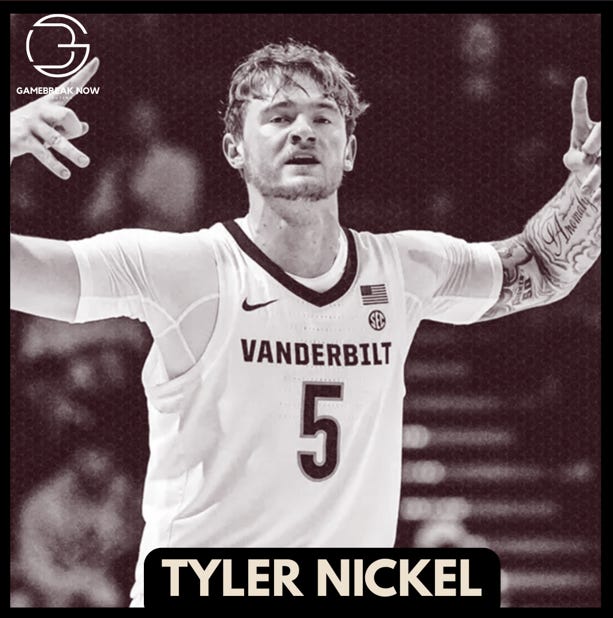
Height: 6’7” Weight: 220Lbs Team: Vanderbilt Class: Senior
Age at Draft: 22.81 Height (Barefoot): 6’6 Weight: 217 Lbs Wingspan: 80.5” (+2.5) Standing Reach: 102.5”
Scouting Snapshot
Tyler Nickel’s collegiate career reflects one of the clearest examples of offensive specialization among modern forward prospects. After beginning his career at North Carolina, transferring to Virginia Tech, and ultimately finishing at Vanderbilt, Nickel steadily developed into one of the nation’s premier high-volume perimeter shooters. Across three programs and multiple offensive systems, his offensive identity remained remarkably consistent: elite floor spacing, movement shooting, offensive efficiency, and low-maintenance complementary scoring.
At 6-foot-7 and approximately 220 pounds, Nickel possesses ideal size for a modern stretch-forward role. Unlike many forwards who generate offense through athleticism, rim pressure, or physical dominance, Nickel’s game is built almost entirely around shooting gravity, floor spacing, offensive IQ, and shot-making versatility. His value comes from the constant pressure he places on defenses without needing high usage or heavy on-ball responsibility.
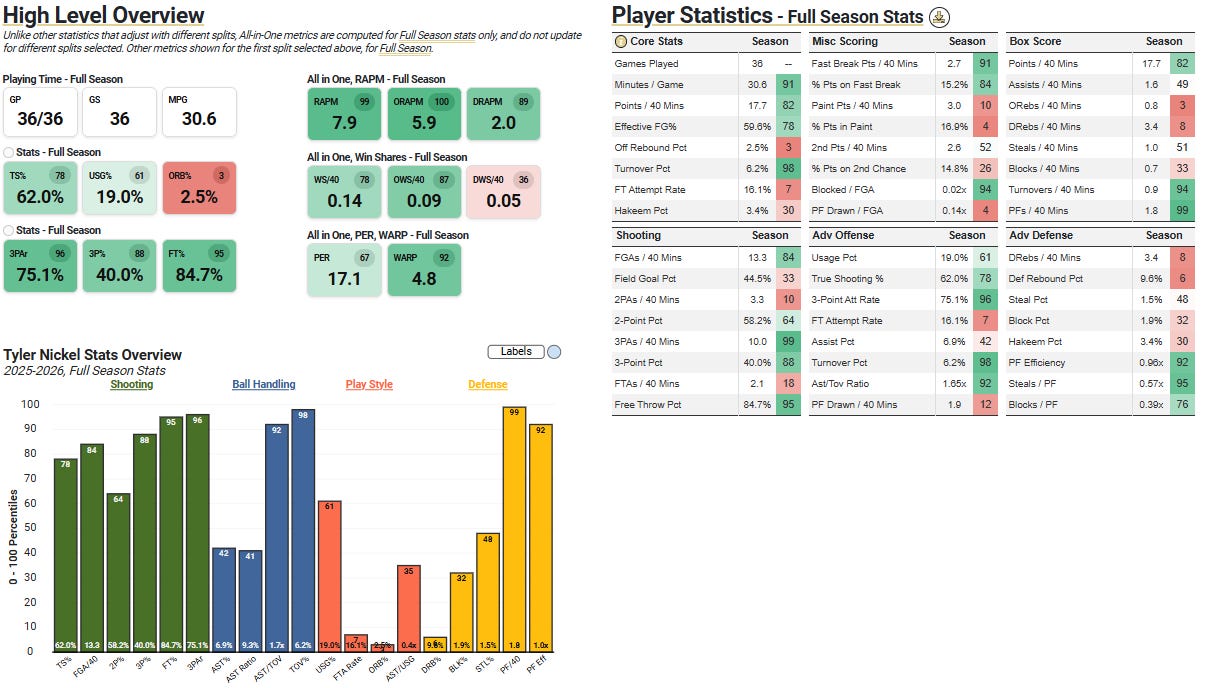
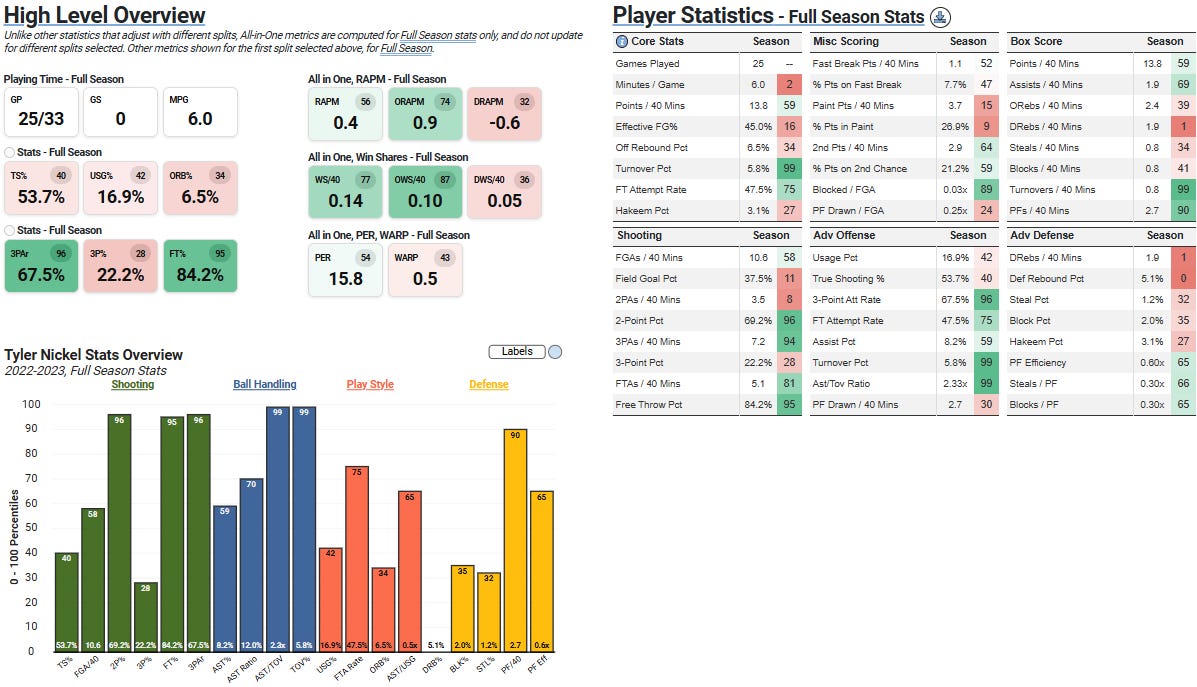
By his senior season at Vanderbilt, Nickel had emerged as one of the most dangerous shooters in college basketball. He averaged 17.7 points per 40 minutes while posting an elite 62.0 percent true shooting percentage. More impressively, he attempted 10.0 three-pointers per 40 minutes while converting 40.0 percent from beyond the arc. Few forwards nationally combined that level of shooting volume with that degree of efficiency. His 96th percentile three-point attempt rate and 88th percentile three-point percentage placed him firmly among the nation’s elite floor spacers.
The advanced metrics further reinforce his offensive impact. Nickel posted a 5.9 Offensive RAPM, ranking in the 100th percentile nationally, while recording a 7.9 overall RAPM. Those numbers suggest his value extended well beyond individual scoring production. Defenses were forced to honor his shooting range at all times, creating spacing opportunities that improved the offensive environment for teammates throughout Vanderbilt’s attack.
One of the more underrated aspects of Nickel’s profile is his decision-making. Despite carrying meaningful offensive responsibility, he posted an elite 6.2 percent turnover rate. Players who combine high-level shooting with exceptional ball security often translate effectively into NBA role-player environments because they can positively impact possessions without requiring significant offensive control.
However, the offensive profile remains highly specialized. Nickel generated very little rim pressure throughout his career and attempted only 3.3 two-point field goals per 40 minutes during his final season. Just 17 percent of his scoring came in the paint, while roughly three-quarters of his shot attempts originated from beyond the arc. His production is overwhelmingly dependent upon perimeter shot-making rather than athletic creation, physical scoring, or downhill pressure.
The lack of self-creation naturally limits some of the ceiling. Nickel is not a player who consistently creates separation off the dribble, collapses defenses, or manufactures offense late in possessions. Most of his scoring comes through catch-and-shoot opportunities, movement shooting actions, relocations, and offensive spacing concepts rather than advanced isolation scoring.
Defensively, the projection is more modest. While Nickel generally played within team concepts and posted respectable impact metrics, he does not project as a major defensive playmaker, versatile stopper, or physical mismatch defender. His rebounding profile remained relatively modest throughout his career, particularly for a player with forward size, reinforcing that much of his overall value is tied directly to his offensive skill set.
From an NBA projection standpoint, Nickel profiles most cleanly as a movement-shooting stretch forward whose value is driven by floor spacing, shooting gravity, offensive efficiency, and complementary offensive impact. The archetype resembles players such as Sam Hauser & Georges Niang, specialist forwards capable of providing meaningful value through elite shooting and offensive connectivity rather than primary creation.
The swing factor is straightforward: the shooting must translate. If Nickel continues to shoot near the levels he displayed throughout his final collegiate seasons, he possesses one of the more translatable specialist skill sets in the class. His combination of size, elite perimeter shooting, offensive impact metrics, and low-turnover decision-making provides a clear pathway toward an NBA rotational role as a floor-spacing forward.
Statistical Overview By Year:
2025-2026 (Senior Season)
2024-2025 (Junior Season)
2023-2024 (Sophomore Season)
2022-2023 (Freshman Season)
Scoring Context By Year:
2025-2026 (Senior Season)
2024-2025 (Junior Season)
2023-2024 (Sophomore Season)
2022-2023 (Freshman Season)
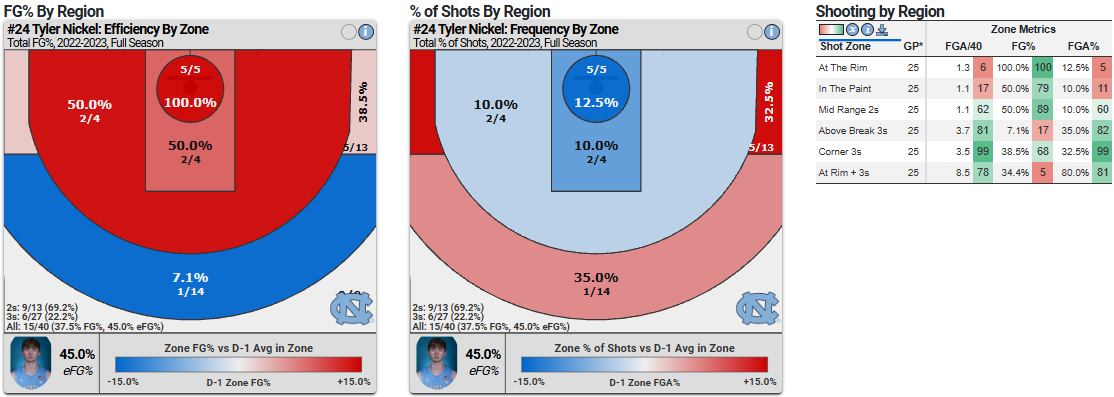
Key Note about Scoring Context: One of the most important contextual elements when evaluating Tyler Nickel’s scoring profile is understanding that virtually all of his offensive value was generated through perimeter shooting, floor spacing, and movement offense rather than traditional forward scoring methods. Unlike many frontcourt players who rely on rim pressure, post scoring, offensive rebounding, or physical interior play, Nickel’s offensive identity became increasingly specialized around three-point volume and shooting gravity throughout his collegiate career.
That specialization became more pronounced every season.
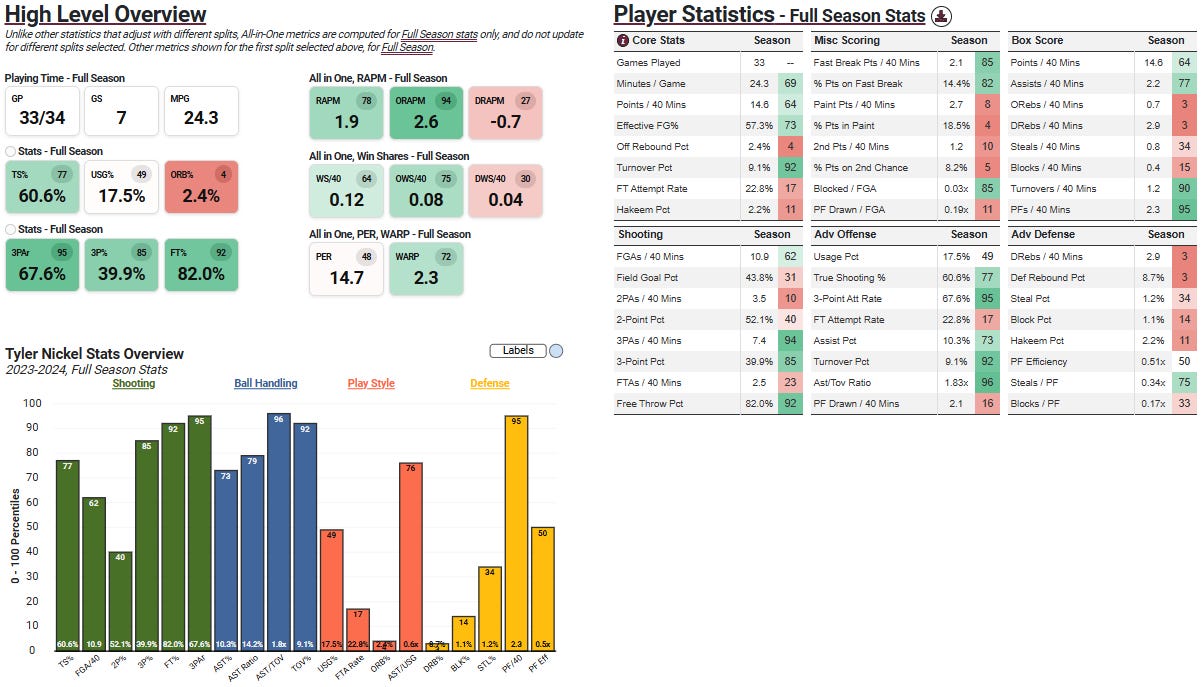
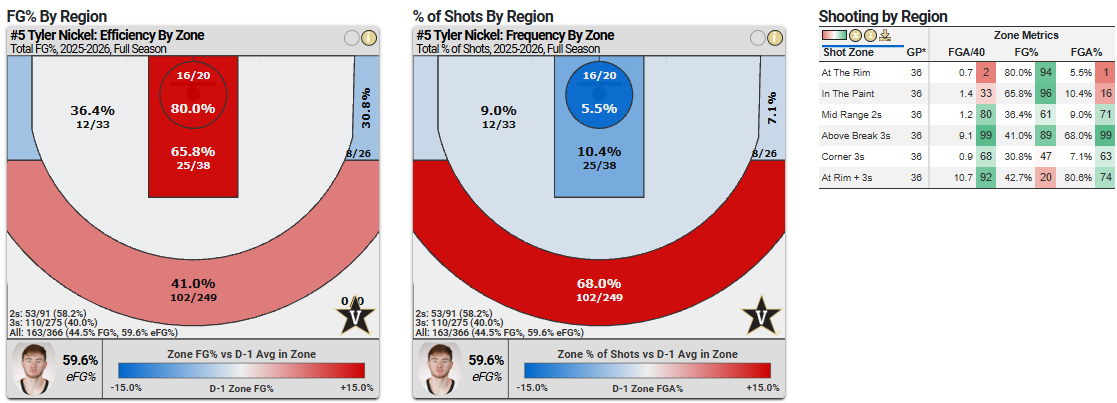
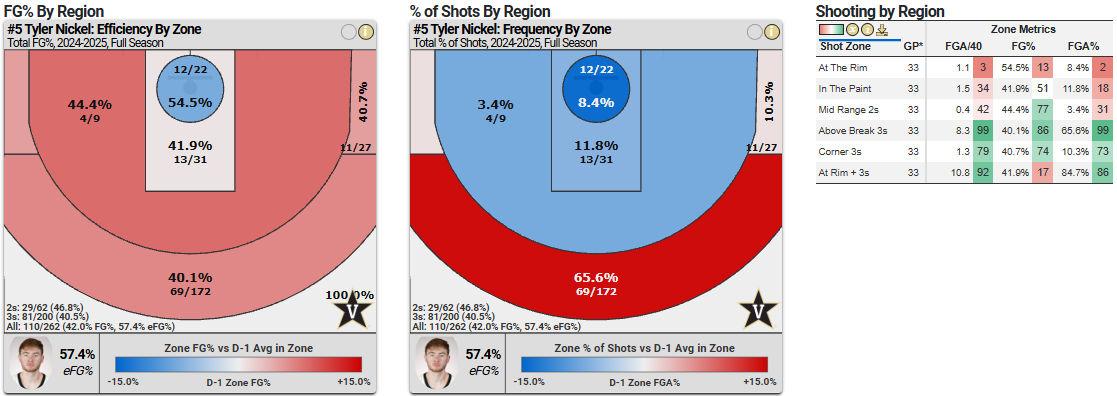
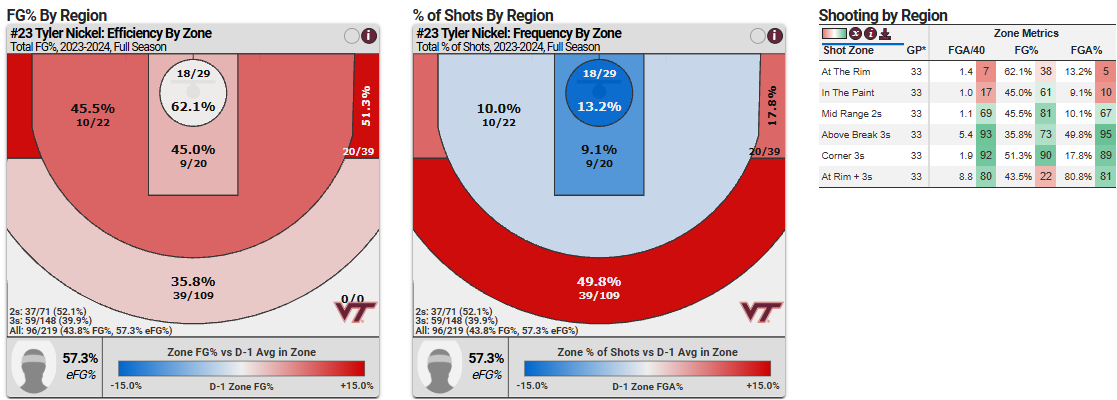
As a freshman at North Carolina, roughly 35 percent of Nickel’s shot attempts came from beyond the arc. By his sophomore season at Virginia Tech, nearly 50 percent of his shots were three-pointers. That figure climbed to over 65 percent during his junior season and ultimately reached 68 percent during his senior campaign at Vanderbilt. Few forwards in college basketball operated with such an extreme perimeter-oriented shot profile.
The efficiency remained remarkably stable despite the increased volume.
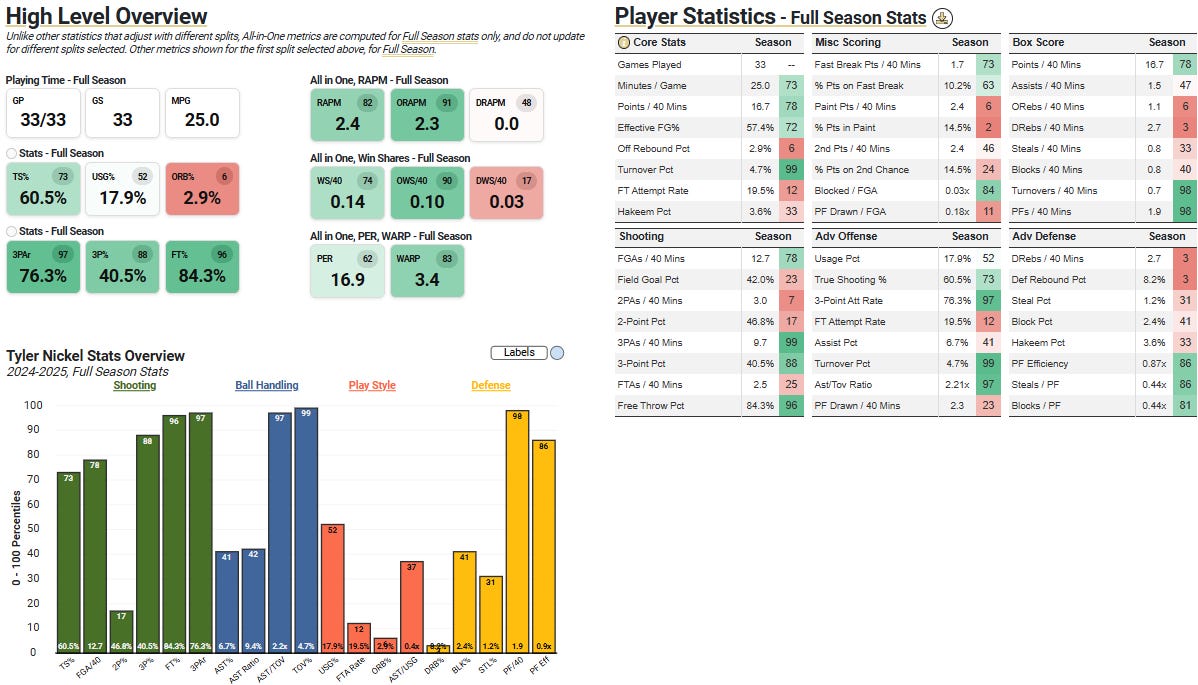
Nickel shot 39.9 percent from three as a sophomore, 40.5 percent as a junior, and 40.0 percent as a senior while steadily increasing both shot volume and defensive attention. More importantly, his three-point production was not confined to one specific area of the floor. During his final season, he converted 41.0 percent of his above-the-break threes on elite volume while also shooting nearly 31 percent from the corners despite relatively few opportunities. Defenses were forced to account for him in virtually every half-court possession because of his willingness to fire from well beyond NBA range.
The shot distribution illustrates just how perimeter dependent the profile became.
During his senior season, 68 percent of Nickel’s total field-goal attempts originated from above-the-break three-point attempts alone. By comparison, only 5.5 percent of his shots came at the rim and just over 10 percent originated from the paint. For a 6-foot-7 forward, those are unusually low interior scoring numbers and further reinforce how different his offensive archetype is from most frontcourt prospects.
The limited rim pressure is arguably the largest contextual factor within the evaluation.
Throughout his career, Nickel consistently posted extremely low rim-attempt volume despite solid size. Even during his most productive offensive seasons, he rarely attacked the basket off the dribble and generated very little offense through athletic finishes, transition rim pressure, or physical mismatch scoring. His offensive profile was built around shot-making rather than advantage creation.
However, the shooting versatility itself deserves significant credit.
Nickel was not merely a stationary catch-and-shoot player. Vanderbilt frequently utilized him in movement actions, flare screens, pindowns, relocations, and secondary transition opportunities designed to free him around the perimeter. His ability to maintain efficiency while taking difficult movement jumpers and high-volume above-the-break attempts adds meaningful value to the projection.
The efficiency profile is also supported by strong shooting indicators.
Across his final three collegiate seasons, Nickel consistently shot above 82 percent from the free-throw line while maintaining elite three-point efficiency. That combination historically serves as one of the strongest indicators of long-term shooting translation. His shooting success was not dependent upon one hot season or an unsustainable percentage spike.
At the same time, the offensive ceiling remains somewhat constrained by the lack of scoring diversity.
Nickel generated very little offense from the midrange, rarely created his own shot off the bounce, and offered limited rim pressure. If the jumper is taken away, there are fewer secondary scoring avenues available compared to more dynamic offensive forwards. NBA defenses will likely test his ability to attack closeouts, finish through length, and create secondary offense when run off the three-point line.
Still, the overall scoring archetype remains highly valuable in the modern NBA.

(Provided by Cbbanalytics)
Video Reference
(Video Credit: Video Coordinator Mixes)
(Video Credit: NBC Sports Bay Area)
NBA Projection & Player Comparisons
Projected Role: Rotational Stretch Forward
Tyler Nickel projects most cleanly as a rotational stretch forward whose primary NBA value comes through floor spacing, movement shooting, offensive gravity, and low-maintenance offensive scalability. His profile is built around one of the most translatable skills in basketball: high-volume perimeter shooting at legitimate forward size. His offensive development across four collegiate seasons, beginning at North Carolina, continuing through Virginia Tech, and culminating at Vanderbilt, steadily reinforced that identity.
At 6-foot-7 and approximately 220 pounds, Nickel possesses the physical dimensions teams seek in modern complementary forwards. While he lacks elite athleticism, advanced shot creation, or physical interior scoring ability, he compensates through elite shooting volume, offensive intelligence, and an understanding of how to create value without dominating possessions.
The strongest argument for Nickel’s NBA viability is the scalability of his offensive game.
Unlike many college scorers whose production is heavily dependent on high usage, isolation opportunities, or difficult self-created offense, Nickel generated most of his value through skills that naturally fit around higher-level talent. He consistently spaced the floor, relocated effectively, punished defensive mistakes, and maintained elite shooting efficiency despite touching the ball relatively infrequently. Those traits are often more valuable in NBA role-player environments than raw collegiate scoring volume.
His shooting profile is particularly encouraging.
By his senior season at Vanderbilt, Nickel attempted 10.0 three-pointers per 40 minutes while converting 40.0 percent from deep. Nearly 70 percent of his total shot attempts came from beyond the arc, with most of those attempts occurring above the break. Defenses were forced to extend coverage well beyond the three-point line, creating spacing advantages that often extended beyond his own box-score production. Few forwards in college basketball combined that level of shooting volume with that degree of efficiency.
The shot distribution throughout his career further reinforces how specialized his offensive profile became. As a freshman at North Carolina, roughly 35 percent of his attempts came from three-point range. That figure increased to nearly 50 percent during his first season at Virginia Tech, climbed above 65 percent during his junior year, and ultimately reached 68 percent during his senior season at Vanderbilt. Simultaneously, his three-point percentage improved from 22.2 percent as a freshman to over 40 percent during both of his final collegiate seasons. The progression illustrates a player who increasingly leaned into his greatest strength while consistently improving the efficiency of that skill.
The advanced metrics strongly support his offensive impact.
Nickel posted a 5.9 Offensive RAPM and a 7.9 overall RAPM during his final collegiate season, both ranking among the elite marks nationally. His offensive influence consistently exceeded his raw statistical production because of the spacing pressure and gravity he generated within Vanderbilt’s offense.
The decision-making profile further strengthens the projection.
He maintained one of the lowest turnover rates among high-usage forwards while consistently making quick, simple reads. Players who shoot at high levels, avoid mistakes, and understand their role often transition more smoothly into professional rotations than players who require offensive control to be effective.
However, the ceiling remains somewhat limited.
Nickel is not a primary creator, advanced ball-handler, or offensive initiator. He generates very little rim pressure, rarely creates separation off the dribble, and offers limited self-creation against set defenses. His offensive value is heavily tied to the jumper continuing to translate at the professional level.
Defensively, the projection is more role-specific than versatile.
While Nickel generally understands positioning and team concepts, he does not possess the athletic profile of a switch-heavy defensive forward. His modest rebounding production, limited event creation, and average lateral quickness may create challenges against more athletic NBA forwards. He projects more as a system defender who survives through awareness and effort rather than a player who consistently creates defensive advantages.
Ultimately, Nickel’s NBA pathway is relatively straightforward.
If the shooting translates, he has a realistic opportunity to become the type of rotational stretch forward every NBA team seeks: a player who spaces the floor, keeps the ball moving, avoids mistakes, and complements higher-usage stars. If the shooting falls below NBA standards, however, the lack of secondary offensive creation and defensive versatility significantly narrows his margin for error.
The archetype is clear. Nickel does not need to become a creator or defensive stopper to earn NBA minutes. His pathway is built around becoming a reliable floor-spacing specialist whose shooting gravity creates value within lineups.
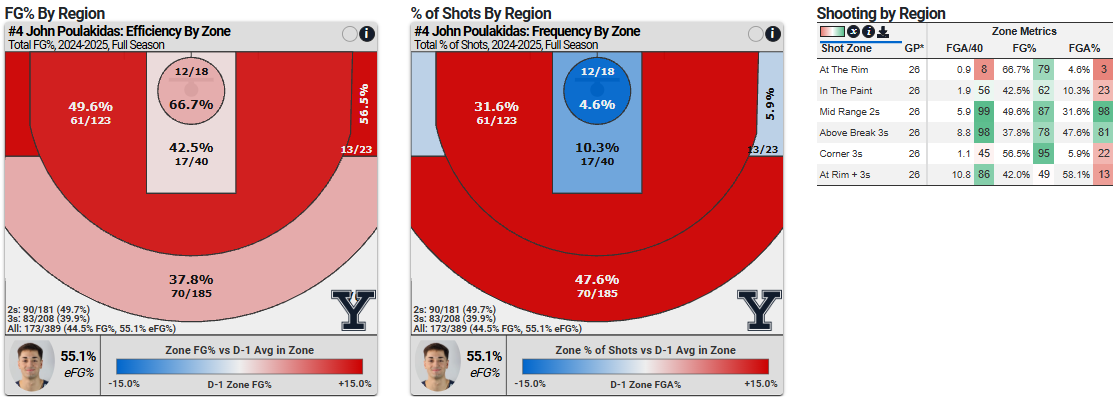
Projected Player Comparison:
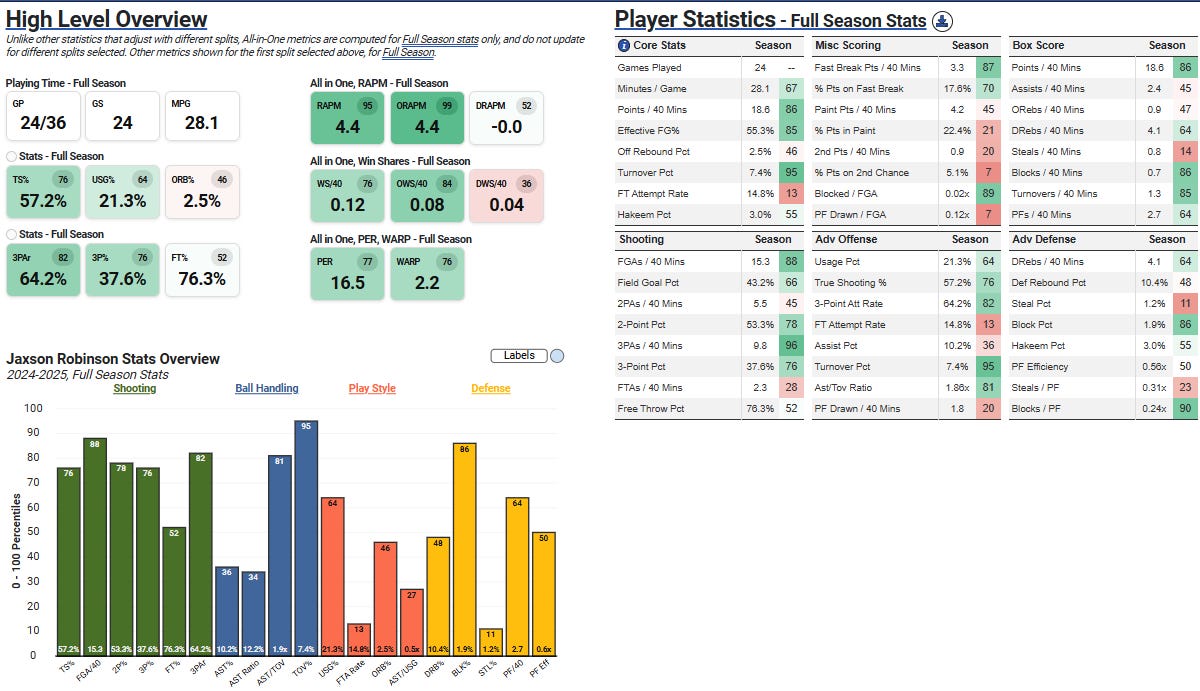
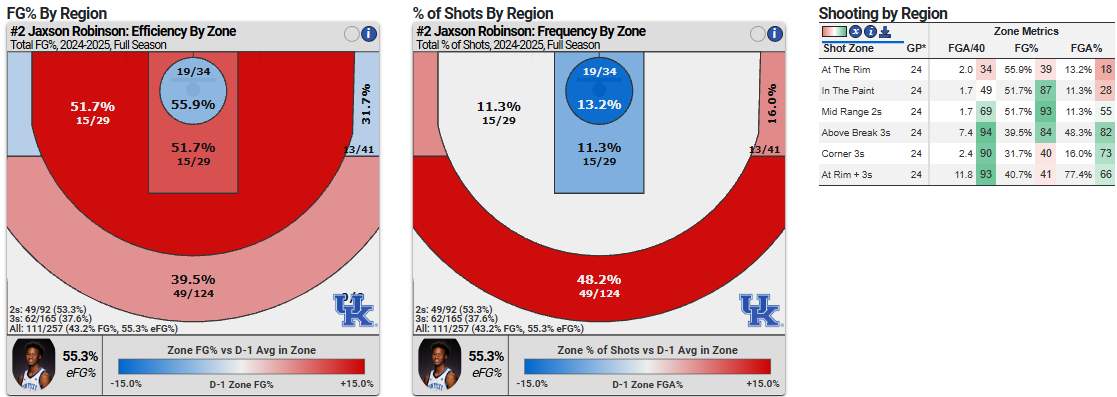
Jaxson Robinson
John Poulakidas
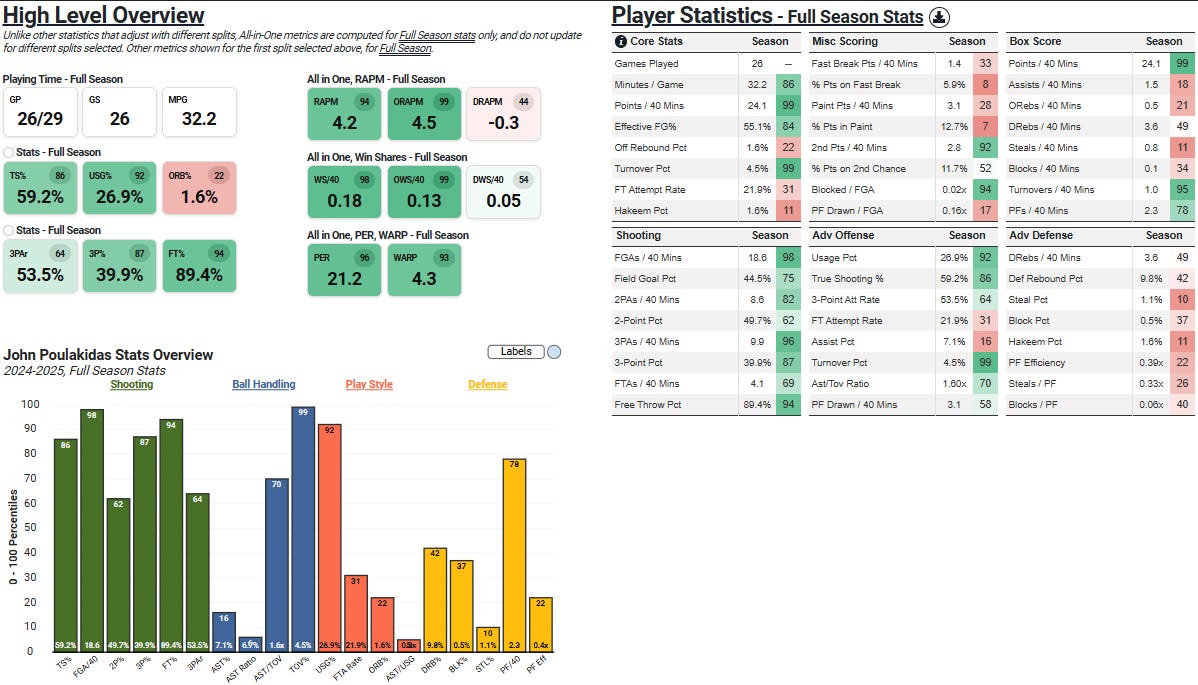
(Provided by Cbbanalytics)
Analysis:
Overall Impact: 12/25
Tyler Nickel’s overall impact profile presents one of the more interesting evaluation cases among modern offensive specialists. On the surface, the box-score production appears relatively modest compared to many high-level collegiate forwards. However, the advanced impact metrics consistently paint a much stronger picture of his actual influence on winning possessions, particularly on the offensive end.
The offensive impact metrics are the driving force behind the evaluation.
Nickel posted an elite 5.9 Offensive RAPM, ranking in the 100th percentile nationally, while generating an overall 7.9 RAPM, one of the strongest marks among high-major forwards during the 2025-26 season. Those numbers suggest his influence extended well beyond traditional box-score production. Vanderbilt’s offense consistently performed at a significantly higher level when Nickel was on the floor, largely due to the spacing pressure and shooting gravity he created.
The shooting profile serves as the foundation of that impact.
Few players nationally combined a 75.1% three-point attempt rate (96th percentile) with 40.0% three-point shooting (88th percentile) while maintaining a 62.0% true shooting percentage (78th percentile). Defenses were forced to account for him several feet beyond the three-point line, creating offensive spacing advantages that often benefited teammates as much as his own scoring output.
His efficiency and decision-making further elevated the offensive value.
Nickel maintained an elite 6.2% turnover rate (98th percentile) despite carrying meaningful offensive responsibility. Players who shoot at high volume, rarely turn the ball over, and consistently make quick decisions often drive offensive efficiency in ways that are not fully captured by traditional statistics.
The on/off data strongly supports that conclusion.
Vanderbilt’s offense improved significantly with Nickel on the floor. The team’s offensive rating, effective field goal percentage, three-point volume, and overall efficiency all benefited from the spacing ecosystem he created. His gravity often generated advantages before he ever touched the basketball.
However, the overall impact profile becomes much less impressive when evaluating non-shooting contributions.
Nickel ranked near the bottom percentile among forwards in offensive rebounding, paint scoring, rim pressure, and free-throw generation. He contributed very little as a secondary creator, rebounder, transition playmaker, or interior scorer. Much of his value remains concentrated within a single offensive skill category.
The defensive impact remains the largest limiting factor.
While his defensive RAPM finished positively, the underlying production remains modest. Nickel generated average steal and block numbers while posting poor rebounding metrics for a player with forward size. He generally survives defensively through positioning and awareness rather than creating defensive advantages.
That creates a somewhat polarized profile.
When the shooting is creating gravity and offensive spacing, Nickel can positively influence winning at a very high level. When the jumper is neutralized or unavailable, there are fewer secondary avenues through which he consistently impacts games compared to more complete forward prospects.
The professional projection ultimately hinges on one question:
How much value does elite shooting gravity create at the next level?
If the shooting translates, Nickel possesses one of the most scalable offensive skill sets in modern basketball. NBA teams consistently search for floor-spacing forwards who can shoot at volume, avoid mistakes, and fit alongside star creators. If that shooting remains a legitimate NBA weapon, many of the statistical deficiencies become less problematic.
If the shooting regresses, however, the lack of creation, rebounding, rim pressure, and defensive versatility significantly narrows his margin for error.
Scoring: 5/9
Tyler Nickel’s scoring profile is one of the most specialized in this class, built overwhelmingly around perimeter shooting, floor spacing, and offensive gravity rather than rim pressure, self-created offense, or physical interior scoring. While the raw production was strong, the way he generated that production is equally important when evaluating his professional projection.
The overall efficiency was highly impressive.
Nickel averaged 17.7 points per 40 minutes while posting a 62.0 percent true shooting percentage and a nearly 60 percent effective field goal percentage. Despite carrying a moderate 19 percent usage rate, he remained one of the most efficient offensive players among high-major forwards, largely because of elite three-point volume and strong shot selection.
The shooting profile drives almost the entire evaluation.
Nickel attempted 10.0 three-pointers per 40 minutes, ranking in the 99th percentile nationally among forwards, while converting 40.0 percent from beyond the arc. More importantly, over 75 percent of his total field goal attempts came from three-point range, ranking in the 96th percentile nationally. Few forwards in college basketball demonstrated that combination of volume and efficiency.
The half-court scoring context further highlights his offensive identity.
Over 83 percent of his total shot attempts occurred in half-court settings, where he converted nearly 40 percent of his three-point attempts on significant volume. His production was not heavily dependent on transition opportunities or easy baskets generated through pace. Instead, most of his offense came through structured half-court actions, movement shooting, spot-up opportunities, relocations, and floor-spacing responsibilities.
The shot distribution is particularly revealing.
Nickel generated only 3.3 two-point attempts per 40 minutes, ranking near the bottom percentile among forward prospects. He produced just 3.0 paint points per 40 minutes, ranking in the 10th percentile nationally, while only 17 percent of his scoring came inside the paint. Those numbers are exceptionally low for a player with forward size and reinforce how perimeter-oriented his offensive profile has become.
His scoring efficiency is almost entirely driven by shooting rather than athletic creation.
Unlike most forwards, Nickel rarely creates offense through rim pressure, transition attacks, post-ups, offensive rebounding, or free-throw generation. He attempted only 2.1 free throws per 40 minutes and generated very little scoring from second-chance opportunities. His offensive production is overwhelmingly dependent upon his ability to create and convert jump shots.
There are encouraging indicators regarding shot versatility.
Although nearly all of his offense comes from perimeter areas, much of his shooting volume originates above the break rather than exclusively from stationary corner opportunities. He converted 41 percent of his above-the-break threes while taking nearly 9.1 attempts per 40 minutes from those areas. That type of shooting is generally more difficult and often translates better than players whose production comes exclusively from corner spacing.
The transition profile provides some additional value.
While transition was not a primary source of offense, Nickel still generated nearly 2.7 fastbreak points per 40 minutes and converted over 41 percent of his transition three-point attempts. His willingness to run the floor and immediately space to the perimeter creates additional offensive value even when he is not attacking the rim.
The primary concern remains the lack of scoring diversity.
When evaluating NBA translation, there is very little evidence that Nickel can consistently create offense inside the arc, generate rim pressure, collapse defenses off the dribble, or manufacture efficient scoring when the jumper is not falling. Because so much of his offensive profile is tied to perimeter shooting, there is relatively little margin for error if the shot does not translate at the professional level.
Still, the offensive archetype remains highly valuable.
Self Creation: 1/9
Tyler Nickel’s self-creation profile is one of the most limited among projected NBA forwards and is heavily dependent on movement shooting, offensive structure, and teammate-created opportunities rather than individual shot creation. While he developed into an elite offensive player during his final collegiate seasons, the overwhelming majority of that production came through spacing, relocation, and catch-and-shoot situations rather than creating offense for himself.
The assisted versus unassisted distribution immediately illustrates the profile.
Nickel generated just 4.8 unassisted points per 40 minutes during the 2025-26 season, ranking in only the 34th percentile nationally among forwards. By comparison, he generated 17.0 assisted points per 40 minutes, with nearly 77 percent of his made field goals being assisted. Those numbers strongly reinforce that most of his offensive value came within the flow of the offense rather than through individual creation.
The perimeter scoring profile is particularly revealing.
Nickel generated an elite 3.82 assisted three-point field goals per 40 minutes, ranking in the 99th percentile nationally. However, he produced only 0.18 unassisted three-point field goals per 40 minutes despite converting 40 percent from beyond the arc. Nearly 96 percent of his made three-pointers were assisted, demonstrating that almost all of his perimeter scoring came from movement actions, catch-and-shoot opportunities, and offensive spacing concepts rather than off-the-dribble shot creation.
The interior self-creation numbers are similarly modest.
Nickel generated just 1.2 unassisted two-point field goals per 40 minutes, ranking in the 30th percentile nationally. For a player standing 6-foot-7, those numbers highlight the limited rim pressure and lack of downhill creation within his offensive game. Most of his interior scoring opportunities came through defensive rotations, cuts, or opportunistic finishes rather than creating advantages off the dribble.
The at-rim creation profile further reinforces those limitations.
Nickel produced only 0.22 unassisted at-rim field goals per 40 minutes, ranking near the bottom of the national distribution. While he finished efficiently when opportunities were available, he rarely generated those opportunities himself. His offensive role was built around spacing defenses rather than collapsing them.
The shot profile itself explains much of the distribution.
Because over 75 percent of Nickel’s total field-goal attempts came from three-point range, many possessions ended immediately upon receiving the ball. He was most effective catching, shooting, relocating, and attacking occasional closeouts rather than functioning as an offensive initiator.
To his credit, he excels at the type of self-creation most relevant to his archetype.
Nickel consistently creates shots through movement rather than dribbling. He navigates screens well, relocates into open windows, and understands how to manufacture separation without relying on advanced ball-handling. While that may not appear in traditional self-creation metrics, it remains an important component of his offensive value.
However, the lack of traditional creation limits the overall ceiling.
Nickel is not a player who consistently creates separation off the bounce, breaks down defenders in isolation, or manufactures difficult offense late in possessions. There is little evidence of advanced pull-up shooting, pick-and-roll creation, or manipulation-based scoring counters that typically elevate offensive ceilings at the NBA level.
The assisted scoring dependency also creates some projection risk.
Players whose offensive production relies heavily on structure often face adjustment periods when transitioning to higher levels of competition. NBA defenders are larger, faster, and more capable of denying clean catch-and-shoot opportunities, meaning players with limited secondary creation skills can become easier to scheme against.
Still, the overall profile remains workable within the proper role.
Nickel’s NBA pathway is not built around becoming a creator. It is built around becoming an elite complementary offensive player who spaces the floor, punishes defensive mistakes, and maximizes possessions through efficient shooting. The self-creation limitations cap some of the upside, but they do not necessarily prevent him from becoming a valuable rotational stretch forward if the shooting translates as expected.
Playmaking: 3/9
Playmaking is easily the weakest component of Tyler Nickel’s overall offensive profile and represents one of the primary reasons his NBA projection remains role-specific rather than versatile. While Nickel provides substantial value as a shooter and floor spacer, he contributes very little as a creator, initiator, or offensive facilitator.
The raw production immediately reflects those limitations.
Despite playing over 1,100 minutes and carrying a respectable offensive role, Nickel recorded just 43 assists all season, producing only 1.56 assists per 40 minutes. More importantly, he accounted for only 7.3 percent of Vanderbilt’s total assists while carrying nearly 17 percent of the team’s shot attempts. Those numbers are well below average for modern forwards expected to contribute as secondary facilitators.
The offensive role itself explains much of the profile.
Nickel was rarely asked to function as a creator within Vanderbilt’s offense. His responsibilities primarily revolved around floor spacing, movement shooting, relocation actions, and finishing possessions rather than initiating offense or creating advantages for teammates. Most possessions involving Nickel were designed to end with a shot rather than begin with him orchestrating offensive flow.
The passing metrics further reinforce that reality.
His Rim + Three assists per 40 minutes ranked below average, and his overall creation volume remained modest despite playing major minutes. While he was capable of making the obvious read when defenses overcommitted to his shooting gravity, there is little evidence of advanced playmaking vision or consistent manipulation of defensive coverages.
Most of his assists came through simple offensive reads.
Nickel occasionally generated kick-outs after attacking closeouts or made quick swing passes that led to perimeter baskets, but those opportunities were largely reactive rather than proactive. He rarely operated as a pick-and-roll ball handler, isolation creator, post facilitator, or offensive hub. The overwhelming majority of his value came from finishing actions rather than initiating them.
The shot profile itself also limits playmaking opportunities.
Because nearly 75 percent of his field-goal attempts originated from three-point range, many possessions ended immediately upon receiving the basketball. Players with such specialized scoring profiles naturally have fewer opportunities to develop creation skills compared to prospects who spend significant time attacking defenses off the dribble.
To his credit, Nickel generally avoided mistakes.
His low assist numbers are somewhat offset by an excellent turnover profile. He posted one of the lowest turnover rates among high-major forwards, demonstrating strong decision-making and an understanding of his role. He rarely forced difficult passes, attempted risky reads, or tried to create offense outside of his skill set.
That restraint is both a strength and a limitation.
While NBA coaches will appreciate his willingness to play within structure, the lack of creation upside limits lineup versatility. Nickel projects as a player who benefits from offensive ecosystems rather than one who actively drives them.
The broader NBA projection reflects that distinction.
Modern stretch forwards increasingly provide some level of secondary playmaking, whether through dribble handoffs, short-roll passing, connective decision-making, or attacking closeouts. Nickel currently offers only flashes of those skills. His offensive impact is driven overwhelmingly by gravity and spacing rather than creation.
Shooting: 8/9
Shooting is unquestionably Tyler Nickel’s defining NBA skill and the foundation of his entire professional projection. Few players in the 2026 class can match his combination of shooting volume, efficiency, consistency, and offensive gravity. While other areas of his game remain role-dependent, the jumper itself projects as an elite translatable skill.
The raw production immediately stands out.
Nickel attempted 10.0 three-pointers per 40 minutes, ranking in the 99th percentile nationally among forwards, while converting 40.0 percent from beyond the arc. Even more impressive, over 75 percent of his total shot attempts originated from three-point range, placing him in the 96th percentile nationally. This was not simply a player taking open spot-up opportunities. He functioned as one of the highest-volume perimeter shooters in college basketball while maintaining elite efficiency.
The shot profile is heavily concentrated in the most valuable areas.
Nearly 81 percent of Nickel’s field-goal attempts came either at the rim or from three-point range, with the overwhelming majority occurring beyond the arc. More specifically, 68 percent of all his shot attempts came from above-the-break threes, ranking in the 99th percentile nationally. That distinction is important because above-the-break attempts are generally more difficult and more translatable to NBA offensive systems than corner-only shooting specialists.
The half-court shooting profile further reinforces the projection.
Over 83 percent of his offensive possessions occurred in half-court environments, where he converted nearly 40 percent of his three-point attempts despite facing set defenses and game-planned coverage. Unlike many collegiate shooters who benefit heavily from transition opportunities, most of Nickel’s production came in structured offensive settings that more closely resemble NBA possessions.
The versatility of the shooting deserves significant attention.
Nickel was not merely a stationary catch-and-shoot threat. Vanderbilt regularly utilized him in pindowns, flare actions, movement shooting concepts, relocations, and secondary transition spacing actions. His ability to maintain efficiency while shooting on the move creates significantly more offensive value than a traditional standstill floor spacer.
The underlying indicators strongly support long-term shooting translation.
Nickel converted an elite 84.7 percent from the free-throw line while maintaining 40 percent three-point shooting on massive volume. Historically, the combination of elite free-throw shooting and elite three-point volume serves as one of the strongest indicators of sustainable NBA shooting success. There is little evidence suggesting his perimeter efficiency was driven by unsustainable variance.
The location data is equally encouraging.
Nickel demonstrated the ability to shoot effectively from multiple areas of the floor. While he was particularly dangerous above the break, he also displayed comfort shooting from both wings and relocating into open space. Defenses routinely extended coverage far beyond the three-point line, creating spacing advantages that impacted possessions even when he was not directly receiving the basketball.
The one limitation within the shooting profile is shot diversity.
While Nickel is an elite perimeter shooter, he offers relatively little scoring value from the midrange or off-the-dribble pull-up game. Most of his perimeter production still comes within offensive structure rather than advanced self-created shot-making. He is far more dangerous running defenders through screens than breaking them down individually.
However, that limitation does little to diminish the overall value of the skill.
NBA teams are constantly searching for players who can provide legitimate shooting gravity at forward size. Nickel’s combination of 6-foot-7 size, elite shooting volume, movement versatility, and efficiency gives him one of the most translatable offensive skills in the class. Even if other parts of his game remain role-specific, the shooting alone provides a realistic pathway toward long-term NBA minutes.
Defensive Attribution: 2/10
Defense projects as one of the more significant concerns within Tyler Nickel’s overall NBA evaluation. While he generally understands team concepts and rarely makes major mistakes within defensive structure, the combination of limited defensive playmaking, below-average rebounding production, and modest physical tools creates a relatively narrow defensive pathway at the professional level.
The first concern is the overall activity profile.
Nickel posted a 1.48 percent steal rate and a 1.91 percent block rate during his senior season, both grading around average or below average compared to NBA-caliber forward prospects. His overall havoc rate of 3.39 percent ranked near the bottom third nationally, illustrating a player who rarely generates defensive possessions through steals, deflections, blocks, or disruptive playmaking.
The rebounding profile further compounds those concerns.
Despite standing 6-foot-7 and weighing approximately 220 pounds, Nickel posted a defensive rebounding rate that ranked in just the 6th percentile nationally among forwards. He collected only 94 defensive rebounds across more than 1,100 minutes and generated very little value as a possession-ending rebounder. For a player who is unlikely to provide significant rim protection or switch versatility, the lack of rebounding impact becomes increasingly important when projecting NBA role viability.
Much of his defensive value comes through discipline rather than disruption.
Nickel committed just 1.78 fouls per 40 minutes, ranking in the 99th percentile nationally. He consistently stayed within team structure, avoided unnecessary mistakes, and generally positioned himself correctly within defensive schemes. His defensive foul rate was equally impressive, ranking in the 99th percentile among forwards. Those numbers suggest a player who understands rotations and assignments even if he lacks the physical tools to consistently create defensive advantages.
The steal-to-foul and block-to-foul ratios provide some positive context.
Nickel generated strong efficiency relative to his foul frequency, producing solid steal-per-foul and block-per-foul numbers. However, much of that is driven by how infrequently he fouls rather than by particularly high defensive event creation. He is a low-risk defender more than a high-impact defender.
Athletic limitations remain the primary concern.
Nickel does not possess the lateral quickness, recovery speed, or overall explosiveness typically associated with versatile NBA forwards. While he competes and generally understands positioning, there are legitimate questions regarding his ability to consistently contain NBA wings, navigate switches, or survive extended possessions against more dynamic offensive players.
The lack of physical defensive versatility narrows lineup flexibility.
Unlike many modern stretch forwards who offset offensive specialization with switchability or defensive playmaking, Nickel currently projects as more of a system defender. He is unlikely to regularly defend guards on switches, provide meaningful rim protection, or generate high-volume defensive events.
The projection ultimately becomes heavily dependent on offensive value outweighing defensive limitations.
Fortunately for Nickel, the offensive skill set is strong enough that he does not need to become a plus defender to carve out a professional role. Many successful NBA shooting specialists have survived as neutral or slightly below-average defenders because their shooting gravity creates enough offensive value to justify minutes.
Still, the defensive profile remains one of the biggest factors limiting his overall ceiling.
If Nickel can improve functional strength, positional rebounding, and overall defensive versatility, he may become more lineup flexible at the next level. As things currently stand, however, he projects as a low-event, low-mistake team defender whose value comes primarily from avoiding errors rather than actively generating defensive advantages.
Off-Ball Offense: 6/9
Off-ball offense is arguably Tyler Nickel’s second-most valuable NBA skill behind his shooting itself. While he offers very little as a creator or playmaker, he consistently generates offensive value through movement, spacing, relocation, and an understanding of how to function within team-oriented offensive systems.
The foundation of his off-ball impact is elite shooting gravity.
Few players in college basketball forced defenses to account for them as aggressively away from the basketball as Nickel. His combination of 40 percent three-point shooting on nearly 10 attempts per 40 minutes created constant stress on opposing defenses. Defenders were rarely comfortable helping off him, often extending coverage several feet beyond the three-point line simply to prevent clean catch-and-shoot opportunities.
The movement shooting profile is particularly encouraging.
Nickel was not simply a stationary floor spacer parked in the corner. Vanderbilt routinely utilized him in pindowns, flare screens, stagger actions, relocations, and secondary transition opportunities designed to free him around the perimeter. His ability to maintain efficiency while constantly moving without the ball adds significantly more value than a traditional standstill shooting specialist.
The shot distribution reinforces his off-ball effectiveness.
Nearly 68 percent of his total shot attempts came from above-the-break three-point attempts, one of the highest marks among forward prospects nationally. Those shots frequently originated from movement actions rather than static spot-up situations. Nickel consistently demonstrated an understanding of timing, spacing, and how to navigate screens to create separation.
His offensive IQ is evident throughout the film.
Nickel regularly makes subtle relocations when teammates penetrate, drifts into open passing windows, and positions himself in ways that maximize spacing within offensive sets. These are often overlooked skills, but they become increasingly valuable at higher levels where offensive spacing and decision-making are critical components of lineup functionality.
The transition spacing provides additional value.
Although he is not a major transition scorer through rim pressure, Nickel consistently runs to space and immediately becomes a perimeter threat in early offense. Defenses are forced to locate him quickly, which often opens driving lanes for teammates even when he never receives the basketball.
The low-turnover profile also complements his off-ball game.
Because Nickel rarely forces offense outside of his role, he consistently keeps possessions flowing. He understands when to shoot, when to move the ball, and when to relocate. Players who thrive without disrupting offensive rhythm often fit naturally into NBA role-player environments.
However, there are still limitations that prevent a higher grade.
Nickel’s off-ball value is heavily dependent on the jumper. Unlike elite off-ball offensive players who also create value through cutting, rim pressure, finishing, or athletic movement, much of Nickel’s production is tied directly to perimeter shooting. He offers very little vertical spacing, backdoor cutting pressure, or interior finishing compared to many modern wings and forwards.
The lack of rim-oriented off-ball scoring narrows the profile somewhat.
Only a small percentage of his offense comes through cuts, transition finishes, offensive rebounds, or interior movement opportunities. Most of his off-ball value stems from forcing defensive attention rather than directly generating efficient paint touches.
Still, the overall archetype remains highly valuable.
NBA teams consistently search for players who can move without the basketball, maintain spacing discipline, punish defensive mistakes, and create offensive gravity without requiring touches. Nickel checks many of those boxes at a high level.
Post (Scoring/Playmaking): 1/9
Post offense is a very minor component of Tyler Nickel’s overall offensive profile and is unlikely to be a meaningful source of NBA value. Despite possessing forward size at 6-foot-7 and 220 pounds, Nickel rarely operated as a traditional post scorer or interior facilitator throughout his collegiate career.
The offensive role largely explains the lack of post production.
Nickel spent the overwhelming majority of his possessions functioning as a perimeter-oriented stretch forward. Rather than establishing deep position, creating mismatches on the block, or facilitating offense from the elbows, he was typically positioned around the three-point line where his shooting gravity could create maximum spacing value.
There is little evidence of consistent post scoring ability.
Throughout his collegiate career, Nickel generated very little offense through back-to-the-basket possessions, post isolations, or physical mismatch scoring. His low paint scoring volume and minimal rim pressure further reinforce that his offensive profile was built around perimeter shot-making rather than interior creation.
The scoring package itself remains limited in those situations.
Nickel does not possess the strength, footwork, touch package, or physical style commonly associated with productive post scorers. When operating inside the arc, he was generally more comfortable finishing opportunistically rather than creating offense through post-up actions.
The playmaking component is similarly modest.
While Nickel demonstrates solid decision-making and generally avoids mistakes, he was rarely used as a post facilitator or offensive hub. There is little evidence of advanced passing reads from the block, double-team recognition, or the ability to consistently create scoring opportunities for teammates through interior touches.
Modern NBA context somewhat minimizes the concern.
Many successful stretch forwards rarely operate from the post, particularly if their primary value comes from floor spacing and perimeter shooting. Nickel does not necessarily need a developed post game to carve out an NBA role because his offensive projection is built around shooting gravity rather than interior offense.
However, the lack of post functionality does limit some lineup versatility.
Players who can punish switches, score against smaller defenders, or facilitate from the block often create additional offensive counters when perimeter actions are taken away. Nickel currently offers very little of that secondary offensive dimension.
Intangibles/Eye Test: 5/11
Tyler Nickel’s intangibles profile is somewhat unique because many of his best traits are subtle and role-oriented rather than immediately apparent through traditional scouting lenses. He projects as a player whose value is built around professionalism, offensive discipline, role acceptance, and basketball IQ rather than physical tools, competitive edge, or high-level two-way versatility.
The strongest intangible trait is his understanding of identity.
Throughout stops at North Carolina, Virginia Tech, and Vanderbilt, Nickel consistently embraced the role that best suited his skill set. Rather than forcing offensive creation or attempting to play outside of his strengths, he steadily refined his game around elite perimeter shooting, floor spacing, and offensive efficiency. That level of role acceptance is often an underrated factor when projecting NBA role players.
His developmental trajectory is also encouraging.
Many players struggle after transferring programs multiple times, but Nickel improved his offensive impact at every stop. He evolved from a limited rotational player at North Carolina into a productive starter at Virginia Tech before ultimately becoming one of the SEC’s premier perimeter scorers at Vanderbilt. The year-over-year progression reflects strong work habits and a willingness to adapt to different systems and coaching staffs.
The offensive IQ consistently shows up on film.
Nickel understands spacing, relocation timing, and how to operate without monopolizing possessions. He routinely positions himself correctly within offensive actions, makes quick decisions, and rarely disrupts offensive flow. Those are valuable traits for players expected to fill complementary roles at higher levels.
The confidence level as a shooter stands out positively.
Elite shooters often possess a willingness to continue taking difficult shots regardless of previous results, and Nickel consistently demonstrated that mentality. His shot preparation, movement without the ball, and readiness to fire from NBA range suggest a player comfortable embracing the responsibilities that come with being a high-volume perimeter threat.
However, the overall eye test is not without concerns.
Nickel’s game lacks a certain level of physical presence compared to many successful NBA forwards. He does not consistently impact games through athleticism, rebounding, defensive intensity, physicality, or energy plays. Much of his value is concentrated in skill execution rather than force of personality or game-changing physical tools.
The competitive profile can occasionally appear passive.
Because he is so perimeter-oriented, there are stretches where Nickel can become somewhat dependent on offensive flow and shot opportunities. Unlike players who create value through rebounding, defense, rim pressure, or hustle plays, his impact can fluctuate when perimeter opportunities become limited.
There are also questions regarding overall versatility.
The eye test often reveals a player with a very clear NBA skill but fewer secondary pathways to influence games when the shot is not falling. Players who project as long-term rotation pieces typically possess multiple avenues for contributing. Nickel’s profile remains heavily concentrated around shooting.
That said, NBA organizations consistently value players who understand their role and maximize their strengths.
Nickel rarely forces bad decisions, plays within structure, and demonstrates a clear understanding of how his skill set contributes to winning offensive basketball. Those traits often become more valuable at the professional level than they appear in collegiate evaluations.
Ultimately, the intangibles projection is solid but not exceptional. Nickel’s maturity, offensive IQ, role acceptance, and developmental progression are all positive indicators. However, the lack of elite competitiveness, physical edge, defensive versatility, or multi-dimensional impact prevents the profile from grading significantly higher.
Complete Evaluation: 43/100
 | A guest post by
|