


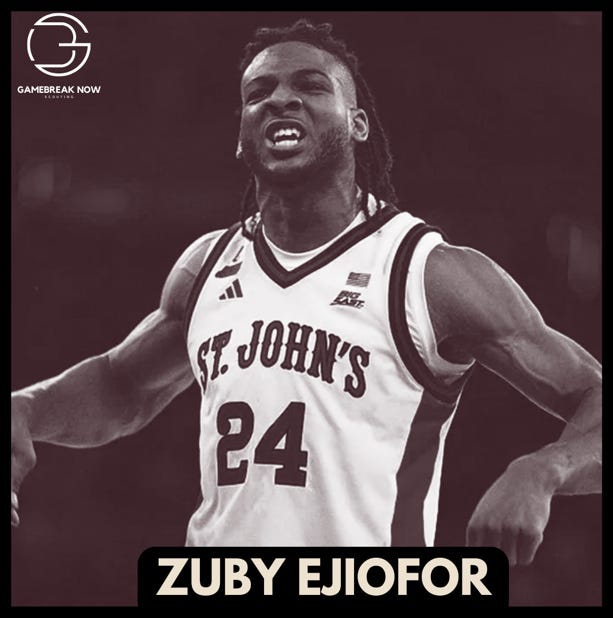
Height: 6’9” Weight: 250Lbs Team: St. John’s Class: Senior
Age at Draft: 22.18 Height (Barefoot): 6’7.5 Weight: 245.2Lbs Wingspan: 86” (+6.5) Standing Reach: 107”
Scouting Snapshot
Zuby Ejiofor projects as one of the more physically imposing and analytically productive interior forwards in the 2026 draft class. Across stops at Kansas and St. John’s, Ejiofor steadily evolved from an energy-based reserve big into a highly impactful high-major frontcourt anchor whose value is driven by interior efficiency, offensive rebounding, physicality, defensive activity, and functional two-way consistency.
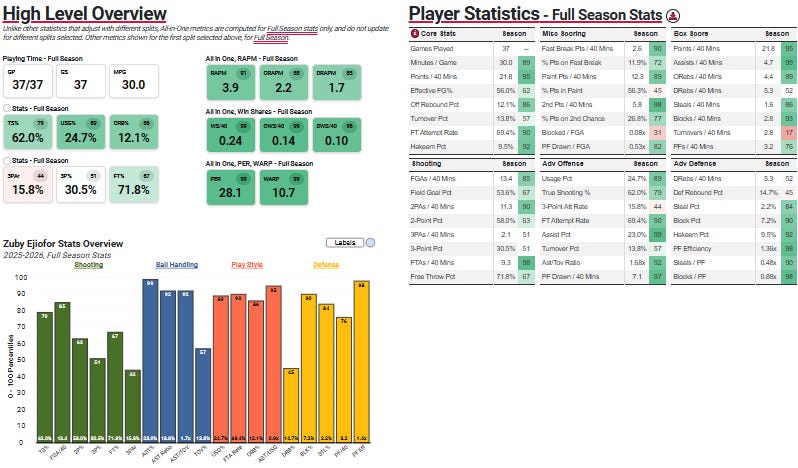
By the 2025-26 season, Ejiofor emerged as one of the most productive frontcourt players in college basketball, posting elite impact metrics across nearly every advanced category. He averaged 21.8 points and 14.8 rebounds per 40 minutes while generating a massive 28.1 PER and 10.7 WARP. His 24.7 percent usage rate paired with a 62.0 true shooting percentage illustrates a player capable of carrying substantial offensive responsibility without sacrificing efficiency.
The offensive profile is built almost entirely around interior dominance.
Ejiofor generated over 11 two-point field goals per 40 minutes while converting nearly 58 percent inside the arc. More importantly, his scoring was heavily pressure-oriented. He lived at the free throw line, posting a nearly 70 percent free throw attempt rate, which ranked among the best marks nationally for forwards. That ability to consistently collapse defenses through physicality and rim pressure became foundational to St. John’s offense.
The rebounding production is elite and immediately translatable.
Ejiofor posted an outstanding 12.1 offensive rebounding percentage during the 2025-26 season while consistently generating second-chance offense. His motor around the basket, willingness to compete physically, and ability to carve out positioning make him a constant possession extender offensively. Defensively, he remained highly productive on the glass as well, helping stabilize possessions and fuel transition opportunities.
Defensively, the profile is extremely functional for a modern rotational big.
Ejiofor generated strong steal and block production simultaneously, posting a 2.2 block percentage and nearly 2 steals per 40 minutes during his senior season. The combination of physical strength, mobility, and effort allows him to impact possessions both as a rotational rim protector and as an active help defender. He consistently plays with strong energy levels and embraces physical defensive assignments.
The progression from year to year is also encouraging.
As a freshman at Kansas, Ejiofor played a minimal role, functioning primarily as a developmental reserve big whose impact came almost entirely through energy and rebounding. By his sophomore and junior seasons, however, his offensive feel, passing flashes, and defensive consistency improved substantially. The jump during the 2025-26 season represented a major offensive breakout where he became a legitimate focal point offensively rather than simply a complementary interior finisher.
There are still some limitations that shape the long-term projection.
The perimeter shooting remains largely undeveloped. Across his collegiate career, Ejiofor showed minimal floor-spacing volume, and much of his offense remains heavily interior dependent. While he converted over 70 percent from the free throw line during his later seasons, the jumper itself is still more theoretical than functional within NBA spacing environments.
Additionally, much of his scoring comes through strength and physicality advantages that may not translate as cleanly against NBA size and length. He is productive creating contact and generating paint touches, but he is not currently an advanced face-up scorer or highly polished isolation creator. His offensive game is much more power-oriented than finesse-oriented.
The passing development, however, is quietly important.
Ejiofor’s assist numbers steadily improved throughout his career, culminating in nearly five assists per 40 minutes during the 2025-26 season. That connective growth significantly raises his offensive floor because it allows him to function within modern movement offenses as more than simply a low-post finisher. He became increasingly comfortable facilitating from the elbows, short roll, and interior touch areas.
Ejiofor projects as a high-energy rotational frontcourt player whose value is built around physicality, interior scoring, rebounding, defensive activity, and connective offensive functionality. If the jumper ever becomes even remotely respectable, the overall profile becomes significantly more scalable. Even without major shooting development, however, his production, toughness, rebounding, and interior efficiency give him a strong pathway toward NBA rotational consideration as a modern energy big capable of positively impacting second units and physical frontcourt lineups.
Statistical Overview By Year:
2025-2026 (Senior Season)
2024-2025 (Junior Season)
2023-2024 (Sophomore Season)
2022-2023 (Freshman Season)
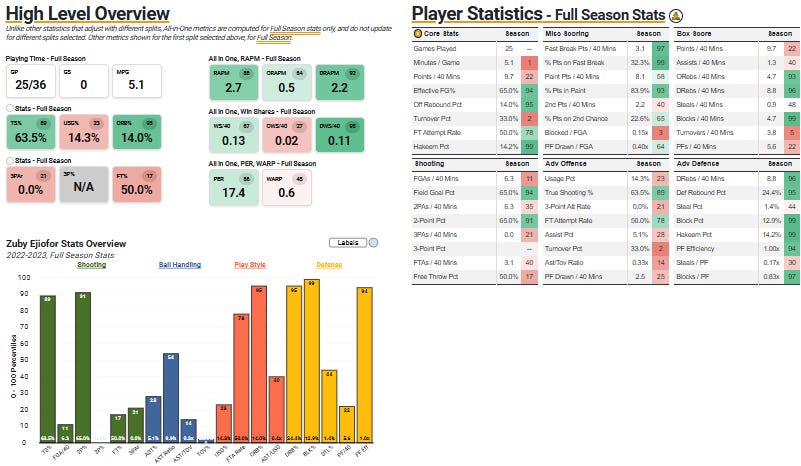
Scoring Context By Year:
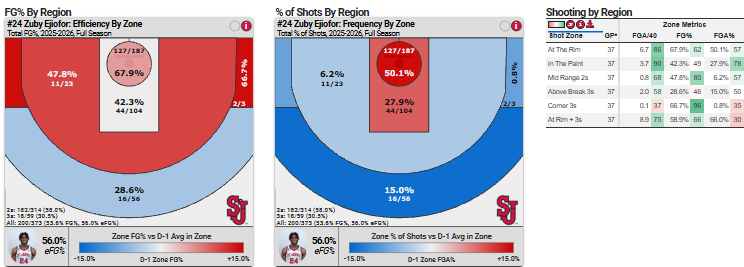
2025-2026 (Senior Season)
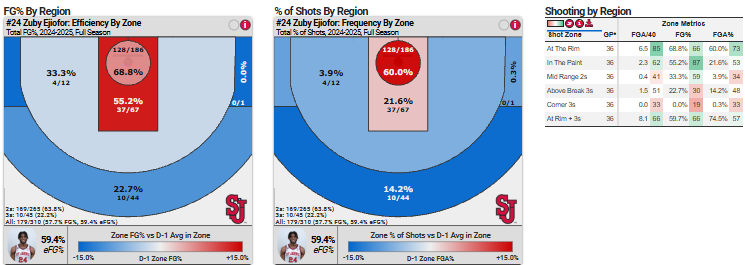
2024-2025 (Junior Season)
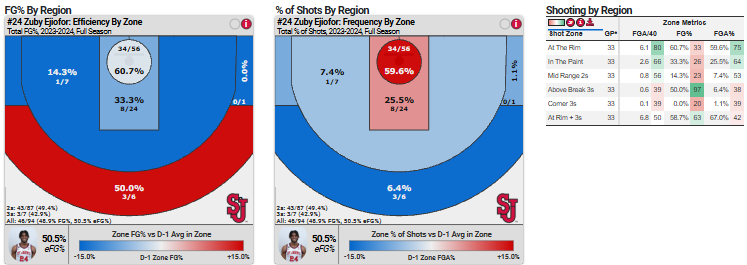
2023-2024 (Sophomore Season)
2022-2023 (Freshman Season)
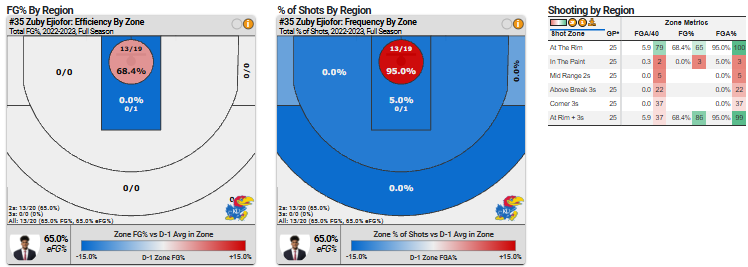
Key Note about Scoring Context: One of the most important contextual elements when evaluating Zuby Ejiofor’s offensive profile is understanding just how heavily concentrated his scoring diet was around interior efficiency, physicality, and rim pressure rather than perimeter shot-making or spacing versatility. Unlike many modern forwards whose offensive value is built through three-point gravity, Ejiofor generated the overwhelming majority of his production directly at the basket and inside the paint.
Across his collegiate career, nearly all of Ejiofor’s offensive workload came within the arc, particularly around the rim. By the 2025-26 season, over 50 percent of his total shot attempts came directly at the rim while he converted nearly 68 percent of those opportunities. Even more importantly, roughly two-thirds of his total offense came from rim-and-paint scoring zones combined, illustrating how dependent his offensive profile was on physical interior production.
That context matters significantly when projecting his offensive translation to the NBA level.
Ejiofor was not creating offense through difficult perimeter shot-making, advanced isolation scoring, or high-level floor spacing gravity. Instead, his offensive value came through relentless rim pressure, offensive rebounding, transition running, duck-ins, short-roll finishing, and generating free throws through physicality. His nearly 70 percent free throw attempt rate during the 2025-26 season reinforces how aggressively he attacked the paint and how frequently he forced defenses into contact situations.
The progression of his shot distribution throughout his career is also notable.
At Kansas as a freshman, almost 95 percent of Ejiofor’s total shot diet came directly at the rim. His offensive role was extremely narrow and almost entirely dependent on energy finishes, offensive rebounds, and interior dump-off opportunities. As his role expanded at St. John’s, the offensive profile diversified slightly, particularly in the short midrange and paint-touch areas, but the identity of the scorer remained largely unchanged.
By the 2025-26 season, Ejiofor still generated over 50 percent of his total attempts at the rim while converting efficiently despite carrying far more offensive responsibility. The ability to maintain strong interior efficiency under increased volume is important because many high-usage interior scorers experience major efficiency drops once defenses begin keying heavily on paint touches.
However, the lack of perimeter volume remains one of the central projection questions.
Across four collegiate seasons, Ejiofor attempted very few three-pointers overall, and even during his senior year, perimeter shooting represented only a tiny fraction of his offensive profile. Defenses at the NBA level will likely prioritize shrinking driving lanes and crowding interior space unless the jumper develops enough to become at least marginally respectable.
At the same time, his scoring context also deserves some positive framing.
Ejiofor was rarely operating with elite spacing advantages offensively. Much of his production came through traffic, physical contact, and congested interior environments where he consistently absorbed defensive attention. He was not simply feasting as a low-usage lob finisher or transition-only big. St. John’s increasingly relied on him as a legitimate interior offensive focal point capable of sustaining efficient paint pressure possession after possession.
The offensive rebounding also amplifies the scoring profile substantially.
Many of Ejiofor’s easiest points came through second-chance opportunities created entirely by his own motor, strength, and positioning. That skill tends to translate relatively well professionally because offensive rebounding production is often tied more to effort, anticipation, and physicality than pure scheme dependency.
Ultimately, Ejiofor’s scoring projection depends heavily on how teams value specialized interior efficiency in modern NBA ecosystems.
If the perimeter shooting never develops meaningfully, his offensive role will likely remain tied to lineups capable of surrounding him with sufficient spacing. However, his combination of physical scoring pressure, offensive rebounding, free throw generation, and interior efficiency still creates a viable pathway toward rotational NBA offense because players who consistently generate paint pressure and extra possessions retain value even without high-end perimeter versatility.

(Provided by Cbbanalytics)
Video Reference
(Video Credit: Shanny Hoops)
(Video Credit: No Ceilings)
NBA Projection & Player Comparisons
Projected Role: Bruising Interior Force Forward
For Zuby Ejiofor, the projection begins with understanding the type of interior pressure and physicality he consistently brought to winning basketball environments throughout his collegiate career. Unlike many modern forwards whose value is heavily tied to perimeter creation or floor spacing versatility, Ejiofor’s impact was rooted in power, rebounding, interior scoring efficiency, free throw generation, and defensive activity around the basket.
By the 2025-26 season at St. John’s, Ejiofor had fully developed into one of the most productive interior forwards in college basketball. He posted a massive 28.1 PER, generated 10.7 WARP, and averaged nearly 22 points with almost 15 rebounds per 40 minutes while maintaining strong efficiency under significant offensive responsibility. His offensive profile consistently revolved around physical dominance inside the arc.
That offensive identity is central to the NBA projection.
Ejiofor generated the overwhelming majority of his offense directly at the rim and inside the paint. More than half of his total shot attempts came at the basket during his senior season while converting nearly 68 percent in those situations. He also generated elite free throw pressure, posting a nearly 70 percent free throw attempt rate. That level of paint pressure and physicality remains valuable in any basketball environment because players capable of consistently collapsing defenses through strength and activity still create efficient offense even without perimeter-heavy scoring profiles.
The rebounding projection is one of the safest aspects of the evaluation.
Ejiofor consistently posted elite offensive rebounding numbers throughout his collegiate career, culminating in a 12.1 offensive rebounding percentage during the 2025-26 season. His motor, physicality, and positioning around the basket allow him to consistently extend possessions and create second-chance offense. Offensive rebounding tends to translate relatively well professionally because it relies heavily on effort, anticipation, and physical competitiveness rather than scheme dependency alone.
Defensively, the projection becomes highly functional within specific lineup structures.
Ejiofor is not necessarily a pure defensive anchor in the mold of elite NBA rim protectors, but he consistently impacted possessions through rotational activity, physical interior defense, rebounding, and effort. He posted strong steal and block metrics simultaneously while maintaining impressive defensive event production across multiple seasons. His combination of strength, mobility, and toughness gives him a realistic pathway toward becoming a highly functional rotational frontcourt defender.
The passing development also raises the offensive floor considerably.
One of the more encouraging aspects of Ejiofor’s progression was the steady improvement in his connective playmaking. By his senior season, he averaged nearly five assists per 40 minutes while functioning increasingly as a short-roll passer and interior facilitator. That growth matters because modern NBA offenses increasingly value frontcourt players capable of making quick reads and maintaining offensive flow rather than simply functioning as finish-only bigs.
The archetype becomes easier to project once viewed through a role-specific lens.
Ejiofor does not project as a stretch-four or perimeter-oriented offensive initiator. Instead, his value comes through functioning as a physical interior force capable of generating paint pressure, rebounding at a high level, finishing through contact, screening effectively, and providing consistent energy on both ends. Teams looking for frontcourt toughness and interior physicality will likely view his profile favorably.
The major swing factor remains perimeter scalability.
Throughout his collegiate career, Ejiofor showed very limited perimeter shooting volume. While the free throw percentage improved into respectable territory, the jumper itself remains largely undeveloped within game environments. Because the modern NBA increasingly prioritizes spacing from frontcourt positions, the lack of perimeter gravity could limit lineup flexibility unless surrounded by adequate shooting.
There are also some concerns about offensive translation against NBA size and length.
A large portion of Ejiofor’s collegiate success came through overwhelming physicality and motor advantages around the basket. At the professional level, those advantages naturally become more difficult to consistently maintain against elite interior athletes and stronger rim protection. He is productive through effort and strength, but he is not necessarily an advanced face-up scorer or polished one-on-one offensive creator.
Still, the broader archetype retains significant value.
Projected Player Comparison:
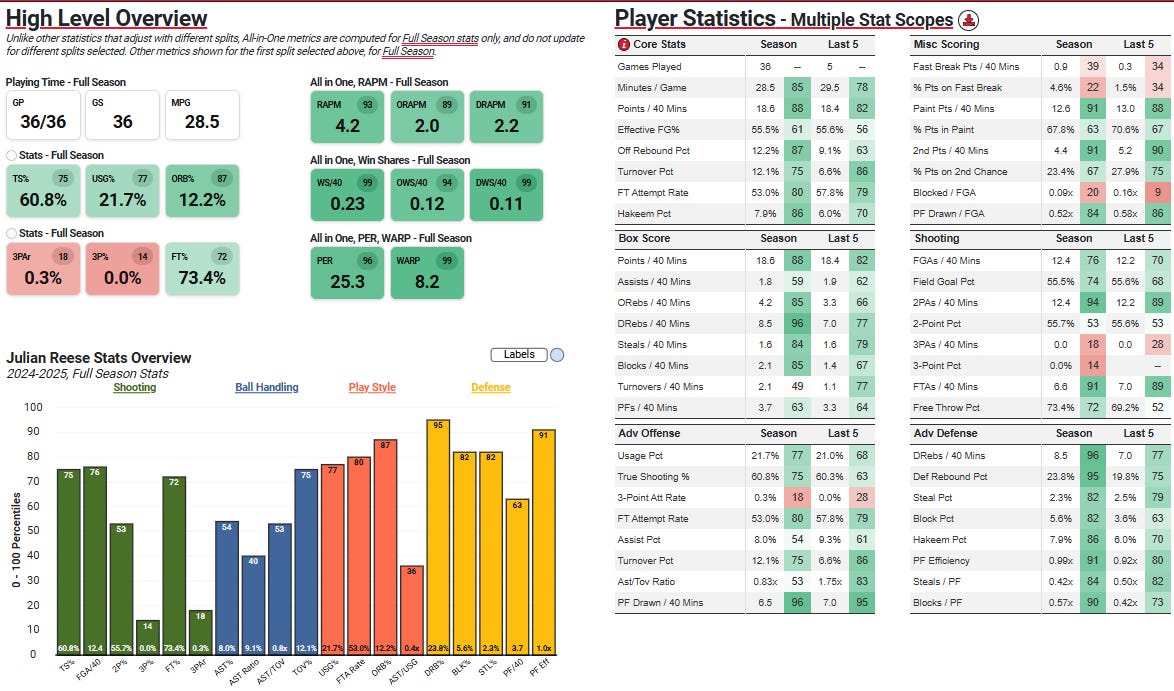
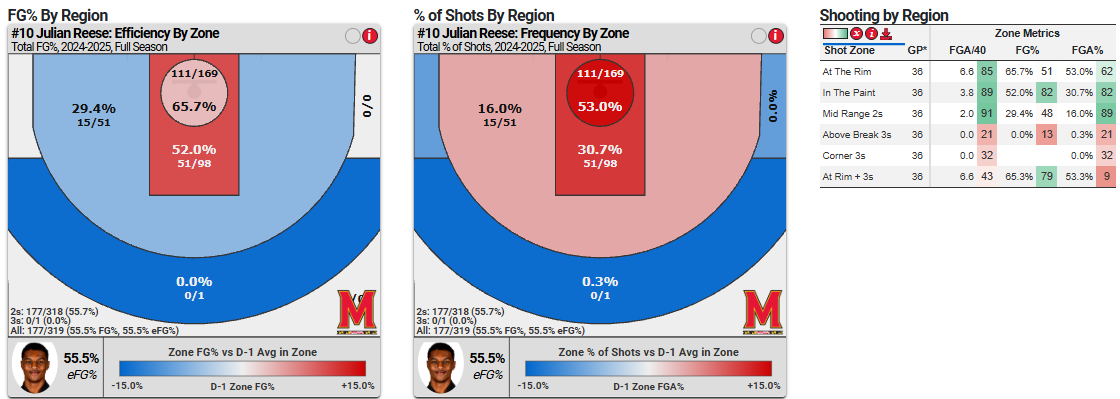
Julian Reese +Defensive Attribution
Dylan Caldwell -Size
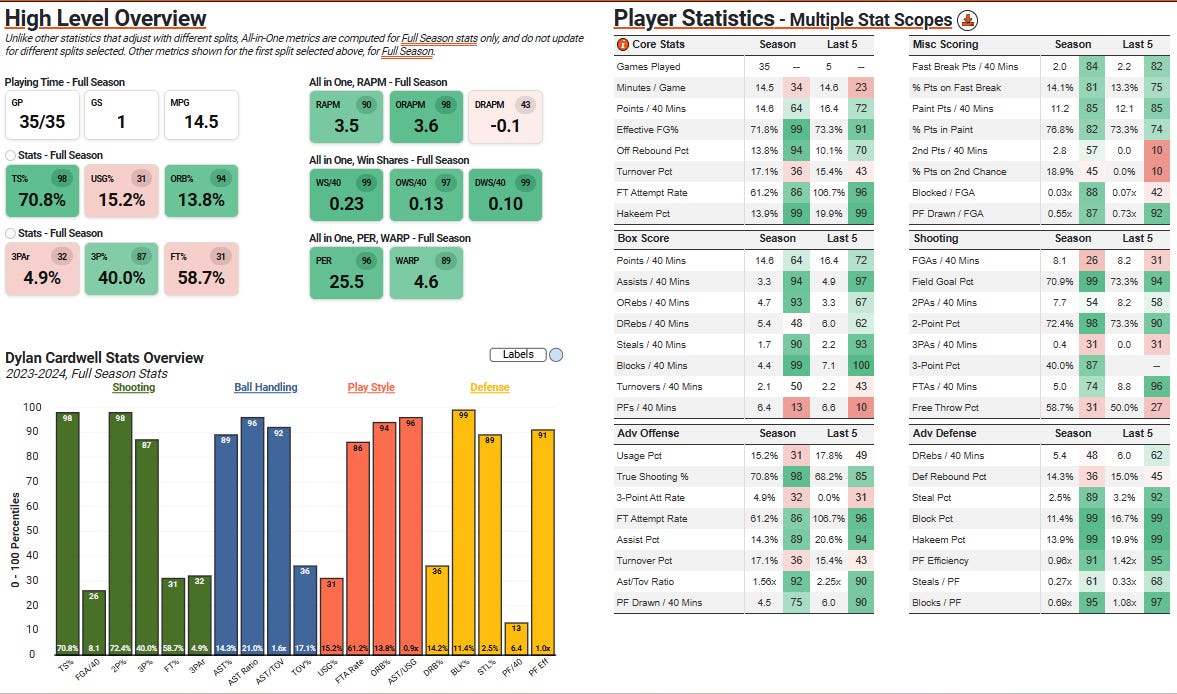
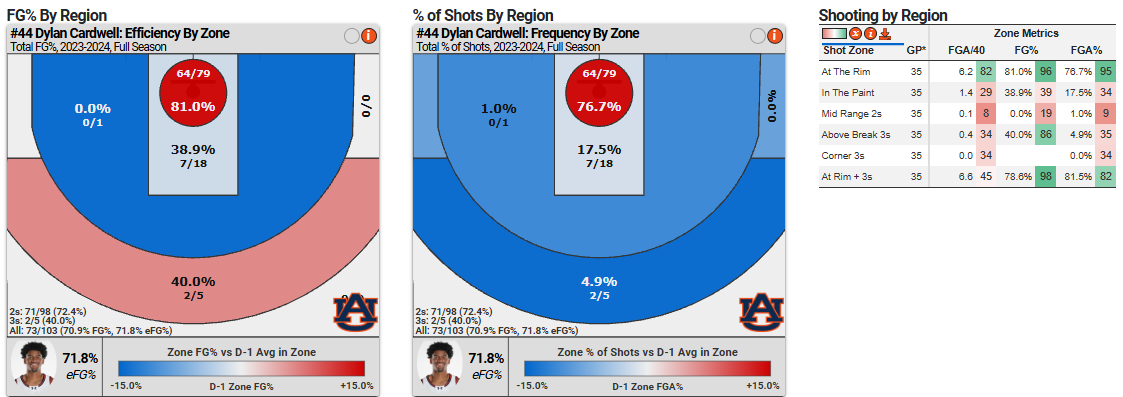
(Provided by Cbbanalytics)
Analysis:
Overall Impact: 19/25
Zuby Ejiofor’s overall impact profile is one of the strongest among interior forwards in the 2026 draft class because of how consistently he influenced winning through physicality, rebounding, interior efficiency, and defensive activity. While his archetype differs substantially from modern perimeter-oriented forwards, the production and impact metrics strongly support the value of his role within high-level competitive environments.
By the 2025-26 season, Ejiofor had fully developed into one of the most productive frontcourt players in college basketball.
He posted an elite 28.1 PER, generated 10.7 WARP, and finished with a 0.39 WARP per 40 minutes, all ranking near the very top nationally among forwards. More importantly, the progression across his collegiate career demonstrates a player who steadily expanded his responsibilities while maintaining strong efficiency and impact.
The developmental arc is highly encouraging.
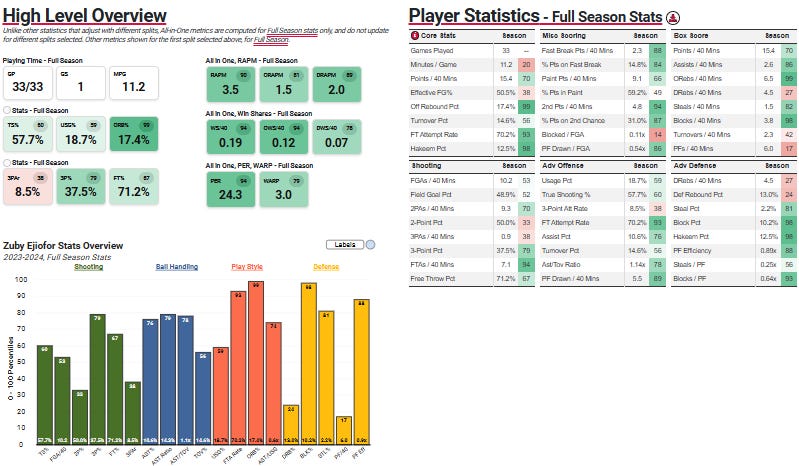
As a freshman at Kansas, Ejiofor functioned primarily as an energy reserve whose value came through rebounding, physicality, and defensive activity in limited minutes. Even then, the underlying efficiency metrics and defensive production hinted at long-term functionality. His RAPM sat positive despite minimal offensive responsibility, largely driven by effort and defensive energy.
The sophomore jump at St. John’s represented the first major breakout.
Ejiofor’s RAPM climbed substantially while his rebounding, scoring volume, and offensive involvement increased dramatically. His offensive rebounding became elite, his interior efficiency remained highly productive, and the physicality translated immediately to the Big East level. More importantly, his role expanded from purely complementary energy big into a legitimate rotation centerpiece.
By the 2024-25 season, the overall profile became increasingly dominant.
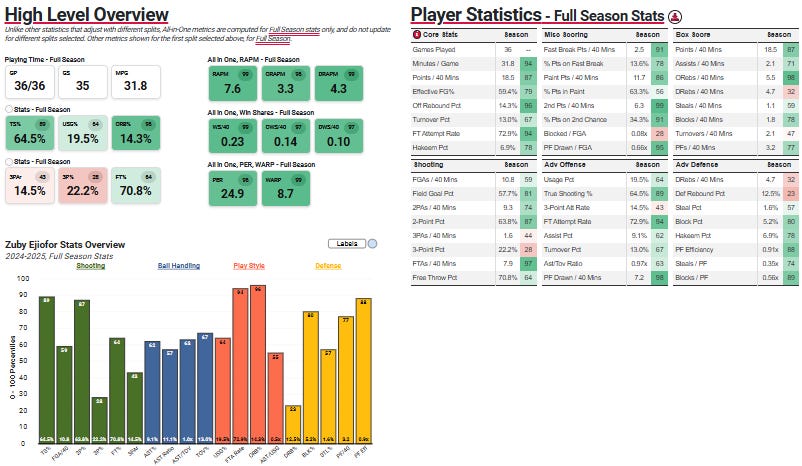
Ejiofor posted a massive 7.6 RAPM, ranking in the 99th percentile nationally, while producing elite win share and WARP numbers simultaneously. The offensive efficiency remained extremely strong despite substantially larger usage responsibility. His interior scoring volume, offensive rebounding, and free throw generation became foundational components of St. John’s offense.
The 2025-26 season ultimately represented the culmination of that progression.
Ejiofor generated nearly 22 points and 15 rebounds per 40 minutes while maintaining a 62 percent true shooting percentage and carrying a 24.7 percent usage rate. That balance between efficiency and workload is extremely important because it demonstrates his ability to sustain physical interior production even as defensive attention increased.
The rebounding impact is arguably the safest translatable component of the profile.
Ejiofor consistently dominated the offensive glass throughout his collegiate career, posting elite offensive rebounding percentages while generating huge second-chance value. His combination of strength, leverage, anticipation, and motor creates constant possession pressure. Offensive rebounding tends to translate relatively well professionally because it relies heavily on physicality and effort rather than offensive scheme dependency.
The defensive impact metrics also consistently graded extremely well.
Ejiofor generated strong steal and block production simultaneously while maintaining high-level foul efficiency. His ability to create defensive events without constantly sacrificing positioning is a major positive within the projection. He consistently impacted possessions through rotational activity, physicality, rebounding, and effort rather than relying purely on highlight rim protection.
The lineup impact data further reinforces his overall value.
St. John’s consistently performed substantially better with Ejiofor on the floor, particularly offensively. The offense improved meaningfully in efficiency, free throw generation, offensive rebounding, and overall physical pressure. His presence fundamentally altered the identity of possessions because of how aggressively he attacked the paint and extended plays around the basket.
One of the more underrated aspects of his development is the connective offensive growth.
By his senior season, Ejiofor had become a significantly better passer and decision-maker from interior touch areas. He averaged nearly five assists per 40 minutes while functioning more comfortably as a short-roll facilitator and elbow connector. That passing development meaningfully raises his offensive floor because it allows him to contribute offensively beyond pure finishing.
The major limiting factor within the projection remains perimeter scalability.
Ejiofor attempted very few perimeter shots throughout his collegiate career, and the lack of shooting gravity naturally creates some lineup construction concerns at the NBA level. Modern spacing environments place tremendous pressure on non-shooting frontcourt players to provide elite defensive value or overwhelming interior dominance to remain highly playable in postseason settings.
There are also some concerns regarding athletic translation.
While Ejiofor is highly physical and productive, he is not necessarily an elite vertical athlete or overwhelming rim protector by NBA standards. Some of the interior scoring advantages he leveraged collegiately may become more difficult against NBA size and length. Additionally, teams may occasionally target him defensively in space against highly dynamic perimeter creators.
Still, the broader impact profile remains extremely compelling.
Players who consistently rebound at elite levels, generate efficient interior offense, defend with physicality, and positively impact possession margins tend to carve out meaningful professional roles even without perimeter-oriented skill sets. Ejiofor’s toughness, motor, and ability to consistently influence physical aspects of the game give him one of the stronger floor projections among traditional frontcourt prospects in the class.
Scoring: 3/9
Zuby Ejiofor’s scoring profile is highly specialized and built almost entirely around interior physicality, rim pressure, offensive rebounding, and free throw generation rather than perimeter shot-making versatility or advanced self-created offense. While the overall production volume became extremely impressive by the end of his collegiate career, the archetype remains fairly narrow compared to more modern perimeter-oriented forwards.
The raw production itself was outstanding.
Ejiofor generated 21.8 points per 40 minutes during the 2025-26 season, ranking in the 95th percentile nationally among forwards. He also posted an elite 62.0 true shooting percentage while carrying nearly a 25 percent usage rate, an important indicator because it demonstrates his ability to maintain strong efficiency under significant offensive responsibility.
However, nearly every aspect of the scoring profile was concentrated around interior pressure.
Ejiofor generated over 12 paint points per 40 minutes, ranking in the 89th percentile nationally, while nearly 57 percent of his total scoring came directly inside the paint. More importantly, he attempted over 11 two-point field goals per 40 minutes and converted nearly 58 percent of them. His offensive identity revolved almost entirely around attacking the basket, finishing through contact, and physically overwhelming defenders around the rim.
An important contextual layer within that production is how much of the offense came against organized half-court defenses rather than purely opportunistic transition scoring.
Nearly 73 percent of Ejiofor’s total field goal attempts came within half-court offense, reinforcing that St. John’s consistently relied on him to generate interior scoring against set defenses. In those situations, he converted just over 51 percent of his two-point attempts across extremely high interior volume. That efficiency becomes more impressive considering the level of physical defensive attention he consistently absorbed around the basket.
Transition scoring still added meaningful value as well.
While not an elite open-floor athlete, Ejiofor converted over 82 percent of his transition two-point opportunities and generated nearly 2.6 fastbreak points per 40 minutes. He consistently ran the floor hard, established early deep positioning, and punished mismatches before defenses fully loaded the paint. St. John’s physical pace-heavy style maximized those strengths effectively.
The free throw generation is arguably the strongest offensive indicator within the entire profile.
Ejiofor averaged over 9.3 free throw attempts per 40 minutes, ranking in the 98th percentile nationally among forwards. That level of foul pressure is extremely significant because it reflects a player consistently creating physical stress on defenses possession after possession. Even without perimeter shot creation, players capable of constantly collapsing defenses and generating contact opportunities still retain offensive value professionally.
The second-chance scoring profile also dramatically boosts his production.
Ejiofor generated nearly 5.8 second-chance points per 40 minutes, ranking in the 98th percentile nationally. Much of his offense came through sheer physicality and offensive rebounding dominance. He consistently extended possessions through effort, positioning, and activity around the basket, converting offensive rebounds directly into highly efficient scoring opportunities.
The putback efficiency especially reinforces the archetype.
Ejiofor converted nearly 69 percent of his putback opportunities while generating strong volume in those situations. In many ways, offensive rebounding functioned almost as a secondary scoring engine within his offensive profile because so many of his easiest points were self-generated through activity, leverage, and persistence around the rim.
At the same time, the broader scoring profile still carries substantial NBA translation concerns.
The perimeter shooting remains extremely underdeveloped. Ejiofor attempted just over two three-pointers per 40 minutes while converting roughly 30 percent overall. More importantly, only about 16 percent of his total shot diet came from beyond the arc. Defenses at the NBA level are unlikely to prioritize him as a perimeter spacer early in his career.
The lack of shot diversity is also important contextually.
Much of Ejiofor’s offense came through effort-driven interior opportunities, offensive rebounds, duck-ins, transition seals, and finishes created by physicality rather than advanced self-creation or difficult shot-making. He is not currently a polished face-up scorer, advanced post technician, or perimeter-oriented offensive creator capable of manufacturing difficult offense late in possessions.
The efficiency profile itself is somewhat dependent on role context.
While the overall true shooting percentage is excellent, much of the efficiency came through high-value interior attempts and elite free throw volume. Against NBA size and length, some of those physical scoring advantages may naturally become harder to maintain consistently, particularly if the perimeter jumper does not continue progressing.
There are also some touch concerns in crowded environments.
Although Ejiofor finished efficiently overall, there are stretches where his scoring can become somewhat mechanical against heavy interior congestion or longer rim protectors. He wins more through strength, leverage, and persistence than finesse or advanced scoring creativity.
Still, the overall offensive archetype retains meaningful value.
Modern NBA teams continue to value physical interior players capable of generating offensive rebounds, drawing fouls, creating second possessions, and maintaining paint pressure without requiring designed offensive touches. Ejiofor’s scoring package may not be aesthetically dynamic, but it consistently produced efficient offense within high-major competition.
Self Creation: 3/9
Zuby Ejiofor’s self-creation profile is somewhat deceptive statistically because the raw unassisted production numbers appear significantly stronger than the actual stylistic projection when contextualized within how the offense was generated. While Ejiofor produced very high levels of unassisted scoring for a frontcourt player, much of that offense came through power finishes, offensive rebounds, interior seals, and physical advantage scoring rather than advanced face-up creation or polished half-court shot-making.
The raw production numbers themselves are impressive.
Ejiofor generated 12.8 unassisted points per 40 minutes during the 2025-26 season, ranking in the 96th percentile nationally among forwards. He also produced nearly three unassisted field goals per 40 minutes while maintaining elite interior scoring efficiency. Those numbers reflect a player capable of creating offense independently around the basket through strength, positioning, and persistence.
The interior self-creation profile is especially notable.
Ejiofor averaged nearly 2.9 unassisted two-point field goals per 40 minutes, ranking in the 84th percentile nationally. More specifically, he generated over two unassisted at-rim field goals per 40 minutes while ranking in the 88th percentile in unassisted rim finishing. That production reinforces how frequently he was able to create paint offense through physicality without requiring perfect setup passes from teammates.
However, the context surrounding that creation is extremely important.
Much of Ejiofor’s “self-created” offense came through effort-based interior opportunities rather than advanced shot-making skill. Offensive rebounds, duck-ins, transition seals, power drives, and second-effort finishes accounted for a major portion of his unassisted scoring profile. He consistently created offense through positioning and motor rather than through perimeter handle creativity or isolation separation.
The offensive rebounding numbers especially amplify the production.
Ejiofor generated over 4.3 offensive rebound field goals per 40 minutes, ranking in the 90th percentile nationally. In many ways, offensive rebounding functioned almost as an extension of his self-creation profile because he repeatedly manufactured his own scoring opportunities through sheer physical dominance around the basket.
The free throw pressure also heavily contributed to the offensive value.
Ejiofor consistently created contact opportunities once he established interior leverage. He was highly effective using his strength and balance to absorb defenders and finish through physical traffic. That style of offensive creation remains valuable because players capable of generating efficient paint pressure without needing perimeter creation still impact offensive ecosystems positively.
At the same time, the broader self-creation limitations are fairly significant relative to NBA offensive expectations.
Ejiofor is not currently an advanced isolation scorer or face-up creator. Much of his offense came within tight interior spaces rather than through perimeter initiation or half-court shot generation. He does not possess a particularly dynamic handle, advanced counter package, or polished off-the-dribble scoring repertoire that would allow him to consistently create difficult offense against NBA defenders.
The perimeter self-creation profile is almost nonexistent.
Although Ejiofor occasionally attempted perimeter shots, nearly all of his made threes were assisted. He generated very little off-the-dribble perimeter offense overall, and defenses are unlikely to treat him as a shooting-based mismatch creator professionally.
The scoring versatility also remains somewhat limited.
Most of Ejiofor’s successful offense came within a relatively narrow range of physical interior actions. He excels finishing around the basket, creating second-chance points, and leveraging strength inside, but there is far less evidence of advanced midrange scoring, perimeter pull-up creation, or complex one-on-one shot-making.
Still, the archetype remains functional within the proper role.
Modern NBA teams do not necessarily require every frontcourt player to become a perimeter-oriented creator. Ejiofor’s ability to manufacture interior offense through rebounding, physicality, screening, and paint pressure still carries meaningful value, particularly within second-unit or energy-frontcourt lineups.
The passing growth also subtly raises the offensive ceiling.
Because Ejiofor improved substantially as a connective passer and short-roll facilitator, defenses cannot simply treat him as a one-dimensional finisher offensively. His ability to make quick reads after creating interior advantages adds another layer of functionality that supports the overall offensive projection.
Playmaking: 4/9
Zuby Ejiofor’s playmaking profile improved substantially throughout his collegiate career and became one of the more underrated aspects of his offensive development by the 2025-26 season. While he is not a primary offensive initiator or advanced creation hub, the progression in his passing feel, interior reads, and connective decision-making significantly raised his overall offensive floor.
The raw production reflects meaningful growth.
Ejiofor generated 33.3 points created per 40 minutes during the 2025-26 season, ranking in the 99th percentile nationally among forwards. He also averaged nearly 4.7 assists per 40 minutes overall, an impressive number considering how heavily his offensive role still revolved around interior scoring and physical paint play.
Much of the value came through interior facilitation.
Ejiofor produced strong passing numbers from both rim pressure and paint touch situations, generating over 2.2 rim-and-paint assists per 40 minutes while ranking near the top percentile nationally in that category. As defensive attention increasingly collapsed toward him inside, he became more comfortable recognizing rotations and making functional kickout or dump-off reads.
The short-roll passing development is especially important contextually.
Throughout the season, St. John’s increasingly trusted Ejiofor to facilitate offense from interior touch areas, particularly after screens or deep catches. He showed improved patience allowing the defense to commit before making reads to corner shooters, cutters, or weak-side finishers. That growth meaningfully increases his NBA viability because modern offenses place substantial value on frontcourt players who can process quickly in short-roll situations.
The passing versatility also expanded more than expected.
Ejiofor generated strong assist production to multiple shot zones, including paint finishes, rim attempts, and above-the-break threes. His above-the-break passing production ranked extremely high percentile-wise, showing that he was capable of finding perimeter shooters once defenses overloaded the paint.
Importantly, the playmaking profile was functional rather than flashy.
Ejiofor is not a high-level live-dribble manipulator or advanced advantage creator. He does not consistently break defenses down with handle creativity or orchestrate complex half-court reads the way true offensive hubs do. Instead, most of his passing success came after advantages had already been created through physicality, interior positioning, or defensive collapse.
That distinction is critical for projection purposes.
Much of Ejiofor’s offensive facilitation was reactive rather than proactive. He generally operated as a connective passer who kept possessions flowing once defenses committed rather than a player consistently engineering offensive advantages himself. NBA teams will likely value him more as a secondary processor than as an offensive initiator.
The assist-to-turnover profile does offer encouragement though.
Despite operating in traffic-heavy interior environments, Ejiofor maintained respectable decision-making efficiency overall. His reads became cleaner and more disciplined over time, particularly compared to earlier stages of his collegiate career when his offensive game was far more simplified.
The limitations still remain fairly clear.
Ejiofor is not currently a perimeter-oriented creator, advanced dribble passer, or offensive organizer capable of consistently running offense through volume initiation. His handle remains somewhat rigid in tight spaces, and he can occasionally struggle making advanced reads against aggressive rotations or highly disruptive defensive pressure.
The passing windows also become tighter at the NBA level.
Many of the reads Ejiofor successfully completed collegiately may become more difficult against NBA size, speed, and rotational recovery. Because he is not a high-level vertical spacer or perimeter gravity threat, defenses may be more comfortable crowding his operating areas early in possessions professionally.
Still, the overall progression matters significantly.
Shooting: 1/9
Zuby Ejiofor’s shooting profile remains the largest limiting factor within his long-term NBA projection because the offensive ecosystem he thrives in is still overwhelmingly confined to the interior. While the overall efficiency numbers appear strong on the surface, the shot distribution and perimeter limitations create real spacing concerns when translating his game to modern NBA frontcourt structures.
The interior efficiency itself is very strong.
Ejiofor converted nearly 58 percent of his two-point attempts overall while finishing almost 68 percent of his at-rim opportunities. He generated over 50 percent of his total field goal attempts directly at the basket and maintained strong efficiency through physicality, touch around the rim, and relentless paint pressure. His ability to finish through contact and convert high-volume interior attempts is unquestionably valuable.
The scoring touch inside also shows up in multiple zones.
He converted nearly 69 percent of his at-rim attempts in half-court settings and remained highly effective across various interior timing windows within possessions. Whether early offense, second-effort opportunities, or deeper clock possessions, Ejiofor consistently found ways to create efficient paint scoring.
There are also some encouraging touch indicators.
Although the overall jumper remains underdeveloped, Ejiofor converted nearly 48 percent of his limited midrange attempts, and the free throw percentage climbed above 71 percent by his senior season. Those indicators at least leave open the possibility for long-term shooting improvement, even if the current perimeter profile remains highly limited.
Still, the broader perimeter shooting concerns are substantial.
Ejiofor attempted just over two three-pointers per 40 minutes while converting roughly 30.5 percent overall. More importantly, only about 16 percent of his total shot diet came from beyond the arc, a relatively low number for a modern NBA forward. Defenses are unlikely to respect him consistently as a floor spacer early in his professional career.
The perimeter shot profile itself also lacked diversity.
Almost all of his perimeter attempts came above the break, with virtually no corner-three volume whatsoever. He attempted only three corner threes the entire season. That matters because corner spacing is often the easiest developmental pathway for non-shooting frontcourt players attempting to scale into NBA offenses.
The mechanics and release profile still appear somewhat inconsistent as well.
Ejiofor’s jumper can become rigid at times, particularly when shooting off movement or without extended preparation. He is far more comfortable operating through interior rhythm and physical contact than functioning as a fluid perimeter catch-and-shoot threat.
The shot distribution reinforces the archetype clearly.
His average shot distance sat just above eight feet overall, illustrating how heavily concentrated the offensive profile remains around the paint. Nearly 85 percent of his total field goal attempts came inside the arc, and most of those occurred very close to the basket. He simply does not currently provide meaningful perimeter gravity.
That lack of spacing flexibility creates some lineup construction concerns.
Modern NBA offenses increasingly prioritize frontcourt players capable of stretching defenses vertically or horizontally. Without consistent shooting gravity, Ejiofor will likely require surrounding spacing to maximize offensive functionality. Teams may also feel more comfortable helping aggressively off him in half-court settings until the jumper proves reliable.
At the same time, the efficiency around the basket does partially offset those concerns.
Players who generate elite interior efficiency, offensive rebounding, and free throw pressure can still provide offensive value without becoming high-level shooters. Ejiofor consistently pressured defenses physically and produced efficient offense within his comfort areas.
The long-term swing factor remains developmental shooting growth.
If Ejiofor can eventually become even a respectable low-volume corner shooter or pick-and-pop threat, the overall projection changes substantially because the rebounding, interior scoring, and defensive activity already provide a strong rotational foundation. Even marginal shooting growth would make his archetype considerably easier to scale offensively.
Defensive Attribution: 8/10
Defense is arguably the cleanest translatable portion of Zuby Ejiofor’s overall NBA projection because his physicality, rim protection, activity level, and interior presence consistently impacted winning at a high level throughout his collegiate career. While there may be some schematic limitations in certain NBA matchups, the overall defensive production and eye test strongly support the projection of a highly functional rotational interior defender.
The rim protection numbers immediately stand out.
Ejiofor posted a 7.2 block percentage during the 2025-26 season, ranking in the 90th percentile nationally among forwards. More impressively, his overall block production relative to fouls was elite. He generated nearly 0.88 blocks per foul committed, ranking in the 98th percentile nationally. That balance is extremely important because it reflects a player capable of consistently contesting and altering shots without completely sacrificing defensive discipline.
The broader defensive activity profile was outstanding overall.
Ejiofor generated a 9.5 percent havoc rate while posting strong steal production simultaneously. His combination of steals and blocks reflects a defender capable of impacting multiple areas of the floor rather than functioning purely as a stationary paint protector. He consistently disrupted possessions through anticipation, effort, and physical presence.
The shot-blocking itself looked highly functional on film.
Ejiofor consistently rotated well as a weak-side helper, challenged vertically around the rim, and leveraged his strength effectively in crowded interior environments. He may not possess elite NBA vertical explosiveness, but his timing and willingness to contest consistently allowed him to alter shots at a high level.
The physicality also translated strongly throughout his defensive profile.
He embraced contact, battled for interior positioning, and consistently competed against opposing frontcourts physically. Many college bigs accumulate strong defensive numbers through scheme protection or weak competition, but Ejiofor’s defensive impact frequently came through sheer effort and physical competitiveness against high-major opponents.
The foul efficiency further strengthens the evaluation.
Although Ejiofor played an aggressive interior style, he still maintained relatively strong foul discipline considering the amount of rim protection responsibility he carried. His overall foul efficiency ranked in the 98th percentile nationally, illustrating how productive he remained defensively without constantly compromising possessions through unnecessary fouls.
The rebounding numbers are slightly more mixed contextually.
While Ejiofor was an elite offensive rebounder, his defensive rebounding percentage graded closer to average relative to other high-level interior forwards. Some of that likely stems from St. John’s aggressive defensive system and his heavy rotational responsibilities around the basket, but NBA teams may still want greater consistency finishing possessions defensively at the next level.
The steal production is another underrated aspect of the profile.
Ejiofor generated over two steals per 40 minutes while posting excellent steal-to-foul efficiency. That is significant because it reflects strong anticipation and active hands rather than simply stationary paint protection. He consistently disrupted interior passing angles and reacted quickly to loose-ball situations.
There are still some important projection limitations.
Ejiofor is most comfortable operating near the basket and inside conservative coverage structures. While he moves reasonably well for his size, there may be challenges defending highly dynamic perimeter players in space or surviving consistently within aggressive switch-heavy NBA systems. Quicker stretch forwards and high-level pick-and-roll guards could occasionally force him into uncomfortable defensive situations away from the paint.
The vertical athletic ceiling is also somewhat limited compared to elite NBA rim protectors.
Ejiofor protects the rim more through positioning, strength, and timing than overwhelming explosiveness. Against NBA length and athleticism, some of the interior deterrence may naturally diminish somewhat.
Still, the broader defensive archetype remains highly valuable.
NBA teams consistently prioritize physical interior defenders who can rebound, protect the rim, defend with effort, and stabilize second-unit frontcourts. Ejiofor already demonstrates many of those traits at a very high level. His combination of toughness, shot blocking, defensive activity, and interior physicality creates a strong defensive floor professionally.
Off-Ball Offense: 2/9
Zuby Ejiofor’s off-ball offensive profile is functional within very specific lineup constructions, but it remains relatively limited compared to more modern frontcourt offensive archetypes. Much of his value away from the ball comes through physical activity, screening, offensive rebounding, and interior positioning rather than perimeter spacing or movement shooting gravity.
The strongest aspect of his off-ball offense is the pressure he creates around the basket.
Ejiofor consistently generated second-chance opportunities through offensive rebounding, deep seals, duck-ins, and interior activity. He was highly effective relocating inside after actions developed and consistently punished defenses that failed to box him out physically. In many ways, his off-ball offense operated almost as an extension of his rebounding profile because so much of his scoring came through persistence and positioning rather than designed touches.
The screening value is also important contextually.
Ejiofor consistently created contact and physical advantages as a screener, helping generate downhill driving lanes and forcing defensive rotations. He plays with strong physicality setting screens and frequently created secondary offensive opportunities by rolling hard into the paint after contact. Modern NBA offenses still place substantial value on frontcourt players capable of consistently creating pressure through screening and rim-running activity.
The transition effort also raises the functionality somewhat.
Although he is not a dynamic vertical spacer, Ejiofor consistently ran the floor hard and established early paint positioning before defenses could fully organize. His ability to sprint into deep seals or transition rim opportunities created efficient offense without requiring advanced shot creation skill.
However, the broader off-ball offensive limitations are still significant.
The lack of perimeter shooting gravity severely limits his scalability away from the basket. Defenses are unlikely to consistently honor him as a spacer early in his NBA career, which naturally compresses spacing in half-court environments. Because he attempted very few perimeter shots and converted only around 30 percent from three, opposing defenses will likely feel comfortable helping aggressively off him.
He also does not currently provide much movement-shooting versatility.
Ejiofor rarely operated in actions designed to create perimeter gravity such as pick-and-pop movement, relocation shooting, or off-screen shooting actions. Nearly all of his offensive value came inside the arc and around the basket rather than through dynamic off-ball spacing.
The vertical spacing profile is also somewhat limited compared to elite NBA rim-running bigs.
While Ejiofor finishes effectively around the rim, he is not an explosive lob threat who consistently bends defenses vertically through above-the-rim athleticism alone. Much of his interior success comes through leverage, timing, and physicality rather than elite burst or vertical pop.
There are also spacing concerns within certain lineup constructions.
Because Ejiofor operates most comfortably near the basket offensively, pairing him with non-shooting frontcourt teammates could become challenging at the NBA level. His offensive ecosystem will likely require surrounding spacing and strong perimeter creation to maximize functionality.
Still, there are enough effort-based offensive traits to maintain value within the proper role.
Players who consistently offensive rebound, set hard screens, create second possessions, and pressure the rim physically still contribute positively within modern offenses even without perimeter gravity. Ejiofor understands how to stay active within possessions and generally does a good job maintaining interior pressure rather than drifting passively away from action.
Post (Scoring/Playmaking): 6/9
Zuby Ejiofor’s post offense and interior playmaking represent some of the most translatable portions of his offensive profile because his physicality, touch around the basket, and improving passing feel consistently created functional half-court offense against high-major competition. While he is not a polished low-post isolation scorer in the traditional NBA sense, he became increasingly effective generating offense through deep positioning, interior leverage, and connective reads from the paint.
The scoring profile inside the post was heavily power-oriented.
Ejiofor consistently established strong interior positioning and leveraged his frame effectively against opposing frontcourts. Much of his scoring came through duck-ins, deep seals, offensive rebounds, short-roll catches, and power finishes around the basket rather than advanced face-up creation or highly technical footwork sequences. He generated over 12 paint points per 40 minutes while converting nearly 58 percent of his two-point attempts overall, reinforcing how heavily his offensive identity revolved around interior efficiency.
What made the post scoring functional was the combination of physicality and persistence.
Ejiofor consistently absorbed contact and played through congestion around the rim. He drew fouls at an elite rate, averaging over 9.3 free throw attempts per 40 minutes, and frequently forced defenses into difficult physical decisions once he established deep paint touches. His offensive rebounding also naturally blended into the post scoring profile because many of his easiest scoring opportunities came through second-effort finishes and quick interior re-attacks.
The transition from Kansas to St. John’s also showcased meaningful growth in offensive comfort level.
Earlier in his collegiate career, Ejiofor primarily functioned as an energy finisher whose offense came almost entirely through simplified interior actions. By the 2025-26 season, however, St. John’s trusted him far more frequently as a legitimate interior offensive hub capable of sustaining possessions through paint touches and physical pressure.
The playmaking development is especially important contextually.
Ejiofor averaged nearly 4.7 assists per 40 minutes during the 2025-26 season while generating over 33 points created per 40 minutes overall. For a player whose offensive role remained so heavily interior-oriented, that level of passing production is highly encouraging.
Much of his passing success came from short-roll reads and interior kickout opportunities.
As defenses increasingly collapsed toward his paint touches, Ejiofor became more comfortable identifying weak-side shooters, cutters, and dump-off opportunities around the basket. He consistently generated productive assists to rim attempts and above-the-break threes, illustrating that he was capable of creating efficient offensive outcomes rather than simply accumulating low-value perimeter passes.
The passing profile looked functional on film as well.
Ejiofor generally processed quickly once double teams or help rotations arrived. He showed improving patience allowing defenses to commit before making reads and rarely appeared completely overwhelmed operating from interior touch areas. His willingness to move the ball also helped prevent possessions from stagnating once the offense flowed through him.
The physical screening and short-roll game projects especially well professionally.
Modern NBA offenses increasingly value frontcourt players capable of screening hard, creating interior pressure, and making quick connective reads after catching in space. Ejiofor already demonstrates many of those foundational traits at a strong level.
There are still some limitations within the projection.
Ejiofor is not currently a highly polished isolation post scorer with advanced counters, elite footwork diversity, or face-up shot-making versatility. Much of his offense still relies heavily on physical strength and leverage advantages that may become harder to consistently maintain against NBA length and athleticism.
The perimeter skill limitations also shrink some offensive flexibility.
Because defenders are unlikely to fully respect him as a shooter early in his career, NBA defenses may feel more comfortable crowding his post touches aggressively. Without meaningful spacing gravity, some of the interior scoring windows could become tighter professionally.
Still, the broader archetype remains highly functional.
Players who can create paint pressure, finish efficiently, offensive rebound, screen effectively, and facilitate offense from short-roll or post-touch situations continue to provide value within modern NBA rotations. Ejiofor’s combination of physical scoring pressure and connective passing gives him a far more scalable offensive profile than many traditional non-shooting interior bigs.
Intangibles/Eye Test: 7/11
Zuby Ejiofor’s overall projection becomes significantly stronger once the physicality, competitiveness, and motor consistently visible on film are layered on top of the statistical profile. While there are still clear limitations regarding perimeter scalability and offensive versatility, Ejiofor repeatedly looked like the type of player capable of positively impacting games through toughness, effort, interior presence, and role acceptance.
The first thing that consistently stands out on film is the physical edge he plays with.
Ejiofor embraces contact on both ends of the floor and rarely shies away from physical play around the basket. Whether battling for offensive rebounds, establishing deep post position, contesting shots, or setting hard screens, he consistently imposed himself physically within possessions. That mentality became a major component of St. John’s overall identity during his later seasons.
The motor also translates very favorably.
Ejiofor consistently played with high energy levels and maintained strong activity throughout games. He ran the floor hard in transition, competed relentlessly on the offensive glass, rotated aggressively defensively, and constantly worked for second-chance opportunities. Much of his production was directly tied to effort and persistence rather than purely scheme-created advantages.
The rebounding competitiveness especially stands out on film.
He consistently fought for leverage and pursued loose balls aggressively around the basket. Offensive rebounding often becomes one of the cleaner translatable skills professionally because it relies heavily on physicality, timing, and willingness to compete, all areas where Ejiofor consistently excelled.
There is also a noticeable level of toughness and role acceptance within his game.
Ejiofor never appeared overly concerned with stylistic offensive touches or perimeter-oriented freedom. He consistently embraced the dirty-work aspects of basketball, screening hard, battling inside, absorbing contact, and creating physical pressure around the rim. NBA coaching staffs generally value players who willingly embrace those responsibilities without needing offensive prioritization.
The progression throughout his collegiate career is another positive intangible indicator.
Ejiofor steadily improved from a limited reserve big at Kansas into a highly productive offensive centerpiece at St. John’s. The offensive development, conditioning improvement, and passing growth all suggest a player who responded well to expanded responsibility and continued refining his game over time.
The passing feel and offensive processing also looked better than expected for a traditional interior forward.
By his senior season, Ejiofor appeared far more comfortable making quick reads from short-roll situations and interior touch areas. He generally kept the ball moving well and did not force excessive low-efficiency possessions once defenses collapsed around him.
Defensively, the effort level remained highly consistent.
He consistently competed as a rim protector, rotated hard into help situations, and played with noticeable physical engagement around the basket. Even when matched against smaller or quicker lineups, the effort and willingness to compete rarely disappeared.
At the same time, the eye test also reinforces several of the broader projection concerns.
The perimeter skill level still looks relatively limited in live game settings. Ejiofor is clearly most comfortable operating inside the paint, and there are stretches where the offensive game can look somewhat rigid once pulled away from interior scoring areas. The jumper still lacks fluid confidence, and the offensive versatility remains narrower than many modern NBA forwards.
The mobility profile also creates some questions.
While he moves reasonably well for his size, there are moments where quicker perimeter actions or aggressive spacing environments can expose some lateral limitations. He is much more comfortable defending physically near the basket than consistently operating in space against highly dynamic athletes.
There are also occasional moments where the offensive game can become somewhat predictable.
Because so much of his value comes through interior pressure and effort-based scoring, defenses that successfully neutralize paint touches can occasionally limit his offensive rhythm. He is not currently the type of player capable of pivoting comfortably into perimeter shot creation when primary actions break down.
Still, the overall eye test remains strongly positive within the context of his projected NBA role.
Ejiofor consistently looked like a player capable of helping winning environments through physicality, rebounding, toughness, and energy. His willingness to embrace physical interior responsibilities, combined with his motor and defensive competitiveness, gives him a relatively strong floor projection as a rotational frontcourt contributor.
Complete Evaluation: 53/100
 | A guest post by
|